Pulse24 Original
One Gigawatt of AI Data Center Can Cost $38 Billion or $60 Billion, Depending on What's Being Measured.
September 18, 2026
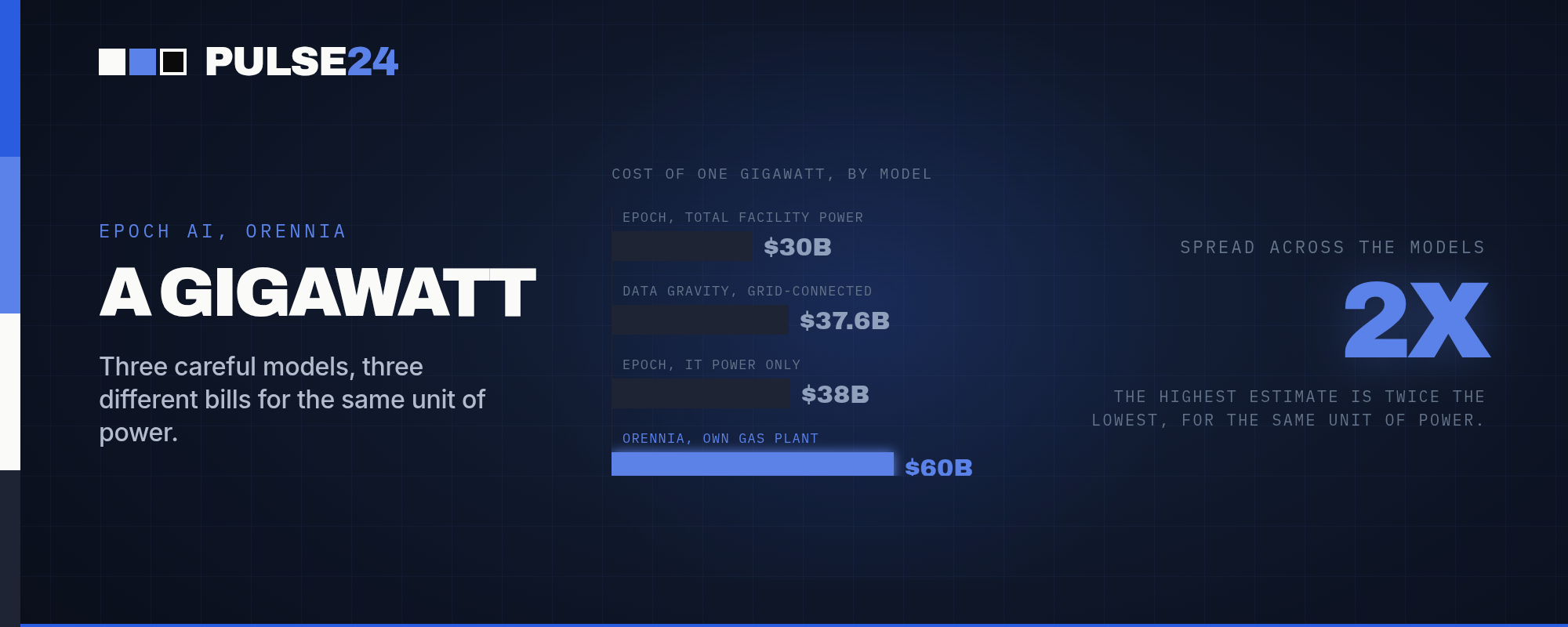
Ask three careful analysts what one gigawatt of AI data center capacity costs and you can get answers from $38 billion to $60 billion, not because anyone did the math wrong, but because the industry hasn't agreed on what a gigawatt is even measuring. What each model prices, and why the gap matters more than the number, is the story.
A gigawatt running nonstop for a year produces roughly as much electricity as more than 800,000 average U.S. homes use in that same year, based on the Energy Information Administration's own consumption figures. Apply the same unit to an AI data center campus and the number stops being simple. Public estimates for what one gigawatt of AI data center capacity costs to build range from about $38 billion to $60 billion, and that spread looks enormous until you ask what each model means by a gigawatt, and what it includes in the bill.
Start with Epoch AI, the research group behind one of the more detailed public cost models. Epoch prices a gigawatt of IT power, the electricity that reaches servers and GPUs directly, at roughly $38 billion. Measured instead as a gigawatt of total facility power, the amount a data center draws from the grid before cooling and other overhead take their share, the same model comes out closer to $30 billion. Two people can cite the same research group and land $8 billion apart before either one has touched a second source, simply because they measured a different gigawatt.
Layer in two more independent models and the range widens further. The analyst newsletter Data Gravity builds its estimate from a 250-megawatt campus, the scale at which real projects actually get built, and scales it up by four to reach $37.6 billion per gigawatt for a grid-connected facility priced around current Nvidia GB200 systems. The energy advisory firm Orennia puts the figure at $60 billion for a facility that builds its own gas-fired power plant rather than draw from the grid. Epoch's model, by contrast, deliberately holds its cost-per-watt assumptions flat across chip generations and data center vintages, on the reasoning that AI hardware cost trends haven't moved as much as the headlines suggest. A story that prices Microsoft's 38-gigawatt AI buildout or any rival's campus rarely says which of these definitions produced its total, and the $38 billion, $37.6 billion, and $60 billion figures land close together mostly by coincidence rather than agreement.
Why Power Source and Project Scope Move the Number
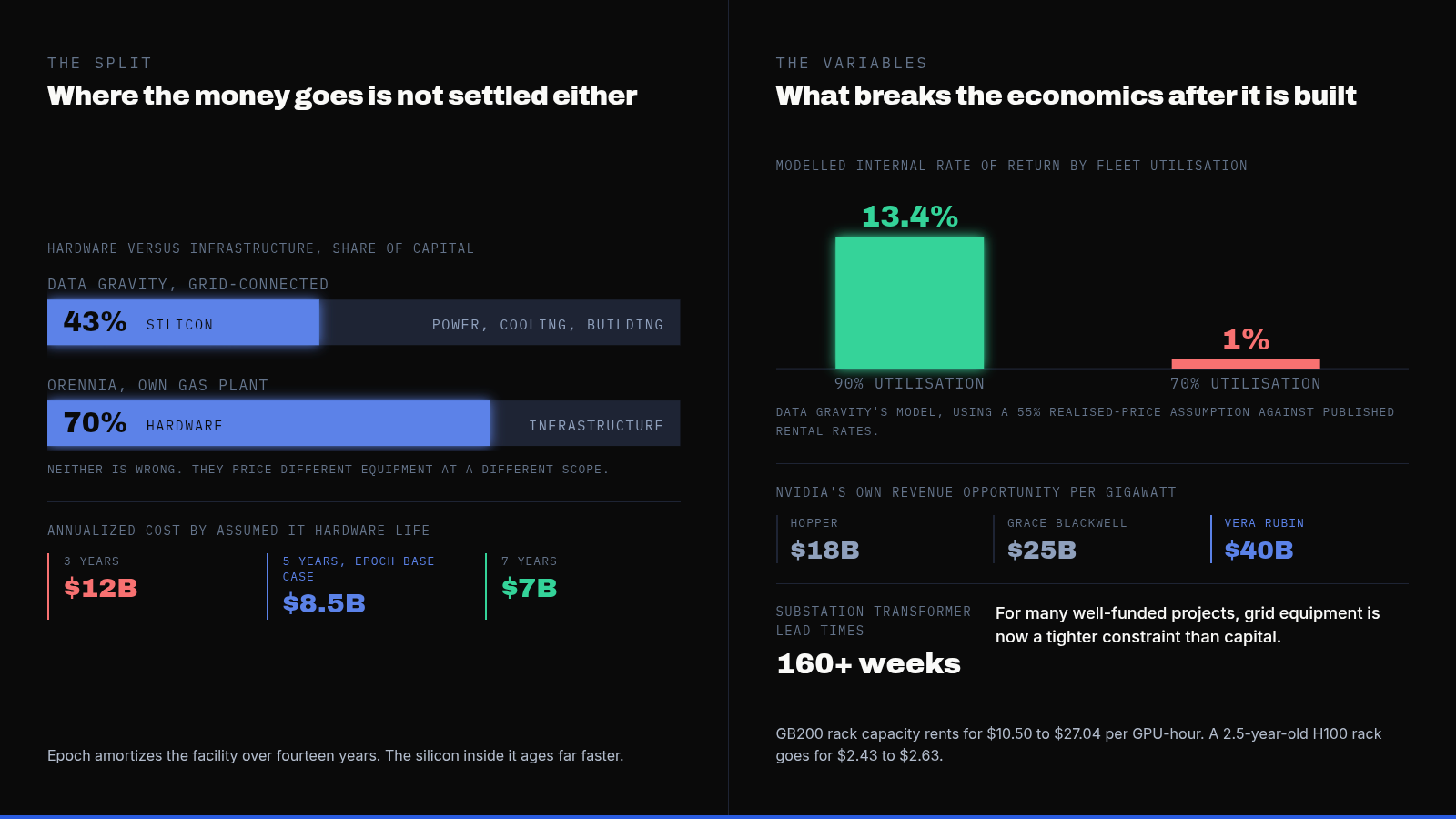
Grid access is increasingly its own cost category. Interconnection queues in much of the country now run into multiple years, and Orennia counts substation transformer lead times exceeding 160 weeks. Building a private gas-fired power plant next to the campus skips that queue, at the cost of adding an entire power plant to the bill. It's tempting to assume that extra spending should show up as a bigger infrastructure share of the total. In Orennia's own numbers it doesn't: hardware still comes out to roughly 70% of its $60 billion figure, a higher hardware share than the grid-connected models show. That's a sign the two kinds of estimates aren't just priced differently. They're scoped differently, with different equipment assumptions baked in, which matters more than which power source gets picked.
Hardware Runs on a Shorter Clock Than the Building
Useful life doesn't change what the first build costs. It changes the annualized economics of owning it afterward, and the two are easy to blur together. Epoch's $38 billion figure is upfront capital cost. Add roughly $0.9 billion a year in operating expenses and amortize the facility on Epoch's own assumptions, five years for IT equipment and fourteen for everything else, and the annualized total comes to about $8.5 billion a year. Shorten the IT assumption to three years and that figure rises to roughly $12 billion. Stretch it to seven and it falls to about $7 billion. Nobody knows yet how long a current-generation system will stay economically competitive, so any annualized cost-per-gigawatt estimate depends heavily on an assumed hardware life, even when the upfront construction figure isn't in dispute at all.
How the Money Splits, and Why That Split Isn't Standardized Either
The ratio between hardware and infrastructure spending isn't settled any more than the total is. Data Gravity's grid-connected model puts about 43% of capital into semiconductors and networking, roughly $16.2 billion, against 57% for power systems, cooling, and the building itself. Orennia's gas-powered model puts the split closer to 70% hardware and 30% infrastructure, even with an entire power plant counted on the infrastructure side. Neither model is wrong. They're pricing different equipment at a different scope, and treating either ratio as a settled fact about "AI data centers" in general will mislead more than it informs.
The lifespan mismatch inside that split is where risk concentrates for whoever owns the equipment. Data Gravity models its physical plant over 15 years; Epoch uses 14 years for facility infrastructure. Both models assume the silicon inside that plant ages far faster: new Nvidia generations have arrived on roughly annual cycles recently, and an older accelerator can stay technically useful for inference or lighter workloads while earning far less in the rental market. Data Gravity's own pricing data illustrates how large that generational gap can get: published on-demand rental rates for GB200 rack-scale capacity currently run $10.50 to $27.04 per GPU-hour, against $2.43 to $2.63 for a 2.5-year-old H100 rack. Those are advertised retail rates rather than what a large campus realizes on a wholesale lease, a distinction the source is careful to flag, and the comparison is a snapshot across two different products rather than proof of how any single rack's price falls over time. Even as a snapshot, it shows how much pricing power a chip generation can lose once a newer one ships.
What Nvidia Says a Gigawatt Is Worth
Nvidia has started putting its own numbers on this, framed as the revenue opportunity it sees per gigawatt of AI factory capacity. That opportunity has grown from roughly $18 billion with Hopper to $25 billion with Grace Blackwell to $40 billion with the current Vera Rubin platform, which Nvidia says now spans the Vera CPU, Rubin GPU, NVLink, InfiniBand or Ethernet networking, and the Groq LPU inference chips it picked up in a $20 billion deal completed earlier in 2026. The dollar figure has climbed sharply with each generation, though it isn't measured against a matching total-cost figure for each era, so it reads best as Nvidia's own growing claim on the gigawatt rather than a precise share of somebody else's total. As that opportunity grows, Nvidia's own exposure to the scale and pace of AI infrastructure deployment grows with it, which provides useful context for its increasing financial involvement with parts of the AI ecosystem, including financing some of the customers who buy from it.
The Variable That Can Break the Economics
Construction cost isn't the only variable capable of breaking the economics. How often the finished data center actually runs at capacity can matter just as much, and it has nothing to do with anything built into the building itself. In Data Gravity's model, a campus earns a healthy 13.4% internal rate of return at 90% utilization, using a 55% realized-price assumption against those published rental rates. Drop utilization to 70% and the modeled return collapses to roughly 1%. That's one model's assumptions, not a universal law of data center economics, but it shows why operators care so much about keeping expensive accelerators occupied. A campus can be physically complete and technologically current and still produce poor returns if too much expensive compute sits idle.
The Physical Bottleneck Is Getting Harder
Getting to a finished gigawatt has become a harder problem in its own right, separate from any of the cost debates above. Interconnection queues run multiple years in much of the country, and transformer lead times measured in years rather than months are now routine. For many well-funded projects, access to power equipment and grid connections is turning into a more immediate constraint than access to capital, at least for now. Orennia has floated a striking follow-on number: multiply its own $60 billion-per-gigawatt figure by its estimate that US data center demand could grow more than 75 gigawatts by 2035, and the implied cumulative investment comes to roughly $4.5 trillion. That's arithmetic built entirely on Orennia's own inputs, not a second independent estimate, worth remembering before it gets repeated as a standalone industry figure.
The Pulse24 Take
A gigawatt sounds like a fact. It's a unit of power, fixed and measurable, and a dollar figure attached to it feels like it should be too. In practice, every gigawatt cost figure in circulation is a bundle of assumptions wearing a single number's clothing: which kind of gigawatt, whose power source, whose depreciation schedule, whose utilization rate. Two careful analysts using similar scope can land close together, and a third using a different scope can land 60% higher, and none of that by itself tells you whose underlying assumptions will hold up best over time.
The useful habit is asking, the next time an AI buildout gets priced in gigawatts, which of those choices the headline number is quietly making. The gap between $38 billion and $60 billion is mostly a reminder that cost per gigawatt isn't a standardized comparison yet, closer to comparing two companies' revenue under different accounting rules than to comparing two prices for the same barrel of oil.
How we read the data
Curious how we get from raw data to a take like this? Our Trader's Toolkit walks through the tools we lean on.
Explore the Toolkit