Pulse24 Original
Texas' Data Center Queue Wants 474 Gigawatts. The Grid's All-Time Record Is 91.
September 27, 2026
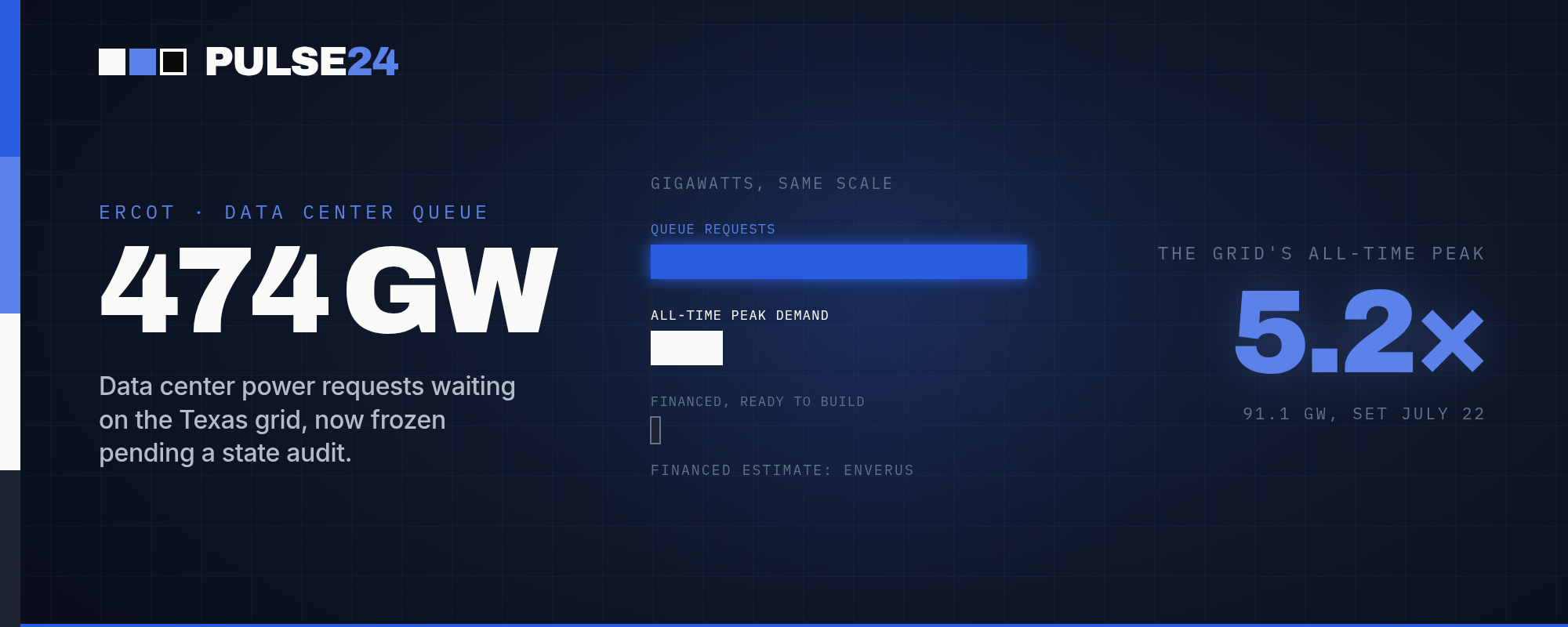
Texas has frozen new permits for data centers while 474 gigawatts of power requests sit in the grid queue, more than five times its record peak. Some of the state's biggest power generators actually want the freeze to stick around.
Ninety-one point one gigawatts. That's the highest hourly demand the Texas grid has ever recorded, set on July 22 during a heat wave that pushed the state's air conditioners about as hard as they've ever been pushed. Sitting in the interconnection queue at ERCOT right now is 474 gigawatts of requested power, more than five times that record, and the overwhelming majority of it wants to plug in a data center rather than a factory or a neighborhood.
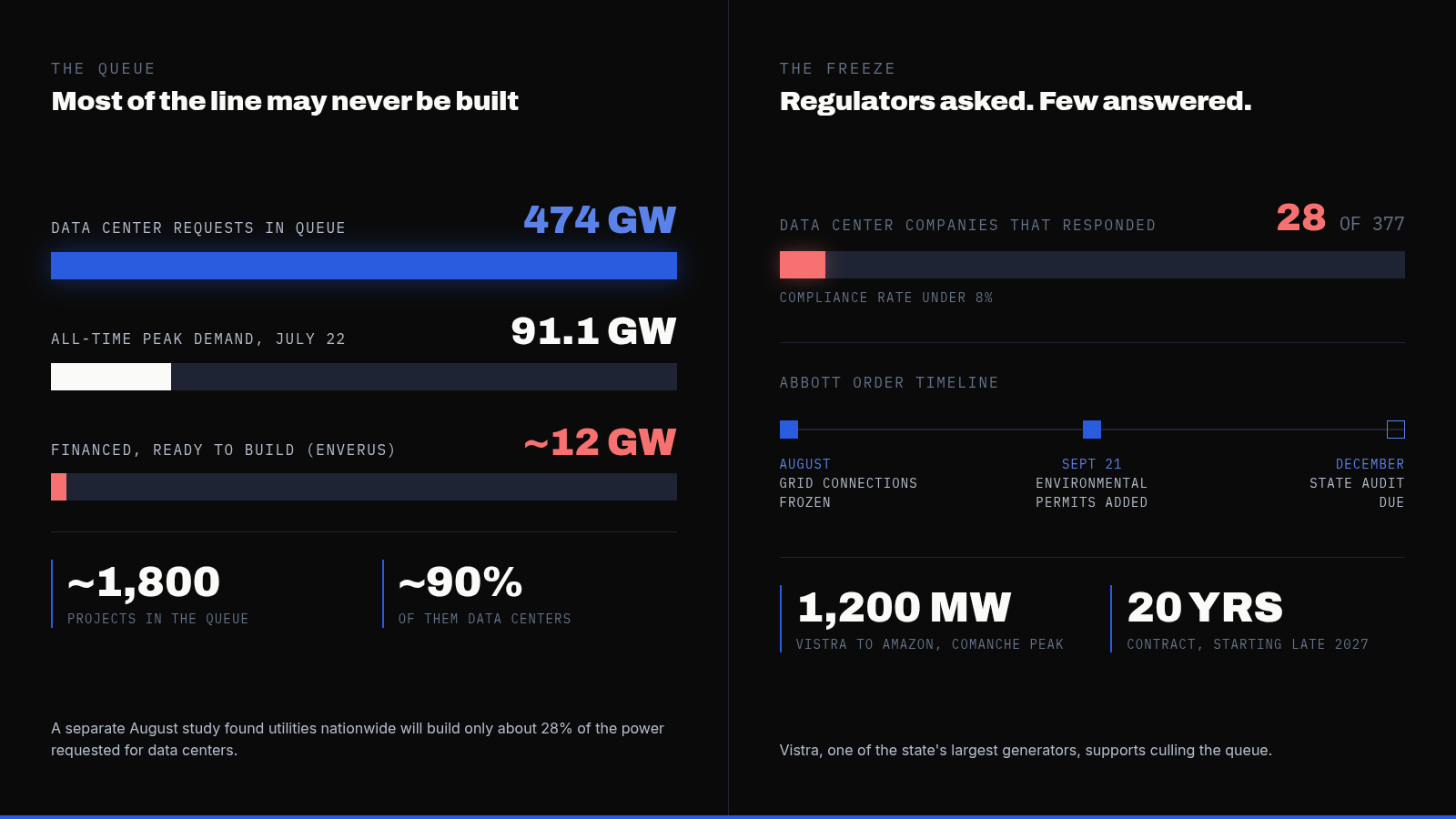
Governor Greg Abbott has responded by freezing the line. Back in August, he ordered ERCOT and the Public Utility Commission of Texas to audit every pending data center project before any new grid connections move forward. On September 21 he broadened that order to cover environmental permits too, a change aimed at facilities that planned to generate their own power on-site and never touch the public grid at all.
What Changed
The scale behind the freeze is what makes it notable. Roughly 1,800 projects are sitting in the queue, and about 90% of them, somewhere around 1,620 developments, are data centers. Regulators asked 377 data center companies to submit basic information about their power and water plans. Twenty-eight actually did. A compliance rate under 8% says something on its own about how many of these filings were ever meant to be built.
Texas officials don't agree on what the freeze accomplishes. Agriculture Commissioner Sid Miller called it “all hat and no cattle,” arguing that without new legislation the directive is “empty political rhetoric wrapped in meaningless fluff,” and he wants Abbott to call a special legislative session instead. State Representative Gina Hinojosa, who is challenging Abbott for governor this cycle, went further, saying he's “taken millions from data center CEOs while giving Texans lip service” to restrictions that don't really exist. Abbott's own framing is simpler than either critique: Texans, he says, must come first, and data centers need to pay their own way and protect the grid and water supply.
Why the Industry Isn't Panicking
Not everyone in the power business reads this as a threat to the AI buildout. Analysis firm Enverus puts the queue's high-confidence load, meaning projects with financing, land, and equipment orders actually in place, at around 12 gigawatts out of the 474 gigawatts total. By that math, most of the queue could be developers reserving multiple sites to keep their options open, or filings for projects that were unlikely to break ground regardless of what Austin decides. Enverus also argues that half of what the audit asks for duplicates checks the interconnection process already performs. The genuinely new questions, on tax incentives and community impact, don't determine whether a project can safely connect to the grid in the first place.
That skepticism about inflated queues isn't new or unique to Texas. A separate study published in August found that utilities nationwide will only build about 28% of the electricity they've been asked to line up for data centers, with the rest amounting to paper reservations rather than real projects. Texas' queue looks like a concentrated version of that same pattern. This also isn't Abbott's first attempt to make data centers bear their own costs directly. In July, Texas regulators separately proposed requiring data centers to pay for the power infrastructure they use rather than spreading the cost across every ratepayer's bill, arriving as the broader utility industry faced an estimated $25 billion in unpaid bills.
Some of the state's biggest generators are on board with the pause for exactly that reason. Vistra chief executive Jim Burke told analysts he'd like to see the queue culled. His company isn't worried about its own position: Comanche Peak, a two-unit nuclear plant that has already cleared every review ERCOT requires, is locked into a 20-year contract to supply Amazon with up to 1,200 megawatts of power, beginning in late 2027 and ramping to full capacity by 2032, tied to a $5 billion data center Amazon is building nearby. Vistra's adjusted EBITDA reached $1.77 billion last quarter, up 30% from a year earlier, even as the company trimmed its longer-term load growth forecast to a range of 4% to 6% from the prior 5% to 6%.
What to Watch Next
Texas isn't acting alone. New York passed a first-in-the-nation, one-year moratorium on new hyperscale data centers in July under Governor Kathy Hochul, while it writes new development rules. PJM, the grid operator covering thirteen mid-Atlantic and Midwest states, has hit its capacity price cap for three straight summers as the same imbalance shows up somewhere else: demand for AI power keeps arriving faster than anyone can build generation to match it.
The financing side of that imbalance shows up in credit markets too. Amazon, Alphabet, Meta, Microsoft, and Oracle issued roughly $220 billion in investment-grade bonds through early August alone to fund data center construction, according to BNP Paribas data, more than three times what the same group borrowed in all of 2025. That's happening at a moment when building a single gigawatt of AI data center capacity can cost anywhere from $38 billion to $60 billion depending on what gets counted. Separately, high-yield borrowers now route close to 19% of new US bond issuance toward AI data centers, a share credit analysts are watching for signs the buildout is running ahead of demand.
What to watch next: whether Texas' audit, due in December, actually strips gigawatts out of the queue or mostly cleans up paperwork, whether other states follow New York and Texas with pauses of their own, and whether incumbents like Vistra keep signing long-term power contracts even as speculative filings get filtered out. None of that settles whether AI itself is overbuilt. It does start to answer whether the grid can keep pace with the AI that actually gets built, and for utility investors and chipmakers that may be the more immediate question.
The Pulse24 Take
A moratorium framed as a rebuke to the AI boom is doing something narrower: separating real demand from reserved-but-unfunded demand. For anyone trying to gauge how much of this buildout will actually get built, that's a useful signal, and on balance a constructive one rather than evidence the boom is cracking. Developers already holding financing and a signed utility contract, the position Vistra and Amazon are in with Comanche Peak, look far more likely to clear an audit built around verification than to get blocked by one. The speculative filers hoping to flip a grid interconnection slot are the ones genuinely at risk, and clearing them out could make the queue numbers, and the power-demand forecasts built on top of them, considerably more trustworthy than a headline figure of 474 gigawatts suggests on its own.
How we read the data
Curious how we get from raw data to a take like this? Our Trader's Toolkit walks through the tools we lean on.
Explore the Toolkit