Pulse24 Original
19% of New US High-Yield Bonds Now Fund AI Data Centers. Europe's Share Is Only 5%, and Wall Street Wants to Close That Gap.
September 19, 2026
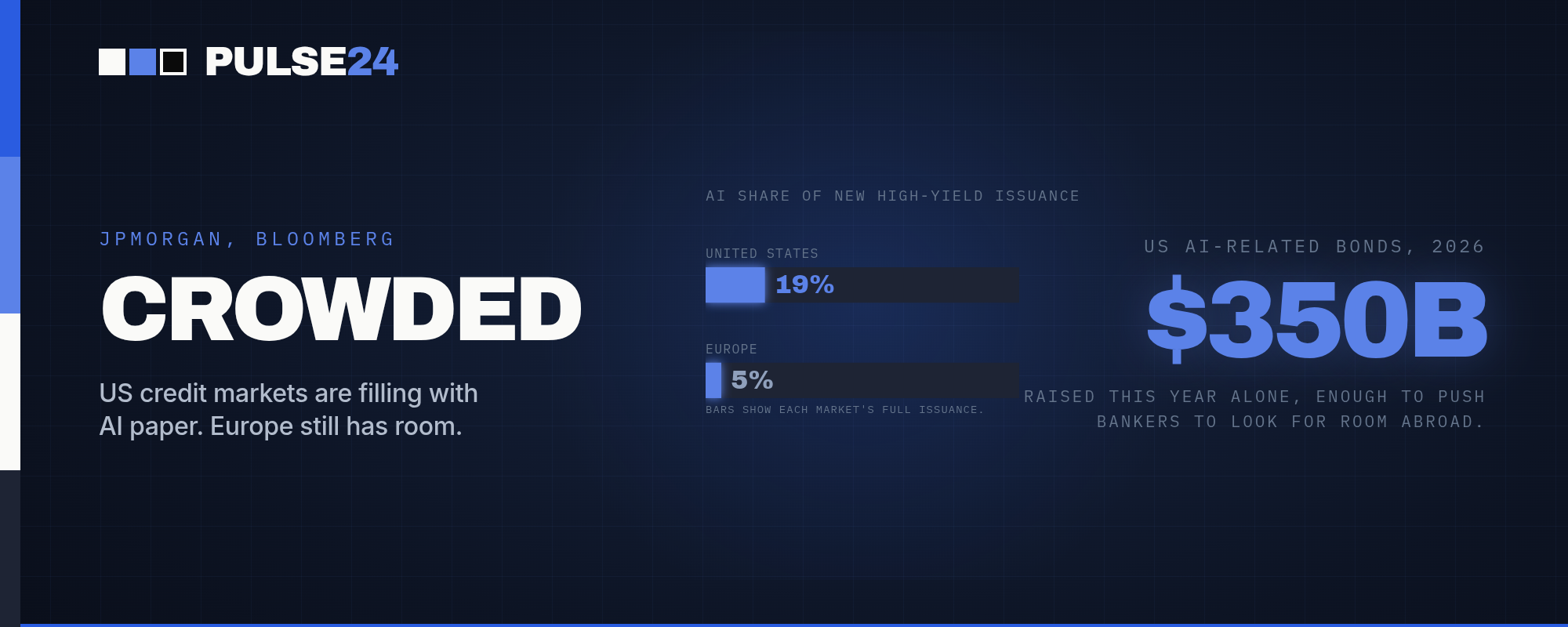
AI-related debt now makes up 19% of new US high-yield bond issuance, and JPMorgan and Goldman Sachs are racing to bring that financing model to Europe. Amazon and Uber both sold their first bonds in European currencies this month as US credit markets get crowded.
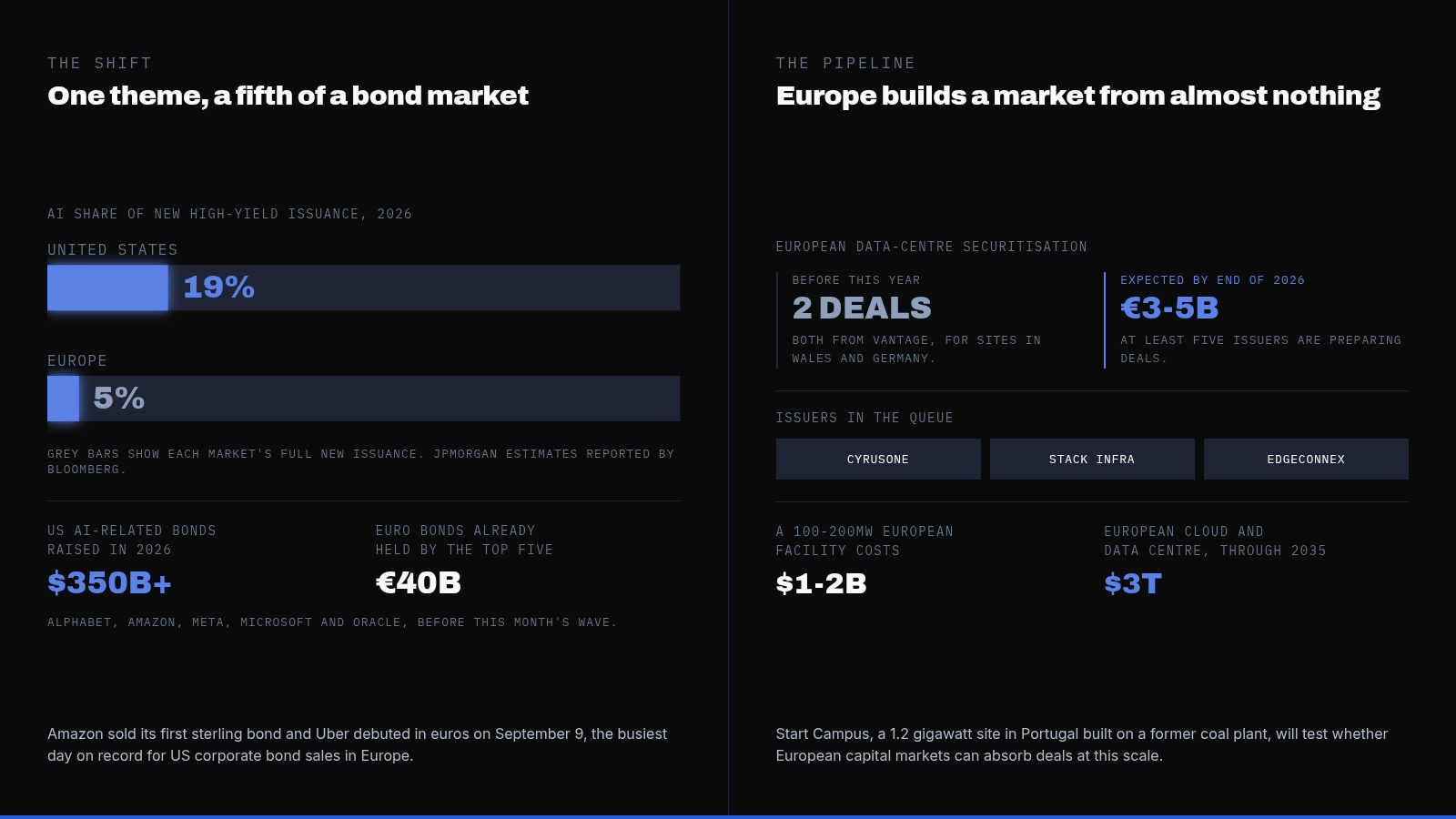
Nineteen percent. That is the share of new high-yield bond issuance in the United States this year that traces back to artificial intelligence infrastructure, up from a figure that barely registered twelve months earlier. JPMorgan estimates American companies have raised more than $350 billion in AI-related debt in 2026 alone, a pace large enough that bankers are now hunting for financing capacity outside the country's own borders.
On September 9, Amazon sold its first bond denominated in British pounds. Uber made its debut in euros that same week. Four other American issuers joined them, producing the busiest single day for US corporate bond sales in European markets on record, according to Bloomberg. The reasoning bankers gave was direct: American credit markets are getting crowded with AI paper, and Europe still has room.
Why It Matters
A single gigawatt of AI data center capacity can run $38 billion to $60 billion, depending on what gets counted, and hyperscalers are now planning individual projects several times that size. Financing numbers that large through cash flow or equity alone is not realistic for most operators, so debt has become the default tool. The five biggest hyperscalers, Alphabet, Amazon, Meta, Microsoft, and Oracle, already carry a combined €40 billion in euro-denominated bonds, and that tally predates this month's fresh wave of issuance.
Europe's own data-center securitization market is smaller by an order of magnitude, but it is catching up fast. Analysts expect €3 billion to €5 billion in European data-center-backed bonds by the end of 2026, a sharp jump from a market that had produced only two public deals total before this year, both from Vantage Data Centers for facilities in Wales and Germany. KKR-backed CyrusOne, Blue Owl's Stack Infrastructure, and EQT-backed EdgeConneX are among at least five issuers now preparing similar transactions. JPMorgan and Goldman Sachs have each assembled dedicated European teams to chase the business. Noah Roth, who leads JPMorgan's EMEA leveraged finance desk in London, told Bloomberg there "hasn't been a great deal of issuance here but there has been intense investor focus."
Not everyone reads the shift the same way. Credit markets have already started pricing in some caution about AI spending elsewhere. The cost of insuring Oracle's own debt against default has climbed sharply over the past year, even as the company keeps signing bigger infrastructure contracts. SoftBank needed a consortium of 20 banks to assemble $11.9 billion just to cover a single payment obligation to OpenAI due in October. Debt investors keep funding the buildout, but they are pricing the risk more carefully than equity markets have been.
There is a regulatory angle too. Texas paused new data center grid connections in August after utility regulators logged an estimated 474 gigawatts of pending interconnection requests, and New York enacted its own moratorium on large data center permits while it writes new development standards. European Central Bank president Christine Lagarde has separately warned that the continent's dependence on American AI infrastructure carries its own strategic risk. Both pressures point in the same direction: more computing capacity, and the debt that funds it, migrating onto European soil.
What to Watch Next
Start Campus, a multi-phase 1.2-gigawatt data campus in Portugal built on a former coal plant site, is the kind of project that will test whether Europe's capital markets can actually absorb deals at this scale. Individual European facilities in the 100 to 200 megawatt range already require $1 billion to $2 billion in financing before construction wraps, and a campus several times that size sits inside the roughly $3 trillion analysts think European cloud and data-center infrastructure will require through 2035.
Watch credit spreads on the new European deals once they price. A recent asset-backed offering from Equinix drew investor orders well above what was on offer, evidence of strong early demand. But oversubscription in a market this new and thinly tested can turn quickly if a high-profile AI project stalls or a hyperscaler's earnings disappoint. The US market offers something of a preview: American AI debt issuance has already reached a scale where analysts openly debate whether spreads properly reflect the risk of a slowdown in AI capital spending. Europe is about to run that same experiment with far less history to lean on.
The Pulse24 Take
This reads as a liquidity story before it reads as an AI story. The buildout needs more capital than internal cash flow or equity markets can comfortably supply, so financing keeps spreading into new corners of the credit market, first into US high-yield, now into European securitization. Diversifying the investor base across currencies and regions is a normal response to concentration risk, not automatically a warning sign. What is worth watching is the pace. Nineteen percent of a bond market rotating toward a single theme in under two years is fast, and fast rotations tend to be the ones that overshoot before they correct. Oversubscribed deals and new specialist teams at the biggest banks suggest investors still want in for now. The real test is a European securitization pricing wide of expectations, or failing to find a buyer at all, not a broad slowdown in AI spending.
How we read the data
Curious how we get from raw data to a take like this? Our Trader's Toolkit walks through the tools we lean on.
Explore the Toolkit