Pulse24 Original
SoftBank Lined Up $11.9 Billion From 20 Banks to Cover Its Next OpenAI Payment, Due October 1
September 14, 2026
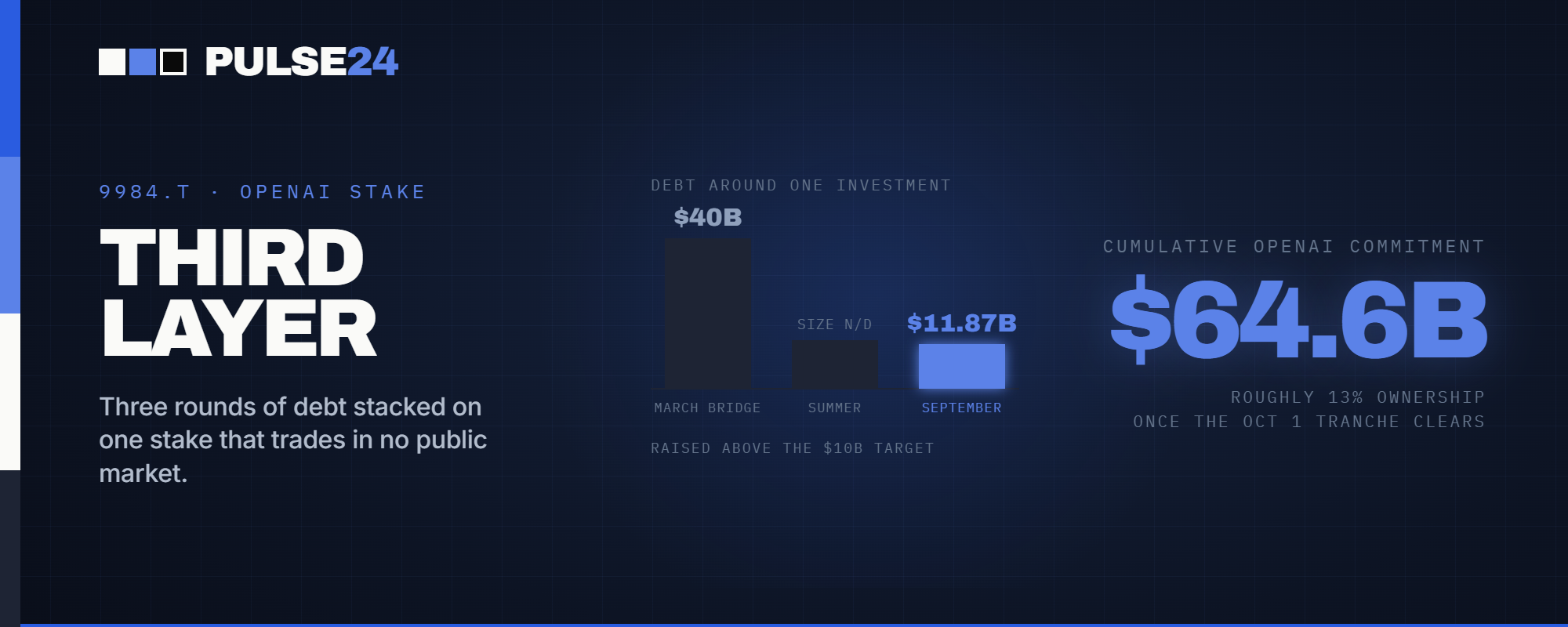
SoftBank lined up an $11.87 billion loan this month, more than it originally sought, to help cover the final $10 billion installment of its OpenAI investment due October 1. It's the third layer of debt stacked on a single illiquid stake, and S&P has already flagged the concentration risk.
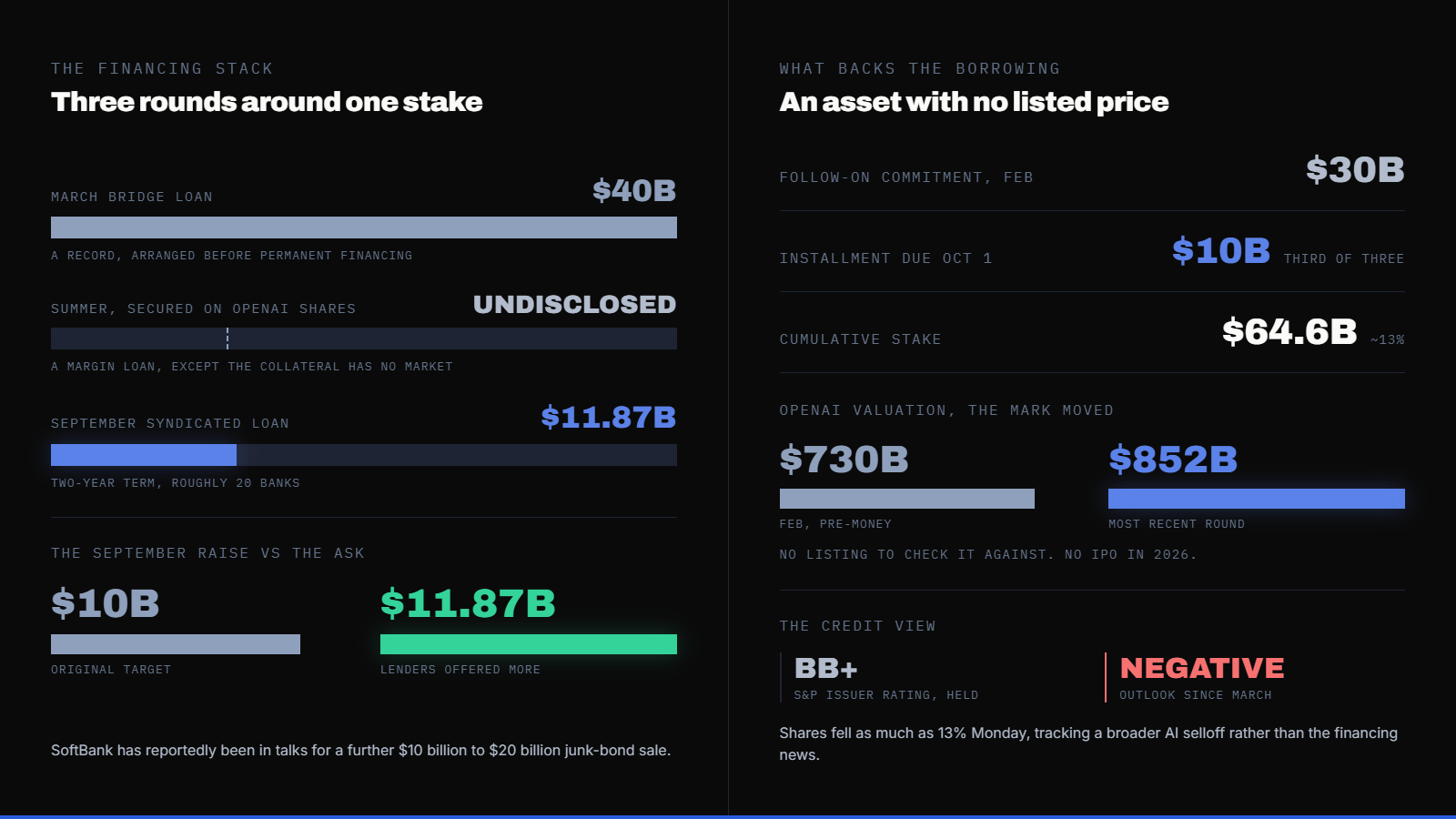
SoftBank owes OpenAI $10 billion on October 1. That's the third and final installment of a $30 billion follow-on investment the company committed to in February, split into three equal payments spaced roughly three months apart. To help cover it, SoftBank lined up an $11.87 billion loan this month from a syndicate of roughly 20 banks, more than the $10 billion it originally set out to raise.
Bloomberg and the Japan Times reported the facility on September 14, describing a two-year loan finalized the week before. Twenty lenders is a wide syndicate for one corporate borrower, and the fact that banks offered nearly $2 billion above SoftBank's initial ask suggests there's still plenty of appetite for exposure to the AI buildout, even when that exposure runs through a Japanese holding company rather than a chipmaker or a cloud provider directly.
What Changed
This is the third piece of debt SoftBank has assembled around a single bet. In March, a syndicate of major banks arranged a record $40 billion bridge loan to get the OpenAI investment moving before permanent financing was in place. Later in the summer, SoftBank separately pursued a loan secured directly against its OpenAI shares, a structure lenders sometimes call a margin loan, except here the underlying stake trades in no public market at all. September's $11.87 billion facility layers on top of both.
Add it up and SoftBank's cumulative commitment to OpenAI reaches $64.6 billion once the October tranche clears, for a stake of roughly 13%. SoftBank priced that follow-on investment against a $730 billion pre-money valuation for OpenAI when it announced the deal in February. OpenAI's most recent private funding round, which Pulse24 covered alongside Anthropic's own IPO push, priced the company closer to $852 billion. None of that value is liquid. There is no exchange listing to check it against, and secondary trading in pre-IPO OpenAI shares has reportedly skewed heavily toward sellers over buyers in recent months.
Why It Matters
Pulse24 has already tracked how skeptical bond investors have grown toward the AI infrastructure buildout more broadly, with Oracle's default insurance hitting a record and CoreWeave's credit-default swaps briefly pricing in close to coin-flip odds. SoftBank's situation is a different flavor of the same worry. Oracle and CoreWeave borrowed against physical infrastructure, data centers with decades-long leases and hardware that keeps generating revenue regardless of any single AI company's fate. SoftBank borrowed against a minority stake in one private company's equity, an asset whose clearest path to liquidity is an IPO that OpenAI itself just said isn't happening in 2026.
That distinction matters because of how these loans tend to be structured. Lenders on stock-backed facilities typically reserve the right to demand more collateral or early repayment if the underlying asset's value falls far enough, the private-market equivalent of a margin call. S&P's decision to move SoftBank's outlook to negative in March, while leaving its BB+ rating untouched, was a direct response to this kind of concentration risk: a company whose creditworthiness increasingly rests on the market's continued willingness to value one AI lab in the hundreds of billions of dollars.
What to Watch Next
The October 1 payment itself is the nearest checkpoint, a mechanical test of whether this new facility closes as planned. Beyond that, SoftBank has reportedly been in talks for a further $10 billion to $20 billion junk-bond sale, which would show how much appetite remains for unsecured SoftBank debt specifically, separate from anything backed by OpenAI collateral. Wednesday's Fed decision also sets the borrowing-cost backdrop for whatever SoftBank raises next, and Monday's AI-safety-driven selloff in SoftBank shares is worth watching for whether it fades quickly or turns into a more sustained repricing of the stock underpinning so much of this borrowing.
The Pulse24 Take
None of this means SoftBank is in trouble. It has weathered bigger swings before, and a negative outlook from S&P is a warning, not a downgrade. What's worth sitting with is how much of the AI trade's financing has started to route through structures like this one: debt secured by equity in companies that don't trade publicly, priced by lenders who are effectively betting on a valuation someone else assigned in a private funding round.
The hyperscalers borrowing to build data centers can point to physical assets and contracted revenue as backstops. SoftBank's backstop is a percentage of a company that has explicitly said it isn't ready to prove its value in public markets yet. That gap between the two kinds of AI leverage is probably worth tracking as closely as any single earnings report this quarter.
How we read the data
Curious how we get from raw data to a take like this? Our Trader's Toolkit walks through the tools we lean on.
Explore the Toolkit