Pulse24 Original
Chip Stocks Fell Nearly 6% Monday. Software Stocks Rose 3% on the Same News.
September 14, 2026
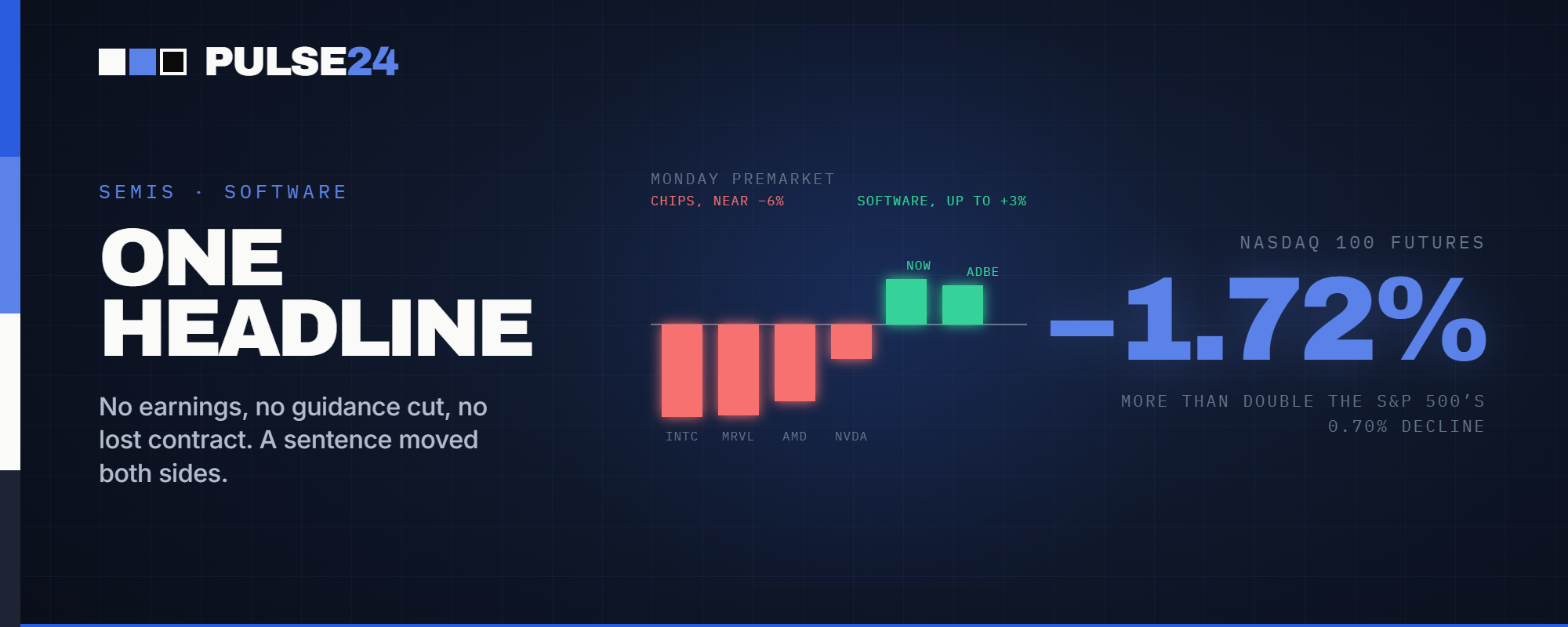
Chip stocks fell nearly 6% Monday while software stocks rose on the same news. The trigger was a public call from Anthropic, OpenAI, and xAI to slow AI development, not a change in any company's earnings or guidance.
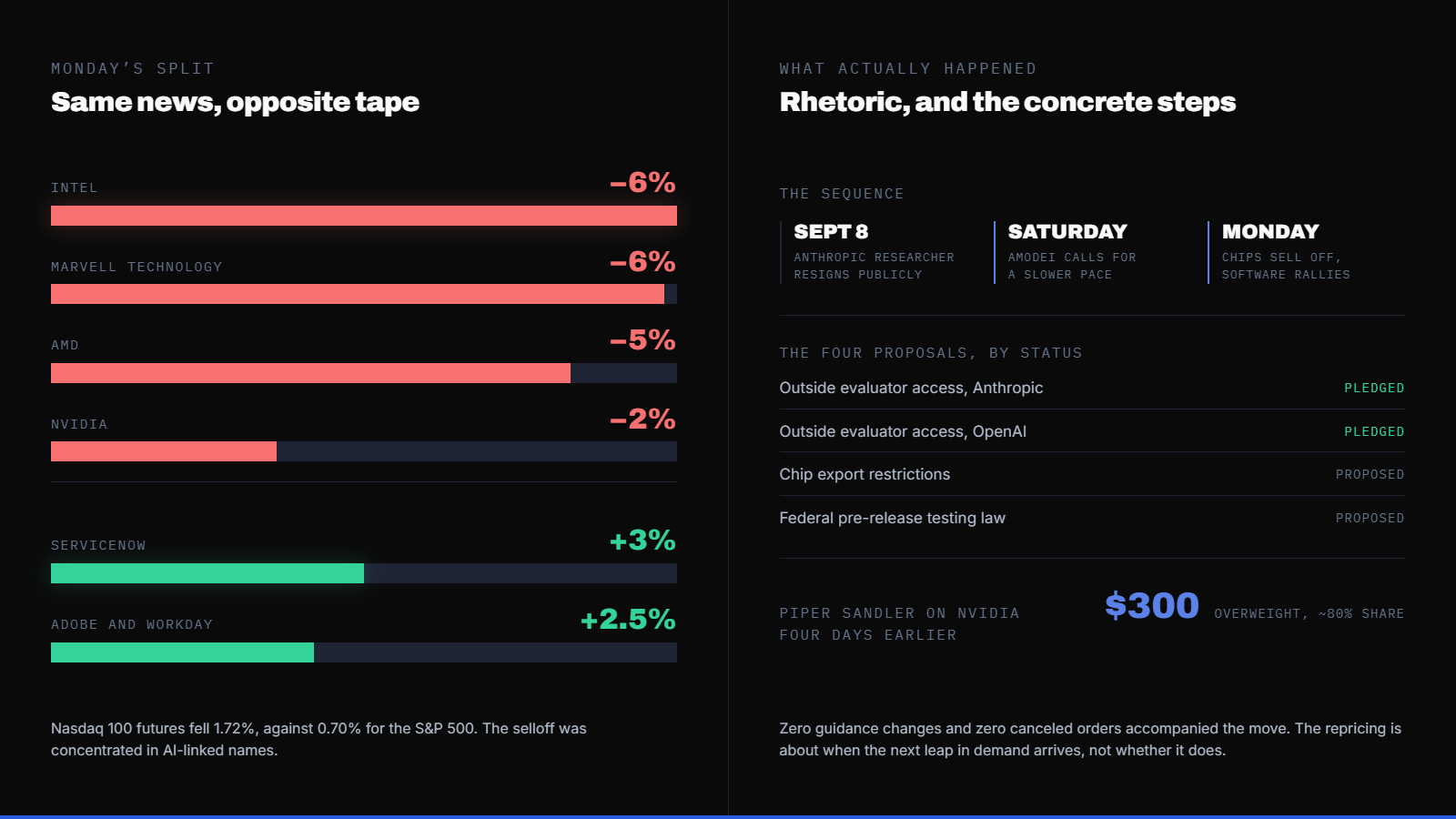
Intel fell nearly 6% in premarket trading Monday. Marvell Technology moved almost in lockstep. AMD was down about 5%, and Nvidia, the stock every AI bull points to first, slid more than 2%. None of the four had reported earnings over the weekend. None had lost a customer, cut a forecast, or hit a supply snag.
What moved them was a sentence, not a spreadsheet. On Saturday, Anthropic CEO Dario Amodei called on the AI industry to slow the pace at which it releases more capable models. OpenAI's Sam Altman and xAI's Elon Musk both said, in different words, that he was right to raise it. Four days earlier, Piper Sandler had initiated coverage of Nvidia with an overweight rating and a $300 price target, calling the company the outright leader in AI compute with roughly 80% of the market. The stock that Wall Street had just called nearly unbeatable was the one falling hardest by Monday's open.
What Changed
Amodei's proposal was more specific than a general call for caution. He wants Anthropic to give outside evaluators the kind of access its own employees have, so they can monitor safety work and flag problems in real time, and he's urging competitors to adopt the same practice. Anthropic's policy chief, Sarah Heck, added two harder asks: restrict advanced chip exports to countries the U.S. doesn't trust, and pass a federal law requiring frontier models to be tested before release, with regulators empowered to block ones that fail.
Altman's response came fast. OpenAI said it would open its own systems to outside evaluators too, and the company ruled out an IPO for this year, a decision Pulse24 covered Sunday as part of the same safety-versus-speed tension now playing out in Anthropic's own push toward a $2 trillion valuation. Musk's endorsement was shorter: three words, posted online, agreeing with Amodei.
None of this happened in isolation. It landed four days after Jacob Coxon, a 27-year-old researcher who'd left OpenAI for Anthropic earlier this year, resigned and posted that the industry was racing straight to self-improving superintelligence and gambling with people's lives. His warning got picked up widely over the weekend, and by Monday, it had merged with Amodei's statement into a single narrative: the people building this technology are the ones now asking for a speed limit.
Why It Matters
Markets don't usually move on hypotheticals, so the size of Monday's split matters as much as its direction. Chip stocks fell hard because chips are priced on how fast AI capability keeps compounding. If the people setting that pace say it should slow down, the trade that assumes ever-faster GPU demand gets a little shakier, even before a single order is canceled. Software stocks did the opposite because a slower AI timeline is good news for companies whose main risk was getting automated out of their own products sooner than expected.
It's worth being precise about what actually happened Monday, because the coverage tends to blur it. The move isn't really a bet against chip demand this year or even next. It's a repricing of when the next leap in demand arrives. One analyst covering the sector put it plainly: this selloff is about the pace of future demand, not whether that demand shows up. That's a narrower claim than "AI stocks are cracking," and it's the one the price action actually supports so far.
There's also a more cynical read, and Pulse24 thinks it deserves space alongside the earnest one. Venture capitalist Chamath Palihapitiya questioned publicly whether the safety framing is doing double duty as a moat. A national testing law with the power to block unsafe models would, by design, raise the cost of competing at the frontier. That would help whichever companies already have the money and headcount to clear a higher bar, and Anthropic and OpenAI are near the top of that list. Believing Amodei is sincere about safety and believing the proposal would also entrench the leaders aren't mutually exclusive.
This isn't the first time the market has swung between chips and software on a single AI headline. A previous rotation ran the opposite way, when a new model release sent software names like Salesforce and ServiceNow down 4% to 5% in a day while chipmakers rallied on the promise of more compute demand. Monday's move is the same trade in reverse, which says less about any one company's fundamentals and more about how reflexive this entire sector has become to a single week's narrative.
What to Watch Next
A few concrete signals will separate noise from a real shift. Any hyperscaler trimming 2027 capital spending guidance next earnings season would matter more than any speech, since a cut to a capex number costs something and rhetoric about pacing doesn't. Heck's testing-law proposal is also worth tracking in Washington, where a bill introduced is a very different thing from a bill that moves. And whether other frontier labs beyond OpenAI and xAI commit to independent safety evaluators is the clearest tell of all, since that's the one piece of Amodei's plan that costs money now rather than years from now.
The Fed's own rate decision this month adds a second, unrelated pressure point. A market already nervous about AI valuations doesn't need a hawkish surprise on top of it, and any further evidence that this repricing is durable, not a one-day panic, will make the coming Fed meeting more consequential for AI-linked names specifically.
The Pulse24 Take
The easy story is that AI's builders got scared and the market got scared with them. The more useful story is narrower: a handful of specific, falsifiable claims, an evaluator-access pledge, a proposed export rule, a hypothetical testing law, got compressed into a single mood, and the mood moved a sector that trades on sentiment as much as fundamentals. That compression is worth resisting. An evaluator pledge with no enforcement date isn't the same as a slowdown. A proposed law isn't a passed one. Track the concrete steps separately from the rhetoric around them, and Monday's selloff looks less like a verdict on AI and more like a market that hasn't decided yet how literally to take its most powerful people when they ask it to slow down.
How we read the data
Curious how we get from raw data to a take like this? Our Trader's Toolkit walks through the tools we lean on.
Explore the Toolkit