Pulse24 Original
SoftBank Is Paying Its Highest-Ever Bond Yields to Fund OpenAI. CoreWeave's Next Interest Bill May Top Its Operating Income.
September 28, 2026
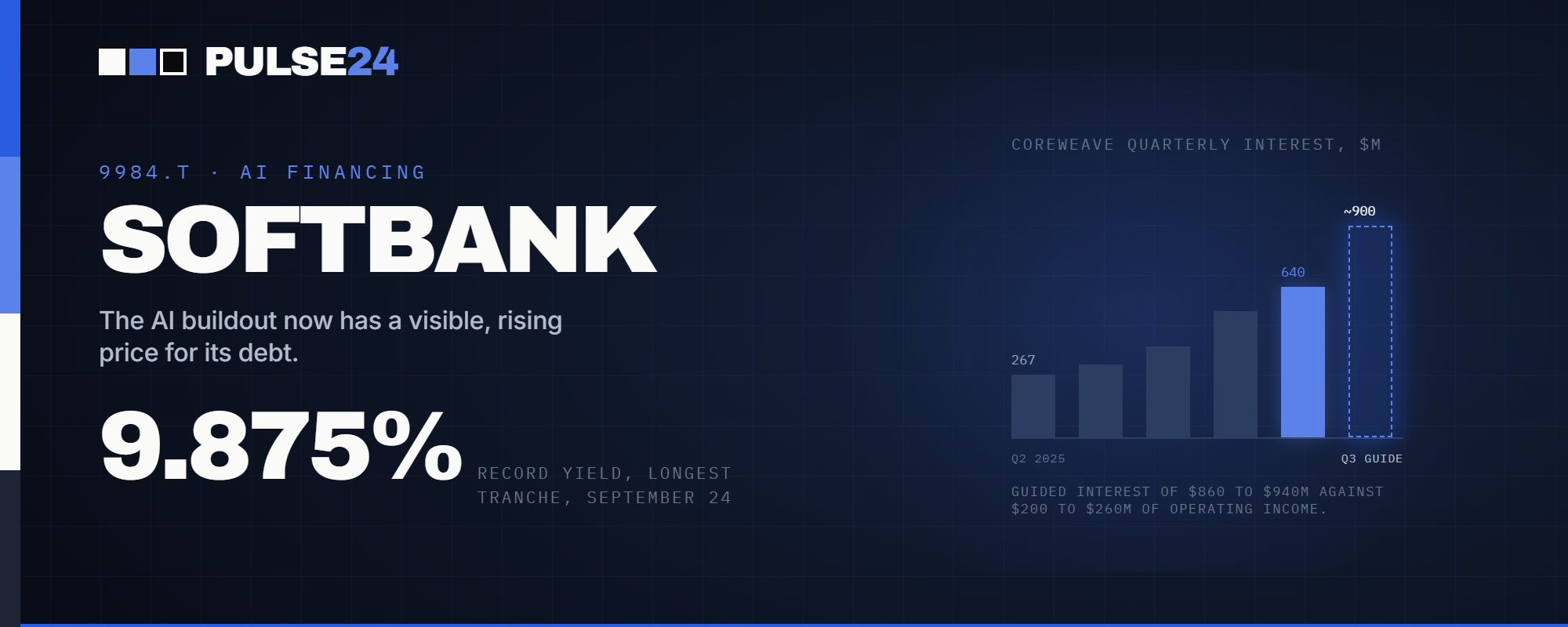
SoftBank agreed to pay its highest-ever bond yields this week to keep funding OpenAI, and CoreWeave's own interest bill is on pace to exceed its operating income next quarter. The Fed's rate hikes are starting to show up as a real, dollar-denominated cost of the AI buildout, not just a debate about valuations.
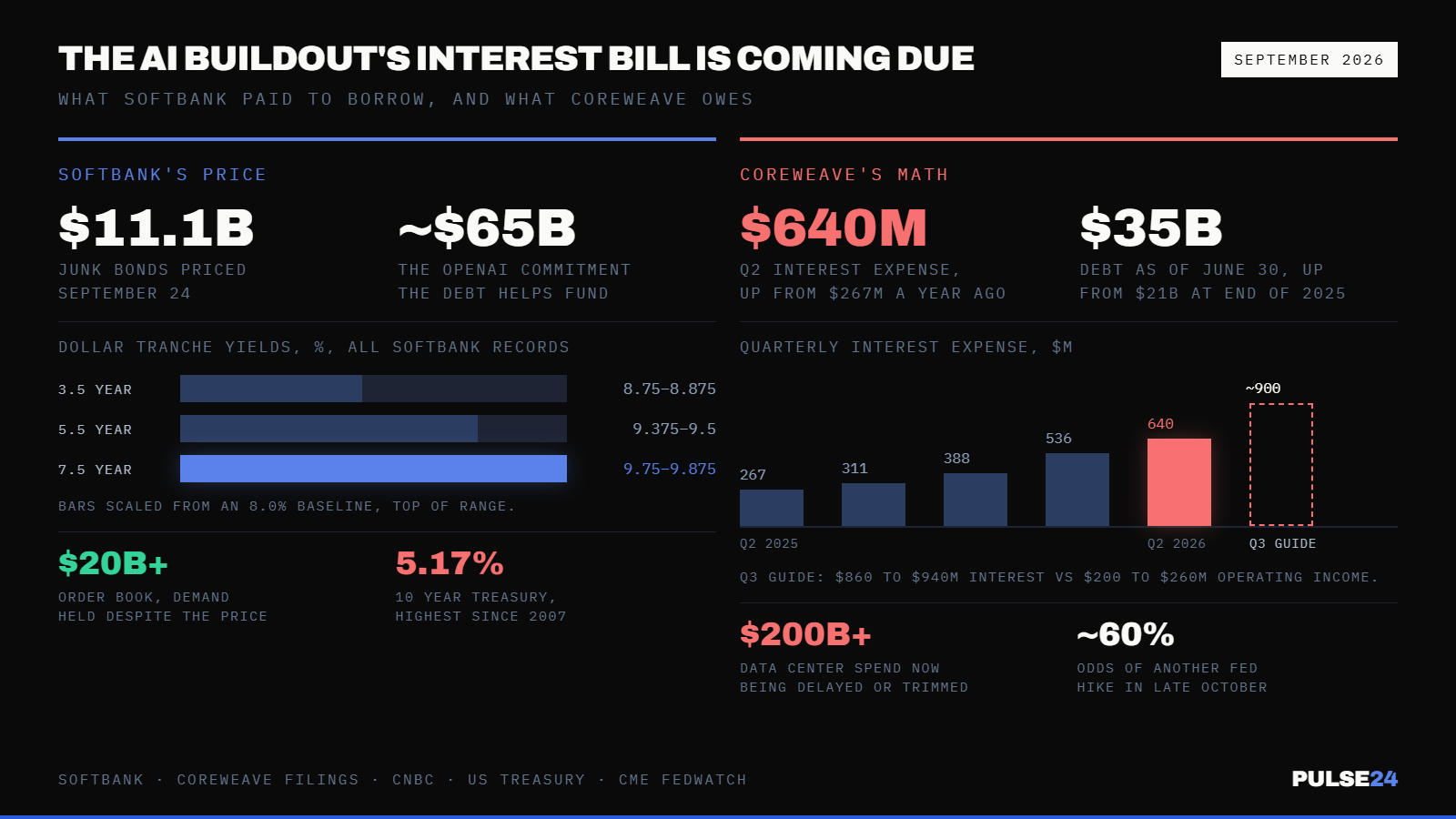
Nine and seven-eighths percent. That is the yield SoftBank agreed to pay on the longest tranche of an $11.1 billion junk bond sale it priced on September 24, and by the company's own history, it is the richest yield SoftBank has ever offered dollar bond investors. The proceeds are earmarked for a commitment to OpenAI that is now approaching $65 billion, and the order book still topped $20 billion despite the price.
Bond math like that used to be background noise for a story about chips and data centers. It is quickly becoming the story itself.
What Changed
SoftBank's deal, split across three dollar tranches and two euro tranches, priced with its 3.5 year notes near 8.75% to 8.875%, its 5.5 year notes near 9.375% to 9.5%, and its 7.5 year notes near 9.75% to 9.875%. Every one of those levels is the highest SoftBank has ever paid for debt of that maturity. A creditor pricing that deal is, in effect, betting on equity risk in a private company rather than lending against cash flow the business already generates, which is exactly the kind of financing structure credit investors are now demanding a premium for.
CoreWeave tells a similar story from the borrower's side. Its interest expense has climbed for four straight quarters, from $267 million to $311 million to $388 million to $536 million to $640 million, tracking a debt balance that grew from $21 billion at the end of 2025 to roughly $35 billion by June 30. Management's own third quarter guidance calls for interest expense of $860 million to $940 million, against adjusted operating income of only $200 million to $260 million. CoreWeave has said a 100 basis point move in short term rates adds about $30 million to its annual interest expense, so even a quarter point Fed hike carries a real, calculable cost.
This is not confined to two companies. CNBC reported September 27 that data center operators collectively holding more than $200 billion in planned spending through 2027 are already delaying or trimming projects as financing costs rise. On a $1 billion data center, a jump in borrowing rates from around 3% to 6% or 7% adds tens of millions of dollars a year in interest, money that has to come from somewhere. Digital Realty Trust and Equinix are both issuing bonds at a record pace to keep up, and JPMorgan estimates the AI buildout could generate $4.1 trillion in debt issuance through 2030.
Why It Matters
None of this means the AI infrastructure boom is ending. Hyperscalers like Microsoft, Meta, Amazon, and Alphabet still carry investment grade ratings and generous free cash flow, and their bonds have absorbed a wave of new supply without any real threat to solvency. What has changed is who is exposed and by how much. The 10-year Treasury yield sitting near a 2007 high sets the floor that every corporate borrower prices off of, and Fed officials signaling more hikes this year mean that floor is not obviously done rising.
The companies furthest from investment grade, the CoreWeaves and SoftBanks of the world, are the ones where a rate increase shows up almost immediately as a bigger interest bill rather than a modest markup on new issuance. That is a different kind of risk than a chip shortage or a slower rollout of a new model. It is a financing risk, and financing risk tends to surface exactly when it is least convenient, in a slowdown or a funding squeeze rather than in a boom.
There is also a valuation angle. Capital Economics has already floated the idea that today's AI-driven rally could partially reverse by 2027 once the capital spending cycle matures. A credit market that is starting to price real risk into AI-linked debt is one more data point for that thesis, even if it is far from proof of it.
What To Watch Next
The Fed's late October meeting is the first thing to watch, with markets currently pricing roughly 60% odds of another quarter point hike, and every basis point that moves through the 10-year flows straight into the cost of financing new data center capacity. CoreWeave's actual third quarter print is the second, since a miss against that $860 million to $940 million interest guidance would make the gap between financing cost and cash generation harder to wave away. Whether more neoclouds follow SoftBank into the high yield market at similarly steep prices, or whether investors start pushing back on price and volume both, is the third.
The Pulse24 Take
The AI buildout was always going to need financing on a scale that outran free cash flow. What is new is that the financing itself now has a visible, rising price, and that price is starting to show up in earnings guidance rather than just analyst spreadsheets. For the hyperscalers, this is a manageable cost of doing business. For the leveraged layer beneath them, the neoclouds and the SoftBanks funding equity stakes with junk debt, it is closer to a real constraint. Nobody should read one bond sale or one quarter of rising interest expense as proof the AI trade is over. But the idea that AI infrastructure spending was somehow insulated from the ordinary mechanics of interest rates was never quite right, and September made that a little harder to ignore.
How we read the data
Curious how we get from raw data to a take like this? Our Trader's Toolkit walks through the tools we lean on.
Explore the Toolkit