Pulse24 Original
Capital Economics Puts the S&P 500 at 8,250 by December. Then It Sees a 30% Reversal by 2027.
September 20, 2026
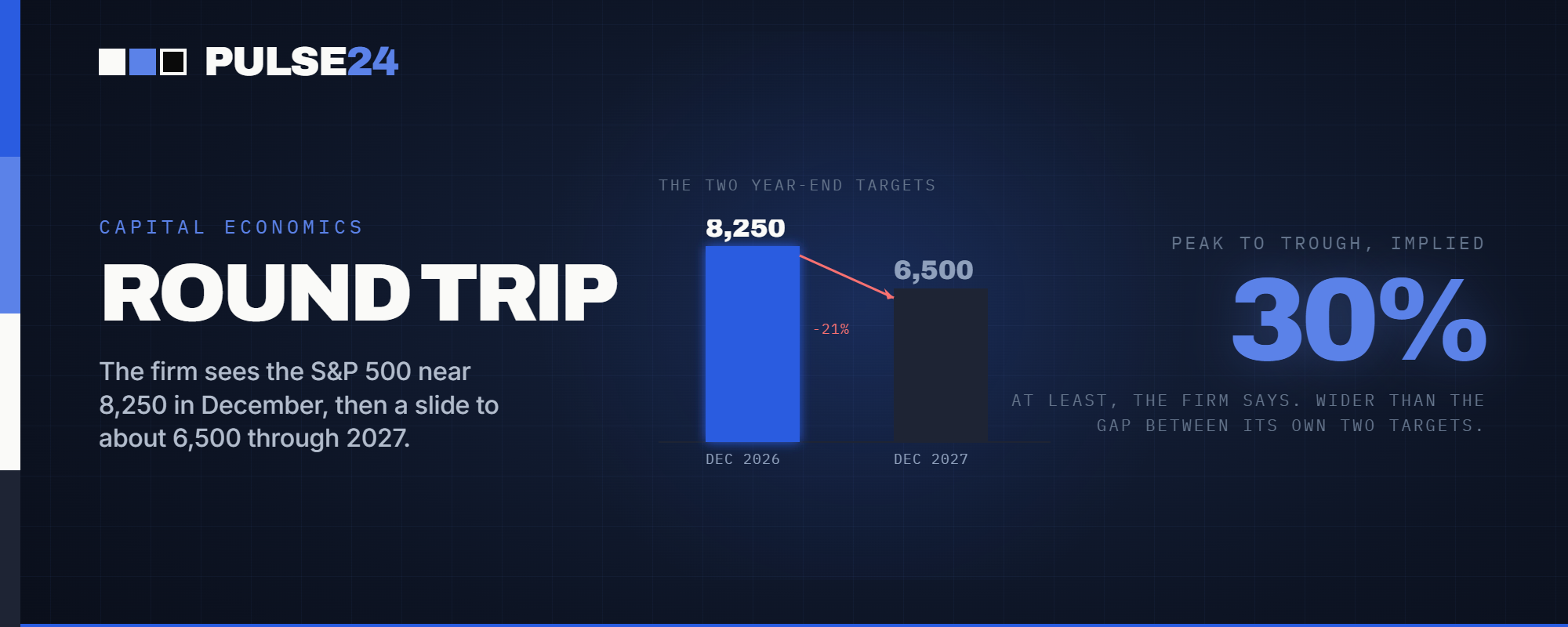
Capital Economics thinks the AI rally has a few more months left, then a reckoning. The research firm's call: S&P 500 near 8,250 by year end, then a slide toward 6,500 in 2027 that it says rhymes with the dot-com bust, even as most fund managers say they're more confident about AI spending than they were a month ago.
John Higgins does not hedge much in his firm's latest client note. Higgins, chief economic adviser for financial markets at Capital Economics, wrote this month that there are "plenty of signs that we are now in the late stages of a bubble in AI." His firm has since attached hard numbers to that view: the S&P 500 climbing to roughly 8,250 by the end of this year, then dropping to about 6,500 by the end of 2027.
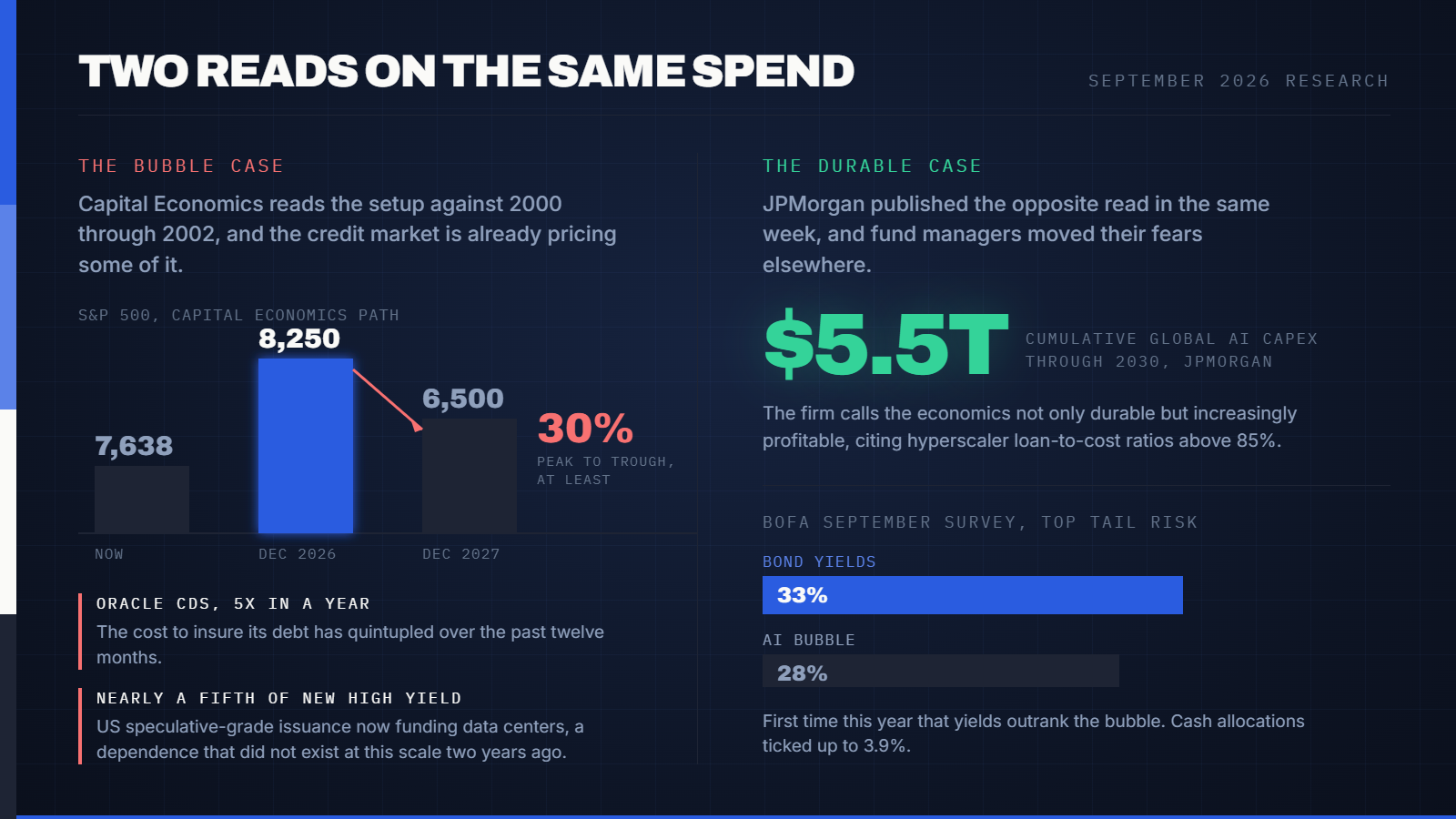
The second number is the one worth sitting with. An 8,250 print would mean the rally that has carried the index through most of 2026 keeps running for a few more months before it tops out. A slide to 6,500 implies a peak-to-trough decline Capital Economics puts at "at least 30 percent," wider than the roughly 21 percent gap between its own two year-end targets. The math there is deliberate: the firm expects the index to overshoot on the way up, undershoot on the way down, or both, before it settles near 6,500.
Where the Bubble Case Comes From
Capital Economics is measuring today's setup against the dot-com collapse of 2000 through 2002, still the closest precedent it can find for a US-led, tech-concentrated bust over the past century. James Reilly, a senior markets economist at the firm, has been more blunt about the comparison, telling reporters this month that stretched earnings expectations for leading AI companies relative to the pace of overall US economic growth look like the dot-com bubble all over again. The firm's own research shows US tech capital spending has already climbed past dot-com-era levels as a share of GDP, alongside heavy equity issuance and a market capitalization increasingly concentrated in a handful of names.
None of the underlying spending is a secret. Nvidia, Microsoft, Meta, Alphabet, and Amazon have raised capex guidance for several quarters running, and the totals keep climbing. What Capital Economics is questioning isn't the spending itself but the assumption embedded in current valuations, that revenue and profit will scale fast enough to justify it. Independent analysts have already pushed back on similar assumptions elsewhere: AMD's own slide put its 2030 AI market estimate at $3 trillion, up from $2 trillion a year earlier, while independent analysts covering the same market kept their estimate closer to $1.7 trillion.
The Money Already Flowing Into AI's Foundations
Some of the revenue underpinning those assumptions runs through arrangements that blur the line between customer and investor. Nvidia has struck financing, investment, or supply deals with more than a dozen AI companies, arrangements in which its own capital shows up again later as revenue on its own income statement. That circularity predates this particular forecast, but it feeds directly into Capital Economics's concern that reported growth is getting harder to read at face value.
Credit markets are already pricing in some of that uncertainty. The cost to insure Oracle's own debt has quintupled over the past year, and Wall Street remains split on what that says about the broader AI financing chain. Separately, nearly a fifth of new US high-yield bond issuance is now funding AI data centers, a reliance on speculative-grade debt that didn't exist at this scale two years ago. If Capital Economics has the timing right, spreads on that debt would likely widen well before the S&P 500 itself rolls over.
Higgins expects the fallout, if it arrives, to spread beyond US equities: international markets falling by less given their lower tech concentration, government bond yields easing modestly as investors rotate toward safety, and the dollar weakening as capital that piled into US tech looks for a new home.
Not Everyone Is Buying the Bubble Call
The forecast lands at an odd moment for the bubble argument. Bank of America's September fund manager survey, published earlier this month, found that a disorderly rise in bond yields overtook the AI bubble as fund managers' top-ranked tail risk for the first time this year, cited by 33% of respondents versus 28% for AI. Cash allocations ticked up to 3.9%, the largest single-month rise since March, which reads more like broad caution than a bet against AI specifically. Notably, 79% of managers surveyed said they don't expect hyperscaler capex cuts in 2026, up from 71% the month before, the opposite direction sentiment would move if doubts about AI spending were deepening.
JPMorgan takes an even more direct opposing stance. The bank now projects cumulative global AI capital spending will reach $5.5 trillion through 2030, with roughly $4.1 trillion of that financed through debt, and expects hyperscaler operating cash flow to exceed $900 billion by 2027. It points to loan-to-cost ratios averaging above 85% on AI infrastructure financing as evidence the economics are, in its words, "not only durable, but increasingly profitable." Its stated caveat is narrower than a bubble call: whether real-world adoption keeps pace with the trillions being committed, and what happens given how concentrated that spending is among a small number of companies.
Academics are similarly split on the terminology. Kenneth French at Dartmouth's Tuck School of Business has cautioned against reaching for the word bubble at all. "We don't have enough information to judge if these prices are right or wrong, too high or too low," he said, adding that AI's impact on earnings already looks larger than many expected. Greg Daco, chief economist at EY-Parthenon, draws a related distinction: many technological revolutions carry a first phase of heavy investment that can look excessive in hindsight, but the concern he hears most is less about whether AI investments pay off financially and more about whether the technology is being deployed with the right guardrails, a different question from a market bubble entirely.
What Would Confirm or Kill This Forecast
The next real test comes with hyperscaler earnings later this year and into early 2027, specifically whether capex guidance keeps rising or finally plateaus. Credit default swap spreads on AI-linked corporate debt are worth watching closely too, since Capital Economics's own framework expects credit markets to move before equities do. The October Bank of America survey matters as well: if AI bubble concerns reclaim the top spot from bond yields, that would suggest sentiment is shifting toward Higgins's side of the argument faster than his own 2027 timeline assumes.
The Pulse24 Take
Capital Economics isn't the first shop to call a top in AI stocks, and 2027 is far enough out that the forecast can't really be graded yet. What makes this one worth tracking is the mechanism behind the number rather than the number itself: a capex-to-GDP ratio that has already passed dot-com levels, increasingly financed through debt and circular deals rather than pure equity, sitting beneath earnings expectations that assume adoption keeps accelerating. That combination doesn't need a 30% crash to matter. Even a modest disappointment in hyperscaler capex guidance could reprice AI-linked credit and equity together, given how intertwined the financing has become. Picking a side in the bubble debate matters less right now than watching the specific pressure points this piece lays out: capex guidance, CDS spreads on AI debt, and whether cash flow generation actually starts catching up to the spending it's supposed to justify.
How we read the data
Curious how we get from raw data to a take like this? Our Trader's Toolkit walks through the tools we lean on.
Explore the Toolkit