Pulse24 Original
Nvidia Has Struck Financing, Investment, or Supply Deals With More Than a Dozen AI Companies. In Several of Them, Its Own Money Comes Back as Revenue.
September 19, 2026
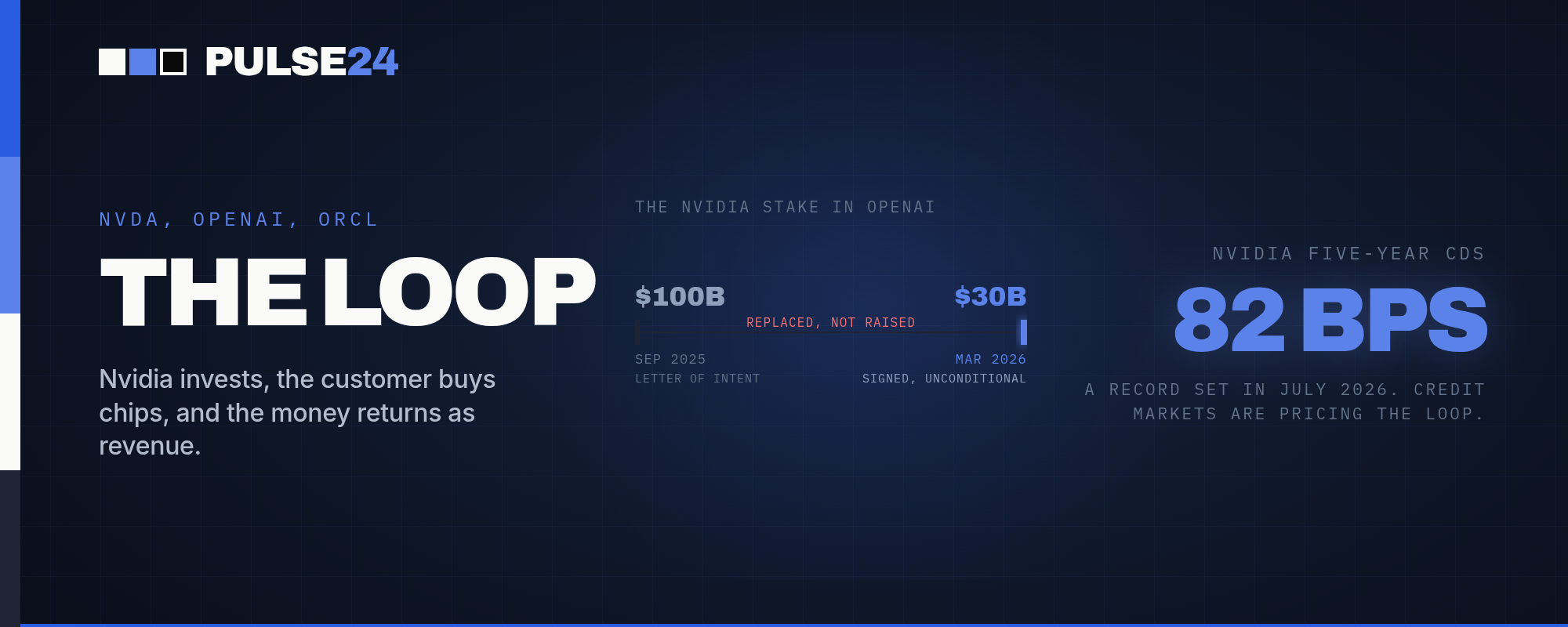
Nvidia invests in a company, that company buys Nvidia chips, and the purchase shows up as Nvidia's own revenue growth. This is a working map of the biggest circular financing deals in AI, who is exposed to whom, and how several of the largest ones have already changed since they were first announced.
Nvidia invested roughly $30 billion in OpenAI in March 2026. OpenAI, in turn, is one of Nvidia's largest customers, with binding commitments to deploy gigawatts of Nvidia's Vera Rubin systems. When OpenAI writes Nvidia a check for chips, some of that money can trace back to capital Nvidia itself provided. That loop, an investor whose investment becomes a sale, and a sale that counts as revenue for the investor, is what people mean when they call AI financing circular.
The pattern has become common enough that it now has its own reference entry: the same capital can effectively flow as both a vendor payment and an equity stake, and a company with a major shareholder among its own suppliers has a reason to keep buying from that supplier regardless of whether a cheaper option exists elsewhere. None of that makes any single deal fraudulent or even unusual by Silicon Valley standards. Vendor financing is an old tool. What's different now is the scale, and how many of the largest deals in AI run through a small handful of companies that are simultaneously investors, suppliers, and customers of each other.
The Nvidia-OpenAI Deal Shows How Fast These Terms Move
The clearest example of how quickly these arrangements move is Nvidia's own relationship with OpenAI. In September 2025, Nvidia announced it would invest "up to" $100 billion in OpenAI, contingent on OpenAI bringing 10 gigawatts of Nvidia infrastructure online, structured as a letter of intent rather than a signed contract. By December 2025, Nvidia's own finance chief was telling investors the deal still wasn't definitive. By March 2026, the two companies replaced it with something smaller and more concrete: a $30 billion unconditional equity investment, folded into a funding round that valued OpenAI at $852 billion after the money came in, alongside separate binding commitments for OpenAI to deploy 3 gigawatts of Nvidia inference capacity and 2 gigawatts of training capacity on Nvidia's Vera Rubin platform. Nvidia's own CEO said the original $100 billion figure was "probably not in the cards," largely because a pre-IPO investment of that size would have complicated OpenAI's own plans to eventually go public.
That's a useful case study for reading every other number in this space. A headline commitment announced today can be a letter of intent rather than a contract, and it can shrink, change shape, or convert into something else entirely by the time it closes. Anyone comparing two companies' AI financing exposure needs to check whether a quoted figure is signed and binding, or still aspirational.
Where the Financing Loops Show Up Most Clearly
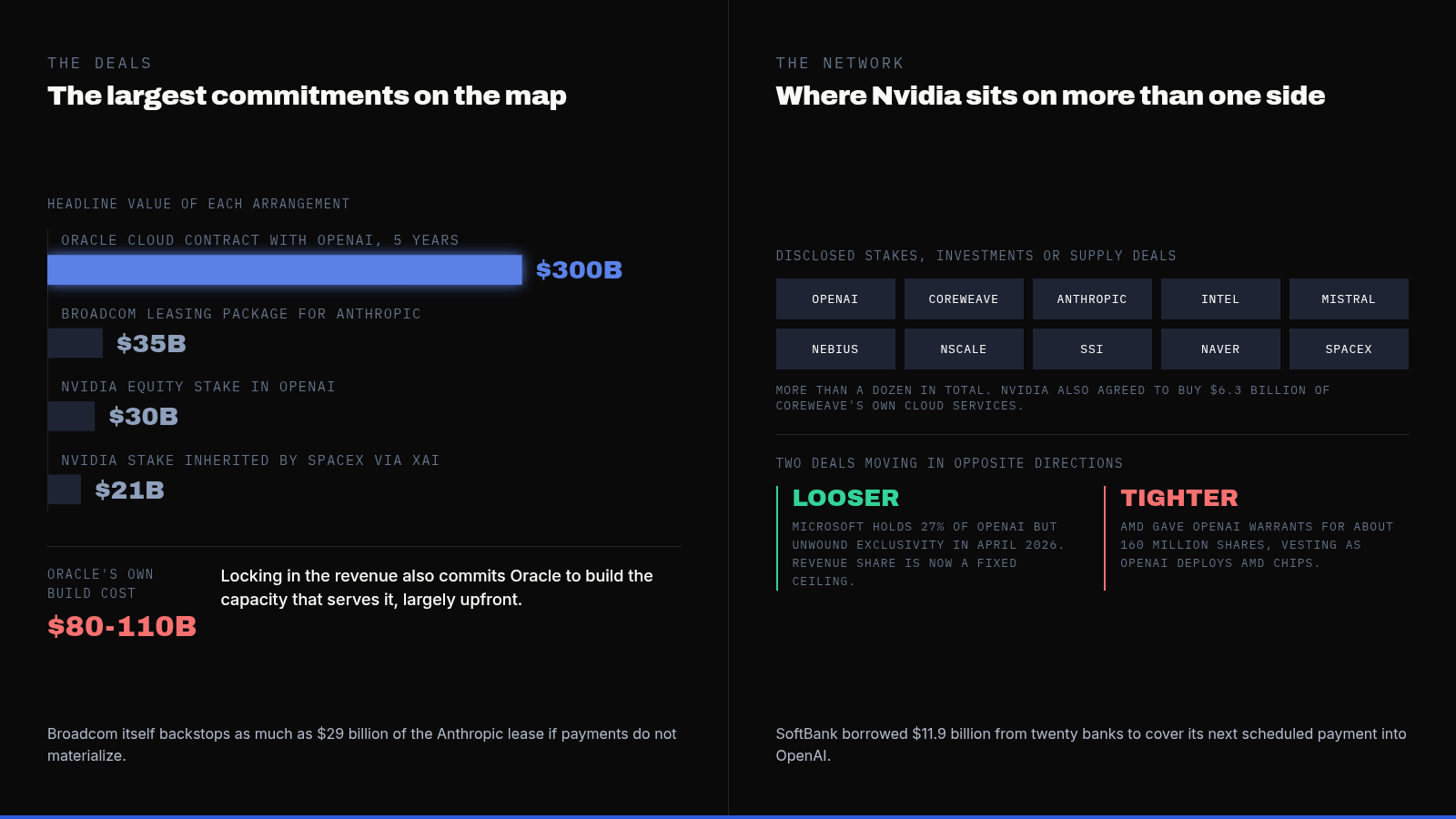
Nvidia is the most visible node in this network because it sits on more sides of more deals than any other company. It holds equity stakes, has made investments, or has struck supply agreements with OpenAI, CoreWeave, Anthropic (alongside Microsoft), Intel, Mistral AI, Nebius, Nscale, Safe Superintelligence, Naver, and SpaceX, which inherited a roughly $21 billion Nvidia stake when it acquired xAI. Several of these follow a similar shape to the OpenAI deal: Nvidia's 2025 investment in CoreWeave came with Nvidia agreeing to buy $6.3 billion of CoreWeave's own cloud computing services, meaning Nvidia is simultaneously a shareholder, a supplier, and a customer of the same company. SoftBank has borrowed against its own OpenAI investment commitment too: it lined up $11.9 billion from twenty banks specifically to cover its next scheduled payment into OpenAI, meaning some of the capital flowing into OpenAI's own funding rounds is itself borrowed rather than sitting on an investor's balance sheet.
Oracle's relationship with OpenAI runs the loop differently, through revenue rather than equity. The two signed a cloud contract in mid-2026 worth roughly $300 billion over five years, structured to ramp from about $20 billion in the first year to $100 billion in the fifth. Locking in that revenue also commits Oracle to spend an estimated $80 billion to $110 billion of its own money on the data centers needed to deliver it, largely upfront. Oracle's backlog grew enormously the day that contract was announced. So did the amount of capital Oracle itself now has to raise to fulfill it, which is one reason credit markets have grown more cautious about Oracle's own debt even as the revenue backlog looks enormous on paper.
Microsoft's relationship with OpenAI has moved in the opposite direction, toward less entanglement rather than more. Microsoft took a 27% equity stake when OpenAI restructured into a for-profit public benefit corporation in October 2025. By April 2026, the two companies had unwound the exclusivity that came with it: OpenAI can now run its models on any cloud, including Microsoft's competitors, and Microsoft no longer collects an open-ended share of OpenAI's revenue, replaced by a fixed repayment ceiling. Other deals lean the other way. AMD gave OpenAI warrants for roughly 160 million AMD shares, close to a tenth of the company, vesting as OpenAI deploys AMD chips and as AMD's own stock price hits certain targets, tying AMD's ownership structure directly to a single customer's purchasing behavior. Broadcom's arrangement with Anthropic runs through a $35 billion leasing package arranged with outside investors, with Broadcom itself backstopping as much as $29 billion of the exposure if the lease payments don't materialize as planned.
What Happens If a Link in the Chain Breaks
None of this proves the AI industry is financing a bubble it can't afford. Every company involved would say, correctly, that the underlying demand for AI compute is real and that vendor financing has helped fund plenty of legitimate infrastructure booms before this one. The risk is narrower and more mechanical: when a supplier is also a major shareholder, a slowdown in demand doesn't just cost that supplier a sale. It can cost the value of its equity stake at the same time, both losses landing together instead of one after the other. Credit markets have started pricing exactly that scenario. Nvidia's five-year credit default swap, the cost of insuring against Nvidia's own default, hit a record 82 basis points in July 2026, and Oracle's own borrowing costs have drawn similar scrutiny as its AI-related obligations have grown.
Why This Isn't Entirely New, and Why the Scale Is
Vendor financing loops aren't unique to AI. Telecom equipment makers financed their own customers through the buildout of the 1990s, and when demand growth slowed, several of those loops helped drag both suppliers and customers down together. What's different this time is concentration: a comparatively small number of companies, Nvidia, Microsoft, Oracle, Broadcom, AMD, OpenAI, Anthropic, and a handful of well-funded startups, sit on multiple sides of most of the largest deals in the industry. That concentration is also why a full accounting is hard to pin down from the outside. Some of these numbers are disclosed in securities filings, some come from company announcements, and some are reported without full confirmation from either side. Expect this map to keep changing as deals close, change shape, or unwind, the same way the Nvidia-OpenAI number did between September 2025 and March 2026.
The Pulse24 Take
The honest answer to who is lending whom the money is that it depends on which day you ask and which version of the deal you're reading about. That isn't evasion so much as an accurate description of an industry moving faster than its own disclosures, where a number quoted with total confidence in one headline can be a letter of intent that gets replaced within six months, the way Nvidia's $100 billion OpenAI pledge did.
The useful habit is checking, for any single number in this space, whether it's signed or aspirational, equity or a purchase commitment, and how many other deals the same two companies are already part of, rather than debating whether circular financing is dangerous in the abstract. Most of the risk in this market lives in that kind of detail, not in the size of any one headline figure.
How we read the data
Curious how we get from raw data to a take like this? Our Trader's Toolkit walks through the tools we lean on.
Explore the Toolkit