Pulse24 Original
Sixteen of Eighteen Fed Officials Want Another Rate Hike This Year. Gold and Bitcoin Are Already Pricing It In.
September 24, 2026
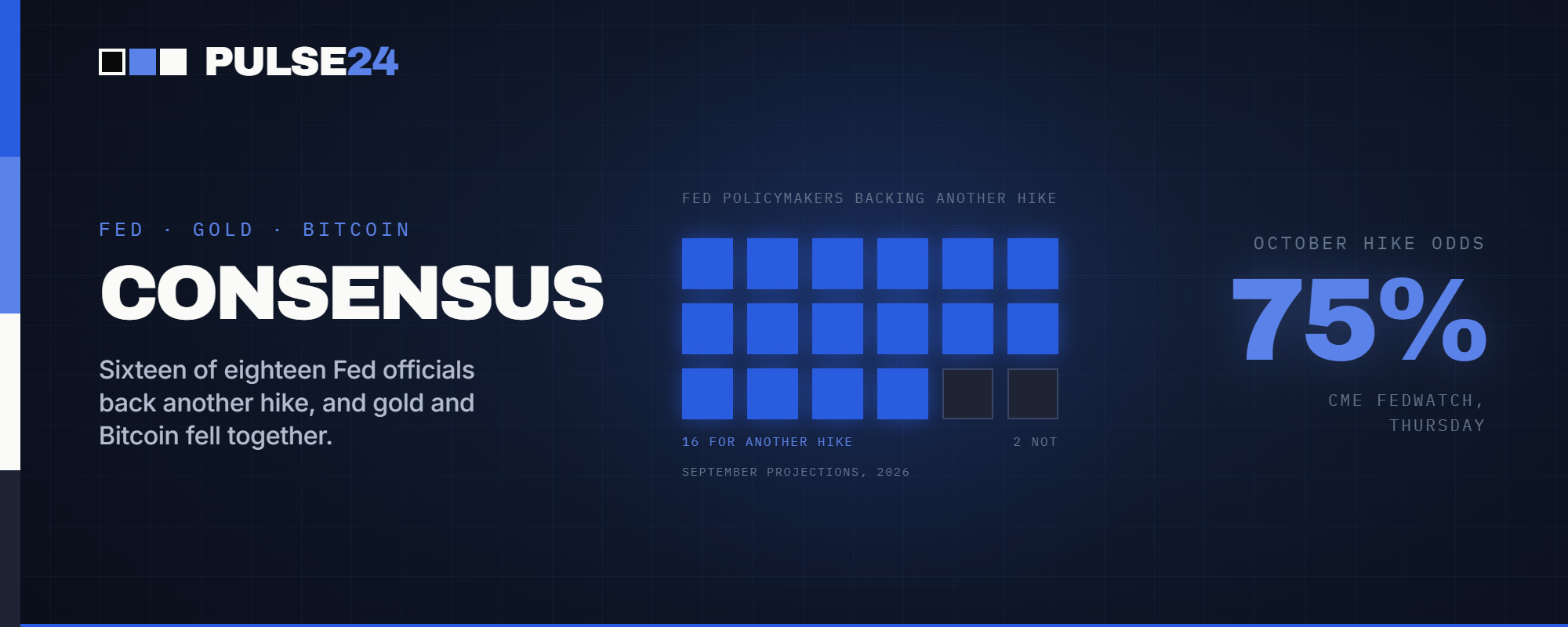
Gold slid and Bitcoin dropped more than 2% Wednesday after Fed officials lined up behind another rate hike this year. Sixteen of eighteen policymakers now back one more move, and both of 2026's marquee inflation hedges are struggling to hold their ground.
John Williams didn't announce anything new Thursday. The New York Fed president simply said out loud what markets had already priced in: another interest rate increase by year end is, in his words, "a reasonable way of thinking about it." He stopped short of naming October, and he didn't need to. Fed funds futures already put the odds of an October hike near 75%, and gold and Bitcoin both fell within hours of each other for what amounts to the same reason.
What Changed
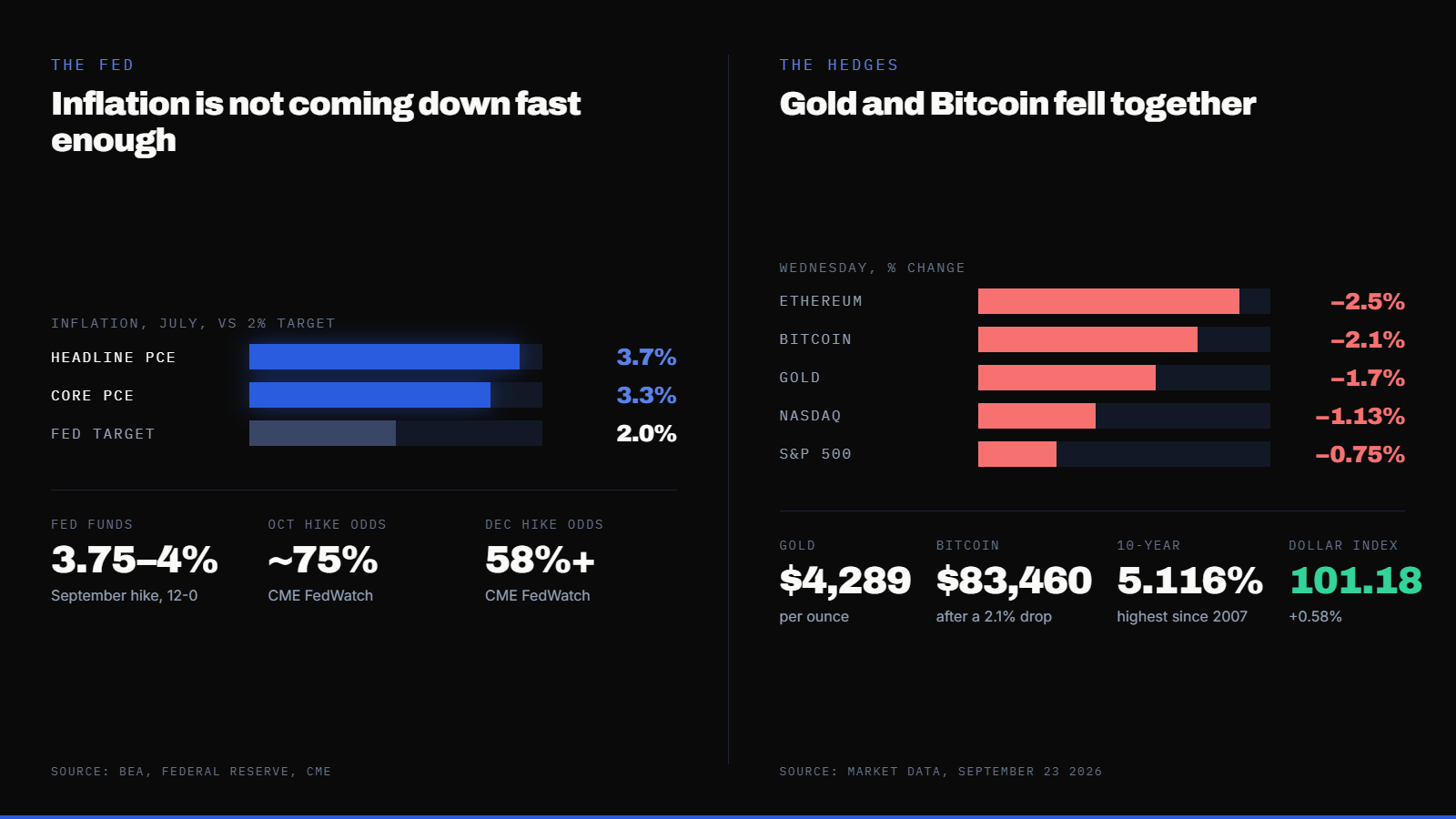
Williams' comments landed a day after Fed Governor Michael Barr told an audience at the Chicago Fed that inflation isn't clearly heading back to the Fed's 2% target "in a timely way." Barr's phrasing carried weight. Core PCE, the Fed's preferred inflation gauge, held at 3.3% in July, while headline PCE sat at 3.7%, both comfortably above target and sticky enough that a majority of policymakers no longer view September's hike as a one-time move.
That September hike, to a fed funds range of 3.75% to 4%, passed 12-0, a sharp reversal from July's 9-3 split and the Fed's first increase in more than three years. Sixteen of the Fed's eighteen policymakers now back at least one more hike before 2026 ends, according to the Fed's own projections, close to consensus for a group of officials who rarely agree on much.
Bonds moved first. The 10-year Treasury yield climbed to 5.116% Wednesday, a level the US hasn't touched since 2007, extending a broader move across the curve that Pulse24 flagged earlier this week when the 5-year crossed 5% for the first time since 2007. The dollar index followed, rising 0.58% to 101.18. Higher yields and a stronger dollar are the two forces gold and Bitcoin struggle against most, since neither asset pays interest and both are priced, one way or another, against the greenback.
Why It Matters
Gold fell about 1.7% Wednesday to roughly $4,289 an ounce, its worst single session in weeks, even with the metal still up nearly 14% over the past year, having pulled back from the record high it set earlier this year. Bitcoin dropped 2.1% to around $83,460, and Ethereum fell 2.5% to about $2,647. Both cryptocurrencies remain up double digits over the past month, so Wednesday looks more like a reset than a reversal, at least for now.
What stands out is that gold and Bitcoin fell together, on the same catalyst, despite being marketed to investors as hedges against exactly this kind of inflation problem. Bitcoin's correlation with gold climbed to 0.50 earlier this month, and Wednesday looked like that relationship playing out in real time. Gold and Bitcoin tend to gain when investors expect central banks to tolerate inflation or debase currency to manage debt loads. They tend to lose ground when a Fed is credibly fighting inflation with higher real yields instead of easier money.
Stocks felt it too. The S&P 500 closed at 7,706, down 0.75%, and the Nasdaq fell 1.13%. The VIX jumped 6.83% to 15.18, still low by historical standards, but enough to show Wednesday's repricing rattled more than just rates and metals.
What to Watch Next
The next real test lands at the October Fed meeting, where futures already assign roughly three-in-four odds of a hike. Barr and Williams have effectively framed the debate, but Fed Chair Kevin Warsh has the final word on messaging, and his own remarks have moved rate-hike odds by double digits within a single week before. Any softening in his tone between now and the meeting would matter more than another hawkish comment from a regional president.
Inflation data between now and then carries outsized weight. If core PCE eases even modestly, the case for an October hike gets harder to make, and gold and Bitcoin would likely find some relief. If it holds near 3.3% or climbs, the roughly 75% odds already priced into futures could edge toward certainty, and both assets may have further to fall before their longer-term bull cases can resume. That backdrop matters even more against signs the broader economy is already cooling, including PC shipments falling at their fastest pace in a decade, where a Fed hiking into softening demand risks overcorrecting.
The Pulse24 Take
Gold and Bitcoin are frequently pitched as the same trade in different clothes: protection against a central bank that eventually gives up on fighting inflation. Wednesday tested that thesis from the other direction. When the Fed signals it's serious about hiking rather than backing off, both assets face the same headwinds, higher real yields and a stronger dollar, and the debasement case for owning them gets harder to make in the short run. That doesn't settle the longer argument. A Fed hiking into an economy already showing some cracks carries its own risks. But for now, the market's message is straightforward: sticky inflation is bad for gold and Bitcoin before it's good for them, because the immediate policy response is tighter money, not looser money. The October meeting will show which version of that story markets end up believing.
How we read the data
Curious how we get from raw data to a take like this? Our Trader's Toolkit walks through the tools we lean on.
Explore the Toolkit