Pulse24 Original
Bitcoin's Correlation With Gold Climbed to 0.50 This Month. Its Link to the Nasdaq Fell to 0.30.
September 21, 2026
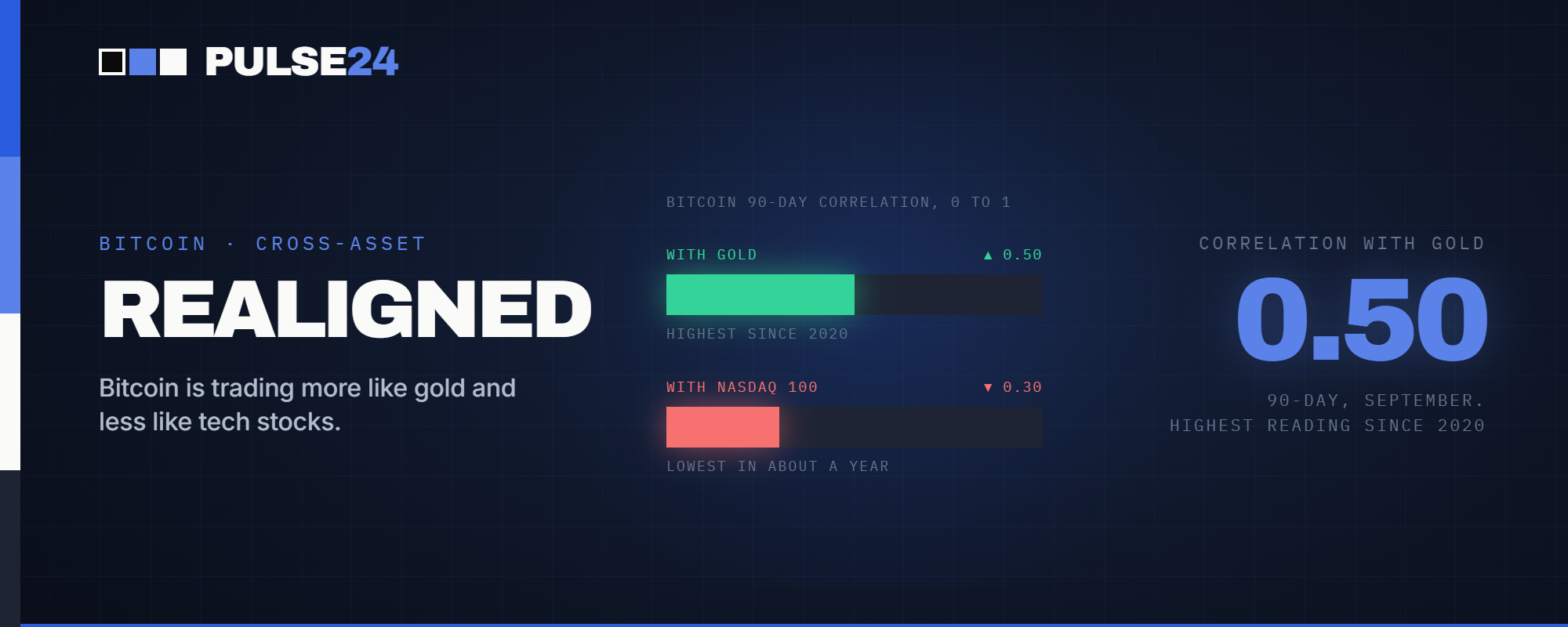
Bitcoin's 90-day correlation with gold touched 0.50 this month, the highest reading since 2020, while its link to the Nasdaq 100 slid to about 0.30, its lowest reading in roughly a year. The shift arrived the same week Bitcoin touched an eight-month high near $85,000, even as the Fed raised rates rather than cut them.
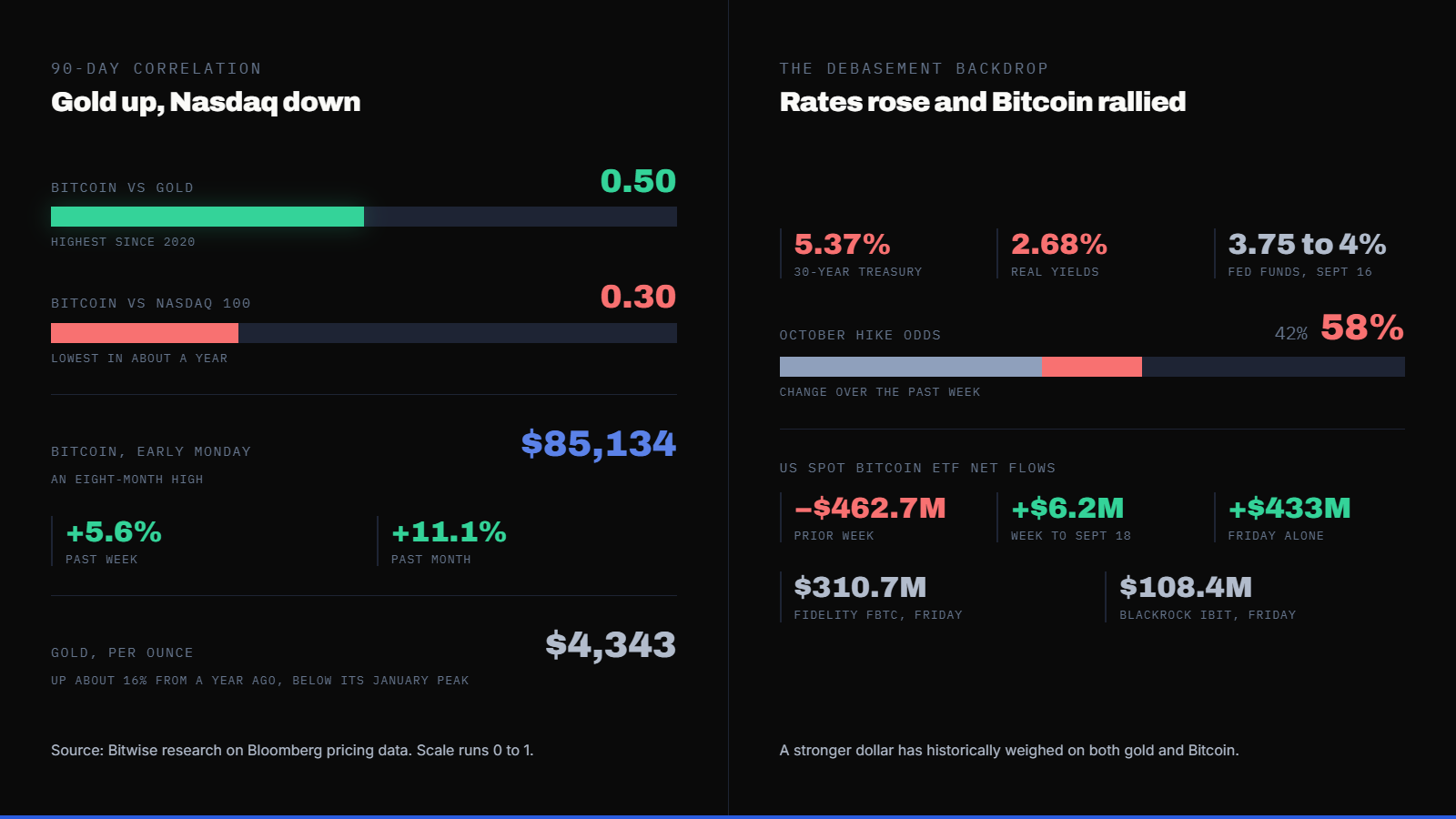
Bitcoin traded at $85,134 early Monday, an eight month high reached after a 5.6% weekly gain and an 11.1% climb over the past month. A rally alone wouldn't be much of a story this year. Bitcoin has had plenty of them. What's different this time is the company Bitcoin is keeping on the way up.
Bitwise's research desk put Bitcoin's 90 day correlation with gold at 0.50 in early September, the highest reading since 2020, using Bloomberg price data that stretches back more than a decade. Over that same window, Bitcoin's correlation with the Nasdaq 100 dropped to about 0.30, its lowest reading in about a year. Two numbers moving in opposite directions like that don't happen by accident.
What Changed
For most of Bitcoin's history as an institutional asset, it traded like a leveraged version of tech stocks. When the Nasdaq sold off, Bitcoin usually sold off harder. When the Nasdaq rallied, Bitcoin often outran it. That relationship is fading. Bitwise's research desk, whose figures were relayed by the Kobeissi Letter, ties the shift to what market commentary has started calling a debasement trade: investors treating Bitcoin and gold as interchangeable hedges against currency and bond market stress instead of treating Bitcoin as just another asset that trades off the Nasdaq.
That stress has a paper trail. Thirty year Treasury yields hit 5.37% earlier this month, their highest level since before the 2008 crisis, even after the Treasury had already doubled its long bond buyback program days earlier in an attempt to steady the market. Days after the Fed's September 16 rate hike to 3.75% to 4%, real yields climbed to 2.68%, the kind of move that normally punishes both gold and Bitcoin by raising the opportunity cost of holding assets that pay no interest. Gold shrugged it off and hit fresh highs that week anyway. Bitcoin, watching from next door, appears to have taken the same cue.
Why It Matters
A correlation shift like this changes how professional allocators think about portfolio construction, not just how Bitcoin's price moves day to day. Part of the pitch for holding Bitcoin alongside stocks for years was that it would diversify a portfolio when equities wobbled. A 0.30 correlation with the Nasdaq still offers some of that benefit, but a 0.50 correlation with gold suggests Bitcoin's biggest moves are increasingly tied to the same forces driving gold, real yields and how much investors trust that governments can manage their debt without debasing the currency along the way.
The flow data shows a market still making up its mind. US spot Bitcoin ETFs pulled in just $6.2 million net for the week ended September 18, barely positive after the prior week's $462.7 million exodus. Friday alone told a different story, with $433 million flowing in over a single session, $310.7 million of it into Fidelity's FBTC and another $108.4 million into BlackRock's IBIT. A short covering squeeze added fuel of its own late in the week, as bearish bets unwound faster than some traders expected.
What to Watch Next
Futures markets are already pricing a rising chance of another Fed move. Odds of an October hike climbed from 42% to 58% over the past week. If that hike lands and real yields keep climbing, the next few weeks become a genuine test of whether Bitcoin's gold-like behavior holds or whether it reverts to trading like a risk asset under pressure. Worth tracking alongside that is the dollar index, which touched a seven week high right after the Fed's September hike. A stronger dollar has historically weighed on both gold and Bitcoin, so a sustained move higher there would be one of the clearest signs yet of whether this correlation shift is durable or just a September coincidence.
The Pulse24 Take
Correlations move around constantly, and a single month of data isn't proof of a permanent regime change. But the direction of travel matters here. Bitcoin's link to tech stocks has been fading, and its link to gold has been building at the same time real yields and the dollar have both pushed higher, exactly the environment where a pure risk asset should struggle most. It hasn't. That doesn't make Bitcoin a stable store of value the way gold has been for centuries. Its pullbacks this cycle have still been far steeper than anything gold has produced, proof it remains the far more volatile of the two. What it does suggest is that a growing share of the money moving Bitcoin's price now cares less about tech earnings and Fed dot plots, and more about the same debasement and duration questions that have kept central banks buying gold all year. If that's right, the next real stress test for bonds, not the next Nasdaq drawdown, may say more about where Bitcoin trades from here.
How we read the data
Curious how we get from raw data to a take like this? Our Trader's Toolkit walks through the tools we lean on.
Explore the Toolkit