Pulse24 Original
The Dollar Index Climbed Above 100 for the First Time in Seven Weeks. Kevin Warsh's First Rate Hike Did That in One Session.
September 17, 2026
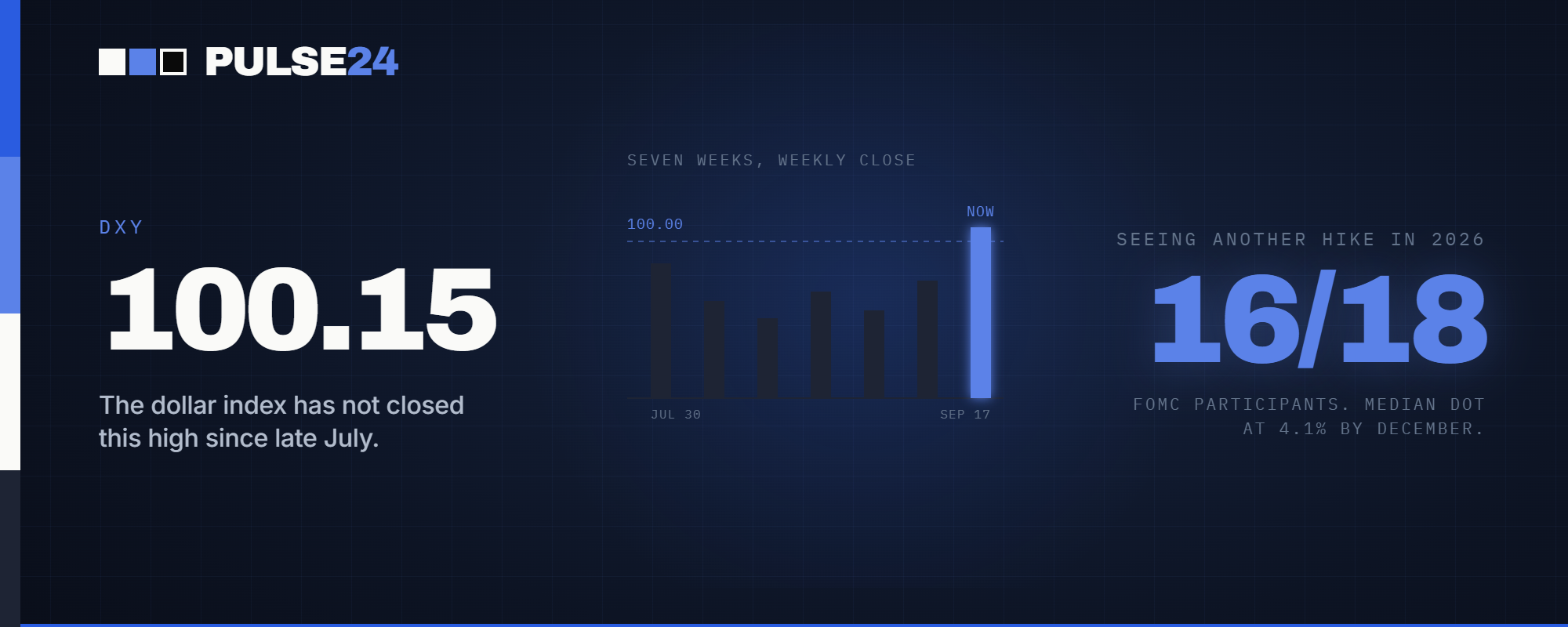
The dollar index broke above 100 for the first time in seven weeks after the Fed's first rate hike in three years, and the move rippled through the franc, the yen, gold and bond yields within hours. Here is what a stronger dollar means heading into the Bank of Japan's decision Friday.
100.15. That is where the U.S. Dollar Index sat Thursday afternoon, a level it had not traded at since late July. The move came less than a day after Federal Reserve Chair Kevin Warsh delivered the central bank's first interest rate increase in three years, lifting the federal funds rate a quarter point to 3.75%-4%. Markets had priced in the hike for weeks. What they had not fully priced in, apparently, was how far the dollar would run once it actually happened.
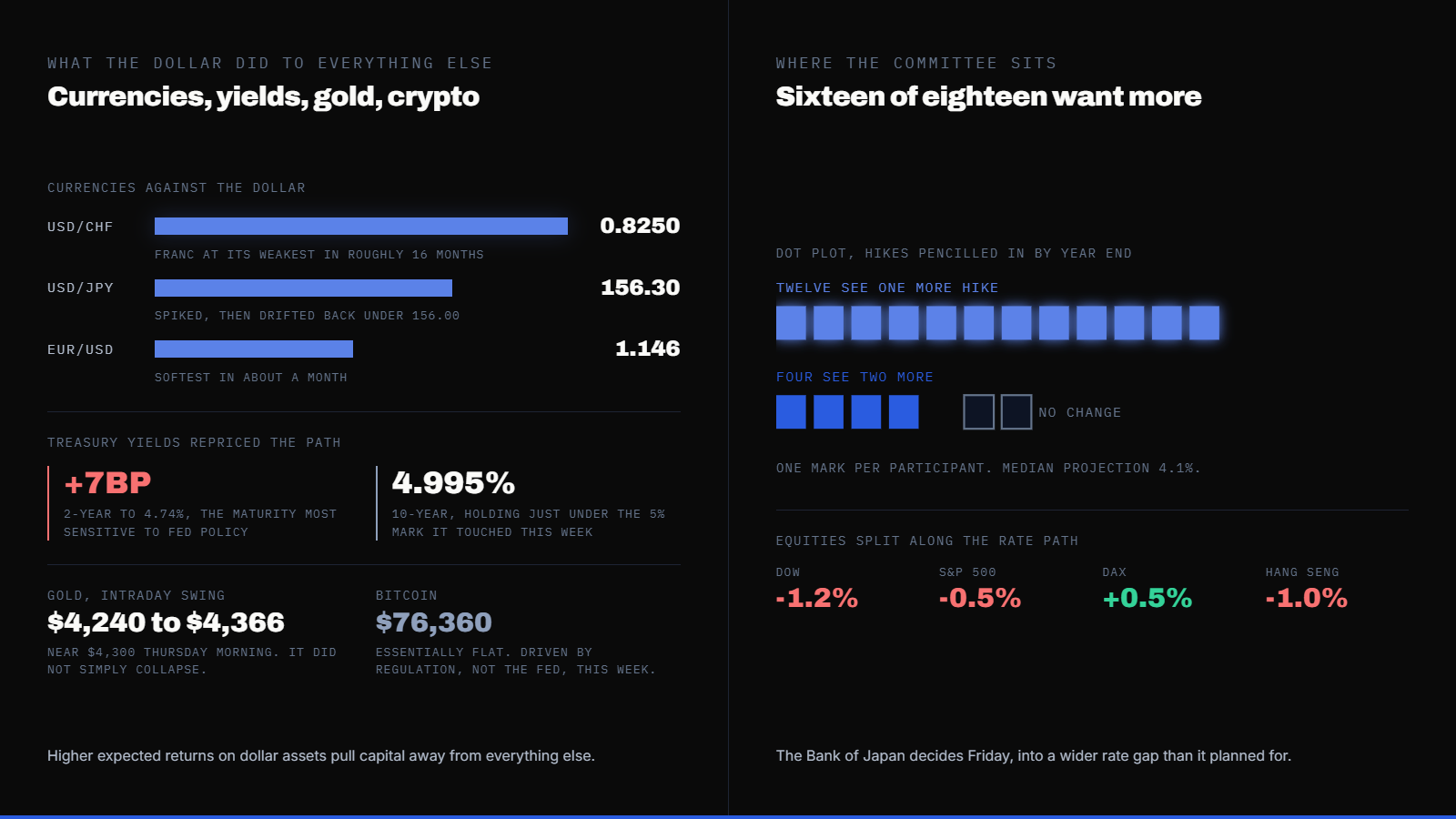
The strength showed up almost everywhere at once. Take the Swiss franc, often treated as a safe-haven alternative to the dollar itself: it slid to its weakest level in roughly 16 months, with USD/CHF pushing above 0.8250. Japan's currency told a similar story in miniature. USD/JPY jumped to 156.30 before drifting back below 156.00 by the afternoon, a round trip that echoes how the yen's six-month high earlier this month already reversed once this week and is now testing investors' patience again. Even the euro joined in, slipping toward $1.146, its softest level in about a month.
What Actually Changed
Start with the vote. Warsh's Federal Open Market Committee approved the hike unanimously, a sharp contrast to July's fractured 9-3 split, and the accompanying dot plot told an even more pointed story than the rate move itself. Sixteen of eighteen participants penciled in at least one additional hike before year-end, with the median projection landing at 4.1%. Twelve saw one more move, four saw two. Only a handful expect the Fed to stay put for the rest of 2026.
That matters because dot plots are supposed to be conservative. When most of a policy committee is willing to put a hike on paper in public, it tends to mean the private conversation runs even more hawkish. Inflation, measured by the Fed's preferred gauge, is now projected to climb to roughly 3.7% by the end of this year before easing toward 2.3% in 2027. Warsh has been blunt that he does not consider current policy restrictive, and a market that spent most of 2025 betting on rate cuts is now recalibrating around the opposite question: how many more increases are coming, and how fast.
Why a Stronger Dollar Ripples Everywhere
A quarter-point hike does not usually move six different asset classes in the same afternoon. A repricing of the entire rate path does. Higher expected returns on dollar assets pull capital away from everything else, which is the mechanical reason the franc, the yen and the euro all weakened at once while Treasury yields climbed. The 2-year yield, the maturity most sensitive to Fed policy, jumped 7 basis points to 4.74%. The 10-year held just under the psychologically important 5% mark that it first touched earlier this week for the first time since 2023, a level that changes the math on everything from mortgage rates to corporate borrowing costs.
Gold's reaction was messier, and arguably more revealing. The metal swung nearly 3% intraday, from $4,240 to $4,366, and was trading around $4,300 as of Thursday morning, still moving. A stronger dollar and higher real yields are normally gold's two biggest headwinds, yet the metal did not simply collapse. That split reaction suggests investors are still hedging against something beyond this single rate decision, whether that is longer-run currency debasement worries, fiscal deficits, or simple uncertainty about how many more hikes are actually coming. Bitcoin, for its part, shrugged. It traded near $76,360, essentially flat on the day, a sign that crypto's recent moves have been driven more by regulatory headlines than by the Fed this particular week.
Equities split along a predictable fault line. Wall Street took the initial hit harder than anyone else, with the Dow falling as much as 1.2% and the S&P 500 down half a percent as the hike and the hawkish dot plot sank in. European indexes shrugged it off by Thursday morning, with the Stoxx Europe 600 and Germany's DAX both up roughly half a percent, insulated for now by the ECB's own, less aggressive rate path. Asian markets were split down the middle: the Nikkei and Kospi edged higher while Hong Kong's Hang Seng fell close to 1%.
What to Watch Next
The next test arrives fast. Japan's central bank meets Friday, one day after the Fed's move, and a stronger dollar makes that decision more complicated, not less. A widening rate gap between the U.S. and Japan is exactly the kind of pressure that reignites the yen carry trade unwind that has rattled markets before. Beyond Friday, watch whether the dollar's strength holds into next week's data, particularly the next PCE inflation reading, which will either validate the Fed's hawkish dot plot or call it premature. Emerging-market currencies and dollar-denominated debt costs are also worth tracking quietly in the background; they rarely make headlines the day a Fed decision lands, but they are usually where a stronger dollar first turns into a real economic story.
The Pulse24 Take
The headline number from this week was always going to be the rate itself: 3.75% to 4%, first hike in three years. But the more useful number for understanding what happens next might be 16 out of 18, the share of Fed officials who are now on record expecting further tightening. Markets do not usually get whipsawed by a quarter point they saw coming for weeks. They get whipsawed by a committee that collectively signals it is not done. That is what pushed the dollar through a level it had not seen since late July, and it is why so many other assets moved in sympathy within hours rather than days. Nothing here demands a dramatic portfolio shift overnight. It does argue for paying closer attention to how much further this dollar strength travels before the next Fed meeting, because that answer will say more about 2027 than Wednesday's vote count ever could.
How we read the data
Curious how we get from raw data to a take like this? Our Trader's Toolkit walks through the tools we lean on.
Explore the Toolkit