Pulse24 Original
The 30-Year Treasury Yield Hit 5.37% This Week, Its Highest Level Since Before the 2008 Crisis. Days Earlier, the Treasury Doubled Its Bond-Buying Support.
September 14, 2026
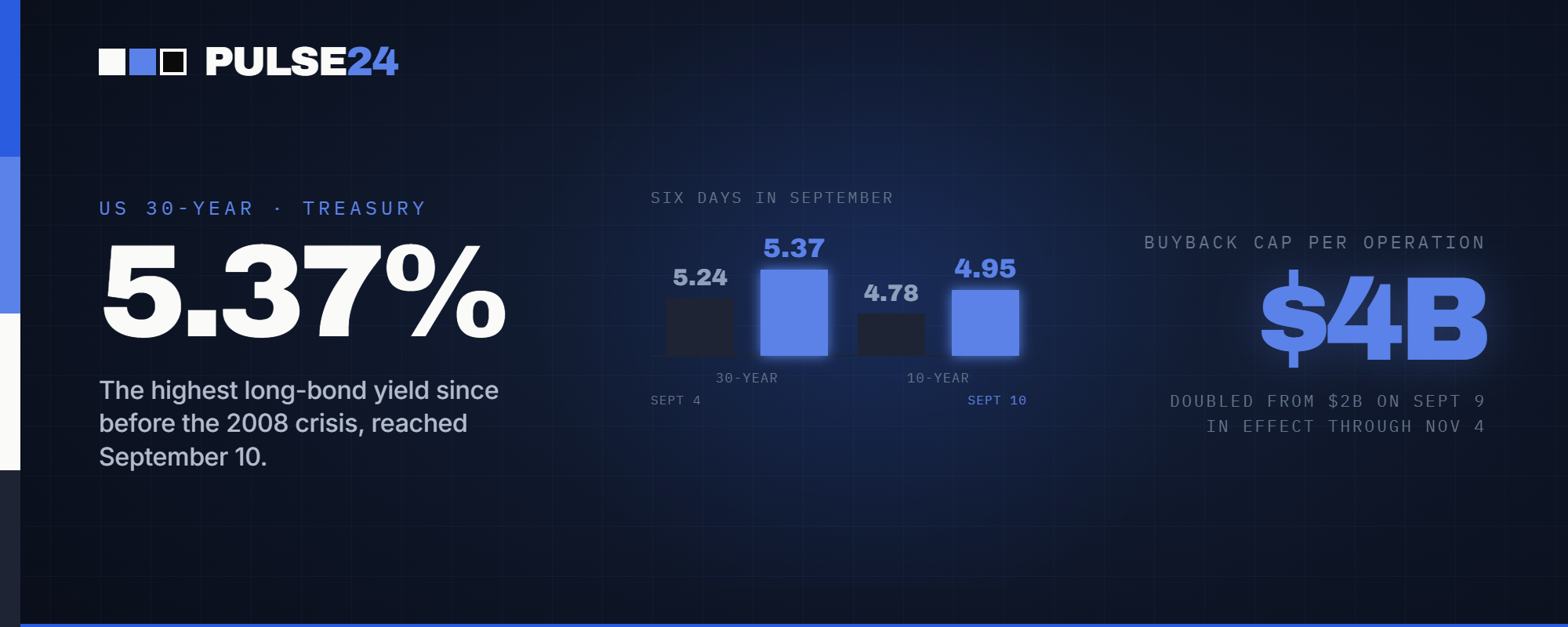
The 30-year Treasury yield hit 5.37% this week, a level unseen since before the 2008 financial crisis, and a weak government auction pushed the Treasury Department to double its own bond-buying support days earlier. Mortgage rates followed the move higher to 6.76%, right as the Fed heads into its own rate decision this week.
The 30-year Treasury yield touched 5.37% on September 10. That's the highest level in nearly two decades, since before the 2008 financial crisis. Six days earlier, on September 4, the same bond yielded 5.24%. Thirteen basis points doesn't sound like much until it shows up in a mortgage quote or a corporate bond desk's pricing model, both of which it did almost immediately.
What Changed
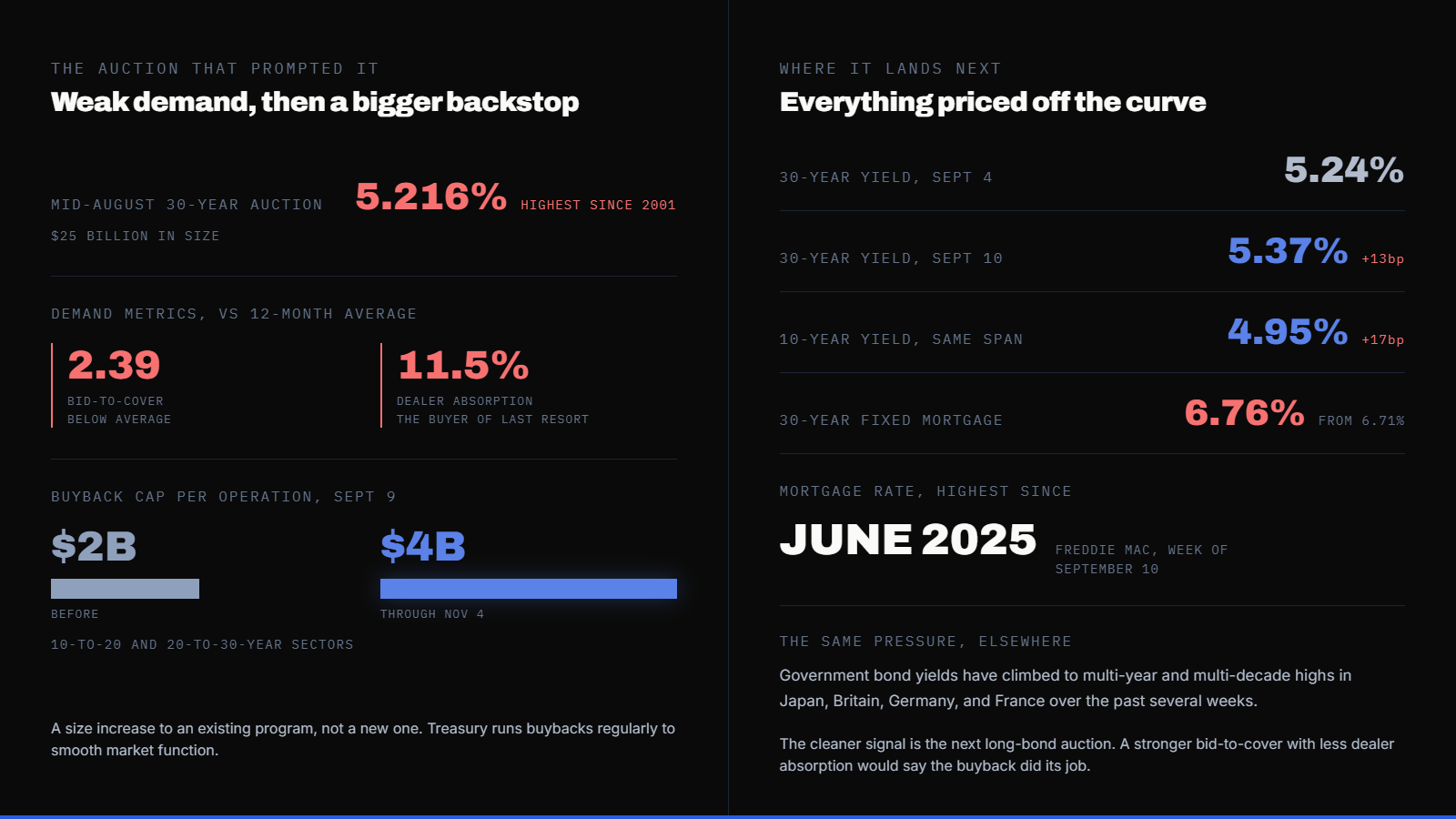
The pressure had been building for weeks before it showed up in that September 10 print. A $25 billion 30-year Treasury auction in mid-August cleared at 5.216%, the highest yield any 30-year auction has fetched since 2001. Demand told its own story. The bid-to-cover ratio came in at 2.39, and primary dealers, the banks obligated to absorb whatever investors don't want, ended up holding 11.5% of the issue. Both figures sat below their trailing 12-month averages, a sign buyers wanted more compensation than the market was offering.
Two days after that August warning sign, and one day before yields reached their September 10 high, the Treasury Department made its move. It doubled the maximum size of its liquidity support buybacks for longer-dated nominal coupon securities, lifting the cap from $2 billion to $4 billion per operation across the 10-to-20-year and 20-to-30-year sectors. The change runs through November 4, the end of the current refunding quarter, and Treasury framed it as support for sectors "where there is consistent strong sponsorship from market participants," bureaucratic language for stepping in as a steadier buyer while the auction calendar works through a rough patch.
Why It Matters
Bond yields this high ripple well outside the Treasury market. The 30-year fixed mortgage rate averaged 6.76% for the week of September 10, according to Freddie Mac, up from 6.71% the week before and the highest reading since June 2025. Homebuilder stocks have already been diverging sharply over exactly this kind of rate pressure, and a mortgage rate that keeps climbing doesn't make that divergence any easier to close. Corporate borrowers feel it too, since investment-grade and high-yield spreads are priced off the same Treasury curve that just moved.
There's also a valuation angle that matters more than most retail investors realize. A higher long-term yield raises the discount rate applied to future corporate earnings, the math that makes richly valued growth stocks, AI infrastructure names among them, more sensitive to a rate move than a utility or a bank would be. None of this is unique to the United States right now. Government bond yields have been climbing to multi-year and multi-decade highs across Japan, Britain, Germany, and France over the past several weeks, and the same forces, growing deficits and buyers demanding more compensation to hold long-dated debt, are showing up in Washington's own auction results.
What to Watch Next
The Federal Reserve's rate decision lands this week, with futures markets pricing a high probability of a hike after core CPI ran hot in August and pushed those odds sharply higher within hours of the report. A hike wouldn't directly explain a 30-year yield move on its own, since long-term yields usually track growth and inflation expectations more than the overnight rate, but a Fed that raises rates while the long end is already under pressure gives bond bears one more reason to stay put.
Auction results are the cleaner signal to watch. If the next round of long-bond sales clears with a stronger bid-to-cover ratio and less dealer absorption than August's, that's a sign the doubled buyback size did its job and demand has stabilized. Weak demand even with Treasury buying more aggressively would point the other way, toward either a further increase to the buyback program or a harder conversation in Washington about the pace of long-term debt issuance itself.
The Pulse24 Take
A buyback program doubling from $2 billion to $4 billion per operation isn't the kind of headline that trends on its own, and it shouldn't be read as an emergency measure. Treasury runs buybacks regularly to smooth market function, and this is a size increase, not a new program. What makes it worth watching is the timing. It arrived within 48 hours of the weakest 30-year auction metrics in a year and the highest 30-year yield since before the 2008 crisis, which makes it less a routine debt-management tweak and more a visible response to a market that needed one.
The bigger picture hasn't changed from what the global bond selloff already showed: buyers everywhere are asking governments to pay more to borrow long-term, and Washington is not exempt just because the dollar is the reserve currency. Treasury can smooth the edges with a larger buyback, and it likely will keep doing so if auctions keep coming in soft. What it can't do is print cheaper long-term borrowing costs into existence. That number gets set by whoever shows up to bid at the next auction, and right now they're asking for more.
How we read the data
Curious how we get from raw data to a take like this? Our Trader's Toolkit walks through the tools we lean on.
Explore the Toolkit