Pulse24 Original
Lennar's Stock Has Fallen 19% This Year. PulteGroup's Is Still Up 5.6%, Even Though Both Sell Into the Same Rate Environment.
September 6, 2026
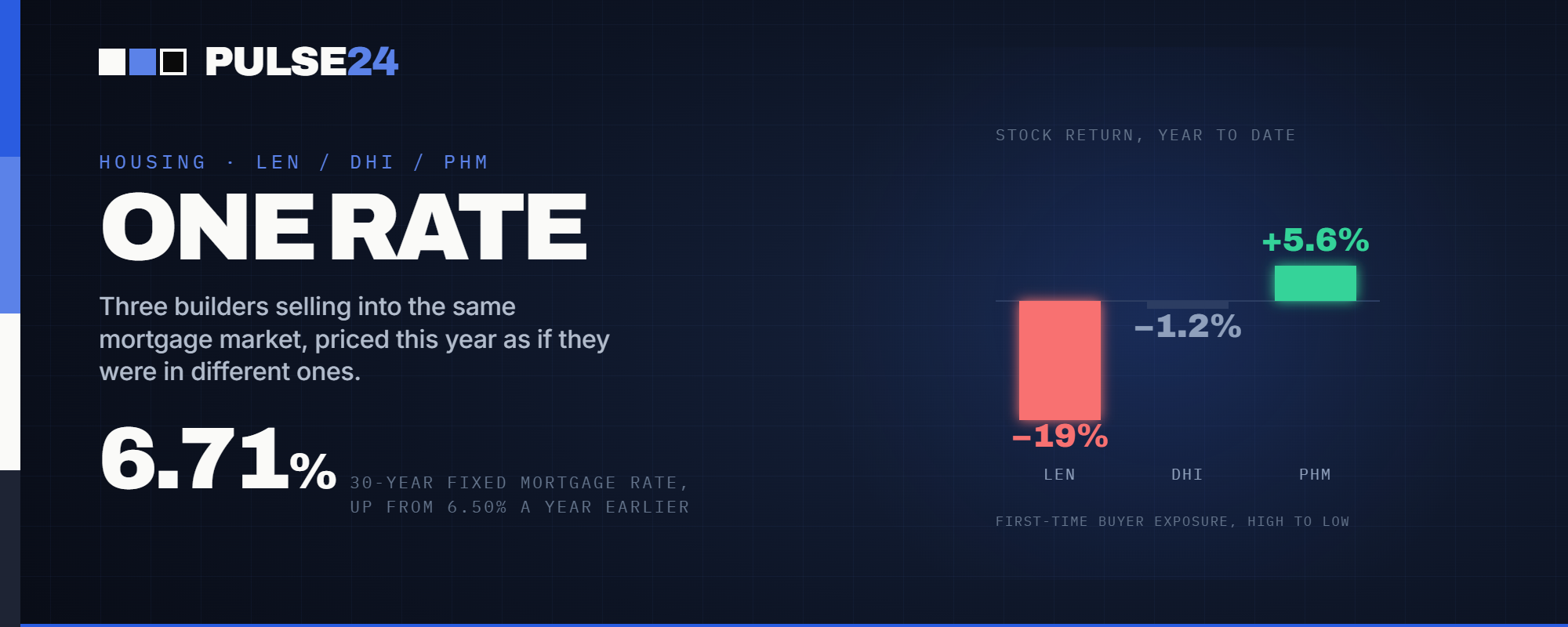
Lennar has lost nearly a fifth of its value this year while PulteGroup is still sitting on a gain, even though both companies are building homes into the same 6.71% mortgage rate. Home Depot and Lowe's just told a similar story from opposite directions, and the split says more about who's positioned for higher-for-longer rates than the bond market move itself.
Lennar has lost about a fifth of its market value so far this year. PulteGroup, building homes into that same national housing market, is still sitting on a gain of roughly 5.6%. Both companies sell new houses to buyers who need a mortgage to close, both are exposed to the same 10-year Treasury yield that sets the price of that mortgage, and yet one stock is down nearly a fifth while the other has held its ground. A single bond market move is landing very differently across companies that, on paper, look like they should be feeling it the same way.
What Changed
The 10-year Treasury yield touched 4.8% this week, its highest level since November 2023 and up sharply from around 4.1% at the start of the year. The 5-year yield, the one lenders lean on most for auto loans, climbed to 4.55% from 3.73% over the same stretch. Neither move happened in isolation. A federal deficit north of $2 trillion, hawkish signals out of a Federal Reserve still working through its response to inflation running above target, and a wave of corporate borrowing to fund AI data centers have all been pulling on the long end of the curve at once.
Mortgage rates track the 10-year yield with a lag, and it shows. Freddie Mac's weekly survey put the 30-year fixed rate at 6.71% this week, up from 6.66% the week before and 6.50% a year ago. The 15-year rate sits at 6.04%. Auto loans track the 5-year more closely, and the average 60-month new car loan now runs close to 7%. That's actually down from a 9.45% panic peak in April, but it's still well above what buyers financing a car five years ago were paying, and it's climbing again as the 5-year yield resumes its move higher.
Why It Matters
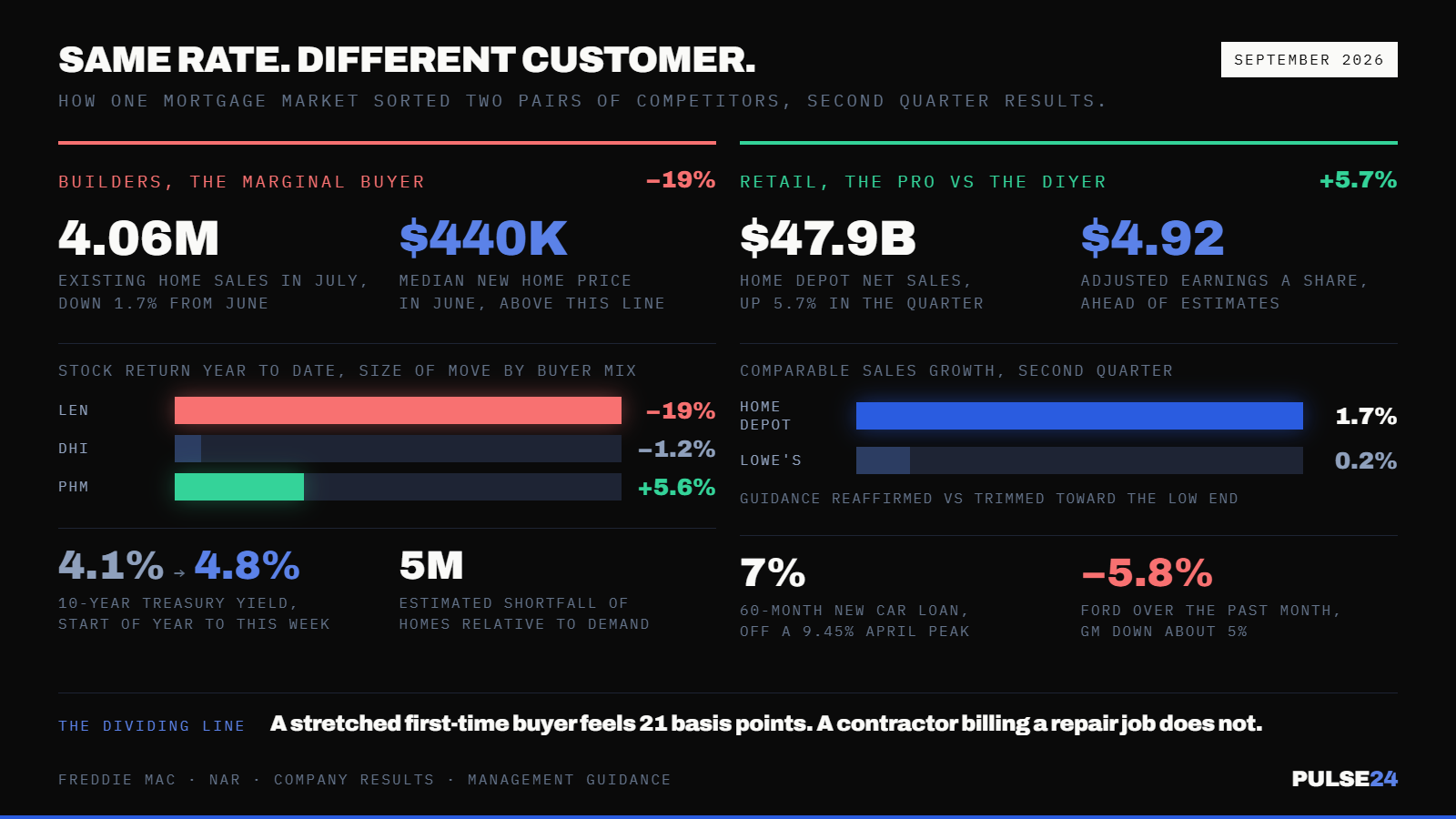
Higher financing costs on cars and homes are a tax on anyone trying to buy either, and the housing side of that tax has been building for a while. The median price of a new home sat above $440,000 in June, and the country is still short an estimated 5 million homes relative to demand. Existing home sales, the resale market where most Americans actually transact, ran at just 4.06 million units annualized in July, down 1.7% from June even though that's up 0.7% from a year earlier. National Association of Realtors chief economist Lawrence Yun put it directly: "there's no doubt that the housing market would be thriving if average mortgage rates were to return near 6%."
That backdrop explains why Lennar and PulteGroup, both selling into the same affordability squeeze, have posted such different results this year. Lennar builds more aggressively into first-time buyer price points, where a move from 6.5% to 6.71% on a mortgage changes the monthly payment enough to price out marginal buyers. PulteGroup's mix skews toward move-up and active-adult buyers who are more likely to be paying cash or carrying more equity from a prior sale, insulating it somewhat from the same rate move. DR Horton sits in between, down about 1.2% for the year. The rate environment is the same for all three. Their exposure to it is not.
Autos are telling a version of the same story. General Motors is down roughly 5% over the past month and Ford about 5.8%, even as Ford's F-Series trucks just hit their highest production output in two years. Higher monthly payments on new vehicles are squeezing the same marginal buyer that higher mortgage payments are squeezing, and the fact that a strong product cycle hasn't been enough to lift either stock says something about how much of this move is about financing costs rather than demand for the vehicles themselves.
Home Depot and Lowe's make the split even clearer, because they sell almost identical products to a similar customer base. Home Depot's second-quarter net sales grew 5.7% to $47.9 billion, comparable sales accelerated to 1.7%, and adjusted earnings of $4.92 a share beat estimates. Management reaffirmed full-year guidance. Lowe's, reporting a few days apart, posted comparable sales growth of just 0.2%, its fifth straight positive quarter but a much thinner one, and trimmed its full-year outlook, narrowing expected adjusted earnings toward the bottom of its prior range. Lowe's CEO Marvin Ellison attributed the gap to "pressure in discretionary DIY spending," even as Pro, online, and home-services sales kept growing, and said he expects the housing market to recover gradually as long as mortgage rates stay elevated near 6.7%. Home Depot's business skews more toward professional contractors and smaller repair projects that don't wait for rates to fall. Lowe's carries more exposure to the kind of big-ticket, discretionary renovation that a rate-squeezed homeowner puts off.
What to Watch Next
The Federal Reserve meets September 15 and 16, and Kevin Warsh's hawkish debut at Jackson Hole is a big part of why traders are now pricing real odds of a rate hike instead of a cut. Whatever the Fed decides at that meeting will move the short end of the curve directly and the long end indirectly, through what it signals about how seriously the central bank is treating inflation that's still running above 2%. Freddie Mac updates its mortgage survey every Thursday, and another leg higher toward 7% would test how much more softening the new-home market can absorb before builders start cutting prices rather than just incentives.
It's also worth watching whether the pattern splitting Lennar from PulteGroup, and Home Depot from Lowe's, holds through the next round of earnings. The same long-end pressure that's setting mortgage rates has been described elsewhere as a story about government deficits and AI-related corporate borrowing competing for the same pool of capital, and that competition isn't going away heading into the fall. If it intensifies, the gap between companies positioned for higher-for-longer rates and those that aren't should widen further, not narrow.
The Pulse24 Take
The easy read on a week like this is that rising rates are bad for anything tied to housing or auto sales, and in aggregate that's true. But averages hide the more useful signal here, which is that the same rate move is sorting companies by how exposed their specific customer actually is. A first-time homebuyer stretching for a starter home feels a move from 6.5% to 6.71% far more acutely than someone trading up with substantial home equity, and a contractor billing a client for a repair doesn't wait for rates to drop the way a homeowner deciding whether to remodel a kitchen does.
For readers trying to position around this rather than just observe it, the more durable question isn't whether the 10-year yield keeps climbing toward 5%. It's which companies in each sector have built a customer base that can absorb higher financing costs and which haven't. Lennar, Lowe's, and Ford are all telling you something about the second group this earnings season. Pay attention to who's still telling a growth story and who's already trimming guidance to match a rate environment that shows no sign of reversing before year-end.
How we read the data
Curious how we get from raw data to a take like this? Our Trader's Toolkit walks through the tools we lean on.
Explore the Toolkit