Pulse24 Original
The 5-Year Treasury Yield Hit 5% This Week for the First Time Since 2007. The 10-Year Is Already Past It.
September 24, 2026
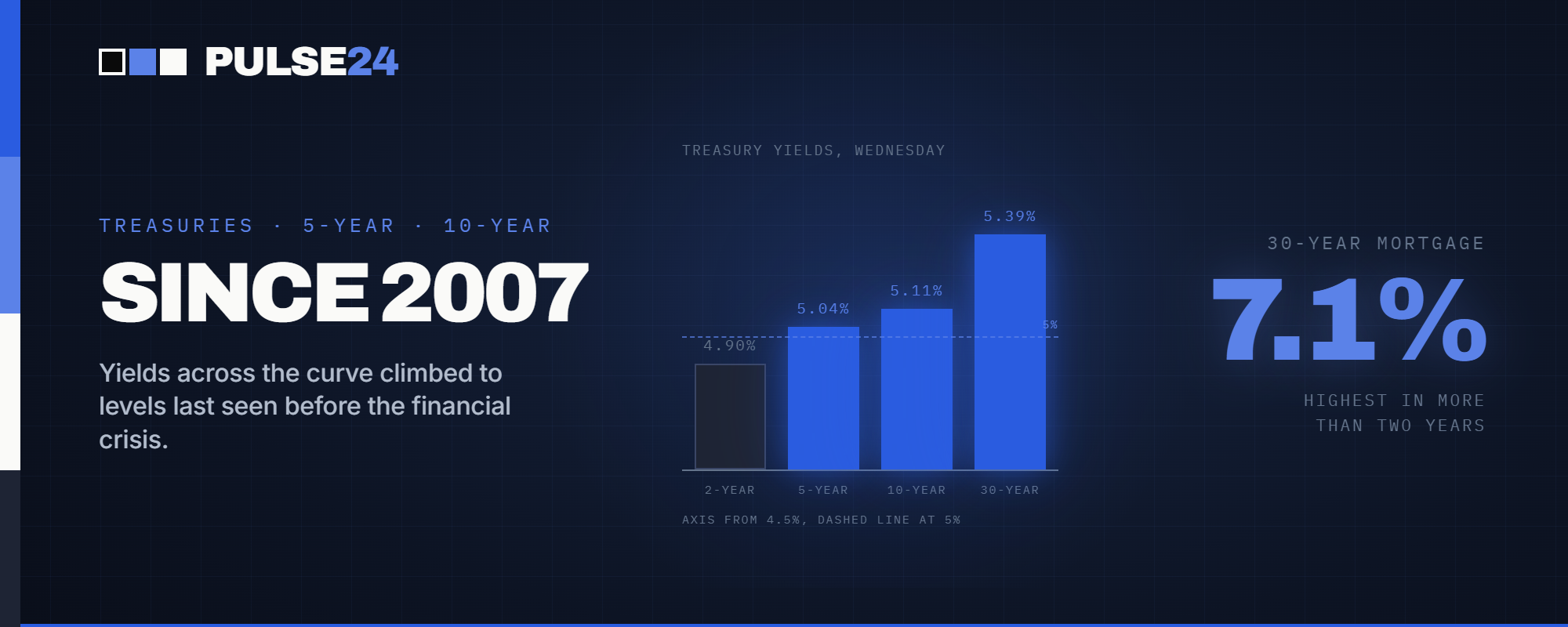
Five-year Treasury yields crossed 5% this week for the first time since 2007, and the 10-year pushed even further into territory last seen before the financial crisis. Hot PMI data and a Fed governor calling for more hikes are behind the move, and mortgage rates are already feeling it.
Five-year Treasury notes yielded just above 5% intraday on Wednesday, a level the bond market hasn't touched since 2007. The 10-year pushed even further past that mark, trading near 5.11%. It first crossed 5% in this cycle the Monday before the Fed's September meeting, when that reading was merely a 2023-era high; this week's move put it somewhere the market hasn't been in almost two decades. Even the 30-year topped 5.39%, and the 2-year, typically the part of the curve most tethered to Fed policy, rose 13 basis points to 4.9%.
What Changed
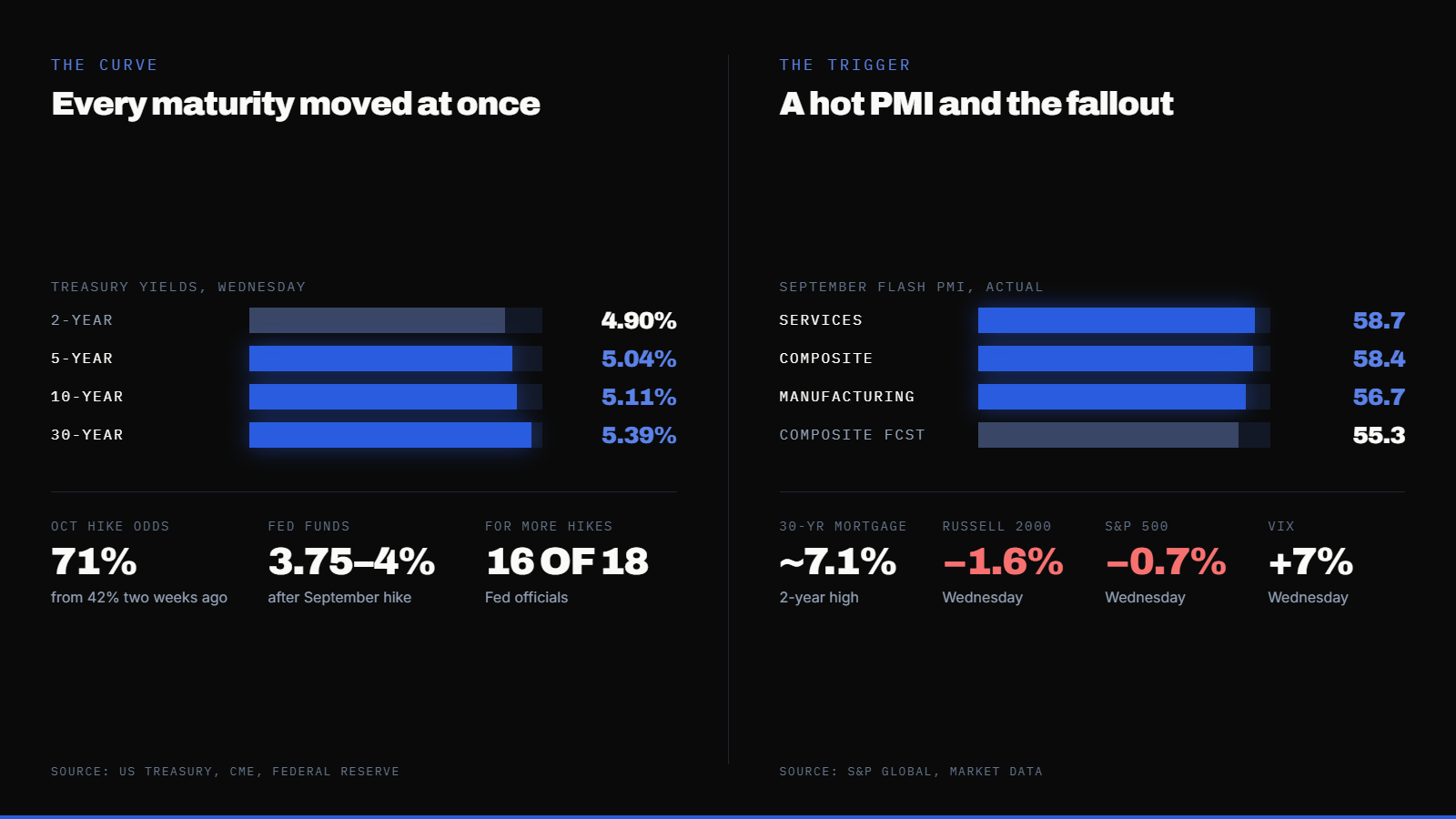
September's flash PMI report gave the bond market its trigger. S&P Global's composite index came in at 58.4, the fastest pace of business activity in more than five years and well above the 55.3 economists expected. Services alone hit 58.7, a 59-month high, while manufacturing reached 56.7, a 53-month high. The survey's own price gauges climbed to their highest reading since October 2022, which is the detail that worried rate traders more than the headline growth number.
That data landed a week after the Federal Reserve unanimously raised its target range to 3.75%-4.00%, its first hike in more than three years. Sixteen of the 18 Fed officials who submit quarterly projections now pencil in at least one more quarter-point increase before year-end, and four of those see room for two. Governor Michael Barr made the committee's reasoning explicit this week, writing that inflation is "above our 2 percent target and not clearly trending toward target in a timely way" and that "in my base case, further policy adjustments are likely to be needed." He pointed to tariffs, ongoing geopolitical disruptions, and a surge in AI-related investment demand as the three forces keeping upward pressure on prices.
Traders responded by pricing a 71% probability of another hike at the October 27-28 meeting, according to CME data. That probability sat at just 42% two weeks ago, before climbing to 58% last week on comments from Fed Chair Kevin Warsh. Barr's remarks and Wednesday's PMI print pushed it higher still, and the reaction shows up across the curve: the 2-year rose to 4.9%, the 5-year crossed 5% for the first time since 2007, and the 10-year and 30-year both pushed to fresh highs of their own. A move that broad, across every maturity at once, usually means traders are repricing the entire path of policy rather than reacting to one number.
Why It Matters
Higher yields ripple outward fastest through housing. The 30-year mortgage rate, which tracks the 10-year Treasury more closely than the fed funds rate itself, is running near 7.1%, its highest level in more than two years. That lands on a housing market that was already struggling. Sales have fallen for three straight months even as inventory topped 1.6 million homes for the first time since 2019, and a mortgage rate back above 7% gives fewer buyers a reason to jump in.
Equities took the more familiar hit. The S&P 500 fell about 0.7% Wednesday, the Nasdaq dropped 1.1%, and the Russell 2000, more sensitive to borrowing costs than the mega-cap names, lost more than 1.6%. The VIX jumped nearly 7%. Energy was the lone S&P sector to close higher, helped by crude trading near $100 a barrel, itself one more input feeding the inflation picture the Fed is watching.
Part of what's pushing yields higher has nothing to do with the Fed at all. The Treasury is issuing more debt to cover a growing deficit, and it isn't the only heavy borrower competing for the same pool of buyers. AI infrastructure companies now account for roughly 19% of new US high-yield bond issuance, and that supply adds to the pressure pushing yields up independent of anything the Fed does at its next meeting.
What to Watch Next
The October 27-28 FOMC meeting is the next scheduled catalyst, and Barr's comments suggest the committee is leaning toward another quarter-point move rather than a pause. Watch the dot plot that accompanies that decision for a signal on 2027, since a Fed that keeps hiking into next year would justify yields staying elevated rather than mean-reverting. Foreign demand at Treasury auctions is worth tracking too, especially after a weak 20-year sale earlier this year raised questions about who's still willing to absorb the growing supply at these yields.
Between now and then, October's PMI reading and the next CPI print will do most of the talking. A composite PMI that cools back toward the mid-50s would ease some of the pressure driving this week's move. Another reading above 58 would likely push October's hike odds closer to a lock.
The Pulse24 Take
It's tempting to read a 2007 comparison as an omen, but the resemblance mostly stops at the yield level. The last time five-year notes traded here, the bond market was pricing housing risk that hadn't shown up in the data yet. This time the move is being driven by an economy growing faster than expected, not one quietly cracking. That's a better problem to have, even if it doesn't feel that way to anyone shopping for a mortgage this week. The bigger question isn't whether yields deserve to be this high given the PMI data. It's whether an economy running this hot forces the Fed to keep hiking well into 2027, a very different environment than the one investors spent most of 2025 planning around. Barr's comments this week suggest the committee thinks so. The October meeting will show whether the rest of the FOMC agrees.
How we read the data
Curious how we get from raw data to a take like this? Our Trader's Toolkit walks through the tools we lean on.
Explore the Toolkit