Pulse24 Original
US Housing Inventory Topped 1.6 Million for the First Time Since 2019. Home Sales Fell for a Third Straight Month.
September 20, 2026
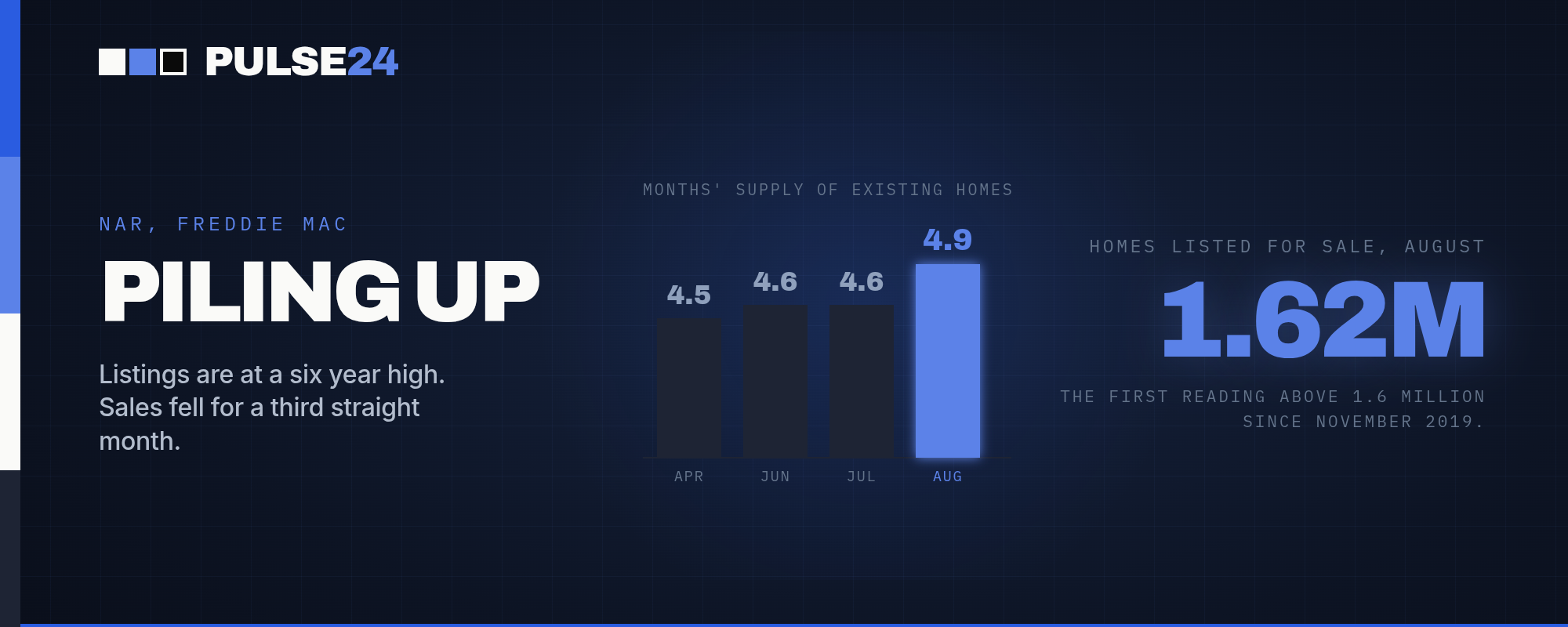
Housing inventory has cleared 1.6 million homes for the first time since 2019, and existing home sales still fell for a third straight month. Mortgage rates near 7% are doing exactly what a hawkish Fed was supposed to do to the most rate sensitive corner of the economy.
Housing inventory in the United States crossed 1.62 million homes in August, the National Association of Realtors reported this month, the first time since November 2019 that the count has topped 1.6 million. Existing home sales fell 2.0% over the same month to a seasonally adjusted annual rate of 3.98 million, the third straight monthly decline. More listings sitting unsold and fewer homes changing hands: normally those two lines move in opposite directions in a healthy market, and lately they've been moving the same way.
What Changed
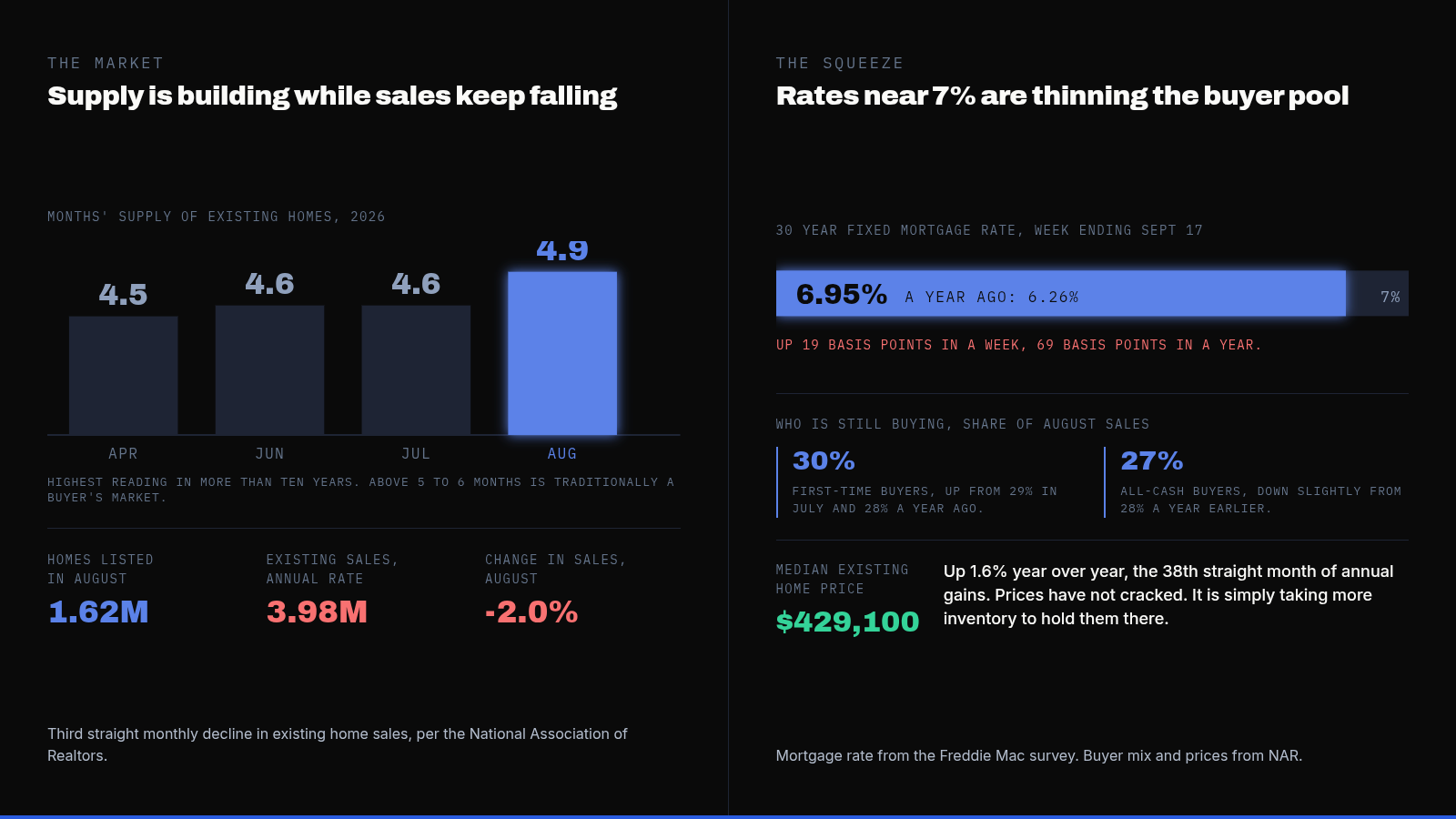
Months' supply, the number of months it would take to sell every home currently listed at the current sales pace, climbed to 4.9 in August. That's up from 4.5 in April, 4.6 in both June and July, and it's the highest reading in more than ten years. A supply figure above five or six months is traditionally considered a buyer's market; below four favors sellers. Five months on its own isn't a crash signal. The direction of travel is what stands out: supply has drifted higher since spring, from 4.5 in April to 4.9 in August, and last month's jump was the sharpest of the stretch.
Prices haven't cracked. The median existing home sold for $429,100 in August, up 1.6% from $422,400 a year earlier and the 38th consecutive month of annual price gains. Days on market held at 31, unchanged from a year ago. First-time buyers made up 30% of transactions, up from 29% in July and 28% a year ago, while all-cash buyers held at 27% of sales, down slightly from 28% a year earlier. Sellers are still getting more than they did last year, on average. It's simply taking more inventory sitting on the market to produce the same result.
Mortgage rates are the mechanism behind most of this. Freddie Mac's survey put the 30 year fixed rate at 6.95% for the week ending September 17, up 19 basis points in a single week and 69 basis points higher than a year ago. That climb tracks the 30 year Treasury yield, which hit its highest level since before the 2008 financial crisis even after the Treasury doubled its bond buybacks in an attempt to hold the long end down. Rates firmed further once Fed Chair Kevin Warsh's first rate hike sent the dollar to a seven week high in a single trading session, and futures markets are currently leaning toward another increase in October.
Why It Matters
Homebuilders are absorbing this unevenly, but none of the three largest builders are having a good year. Lennar is trading near a 52 week low around $76 a share, down roughly 40% over the past twelve months after missing Q3 earnings estimates and cutting its 2026 delivery guidance again. D.R. Horton has fallen close to 20% over the same span and is also drifting toward its own 52 week low. PulteGroup, the steadiest of the group, is still down around 17%. D.R. Horton's own cancellation rate reached 20% last quarter, up from 17% a year earlier and 16% the quarter before, which its own CFO called within its normal historical range even as he pointed to mortgage qualification as the main reason buyers walk away from signed contracts.
Wage growth is doing a lot of the work keeping sales from falling further. Average hourly earnings rose 3.1% in August, according to NAR, which is propping up the buyers who can still qualify at a rate near 7%. But the buyer mix tells its own story: first-time buyers and all-cash buyers together made up 57% of August transactions, with first-time buyers up from a year ago and cash buyers essentially flat to down. A narrower group of cash-rich buyers and stretched first-timers is effectively setting prices for everyone else right now, while move-up buyers who'd need to sell one mortgage to take on another are mostly staying put.
There's a broader read here too. Consumers already feel worse about the economy than they did entering every recession on record, even as their inflation expectations keep climbing. Housing is usually one of the first places that kind of pessimism shows up in hard data, since a home purchase is the most rate sensitive, most deferrable major decision most households make. Regional banks and mortgage originators with concentrated housing exposure are watching the same inventory figures for early signs of stress, particularly in the Northeast, where sales fell 4.0% in August alone.
What to Watch Next
Two things will determine whether this inventory build turns into real price weakness rather than just a slower version of the same market. The first is whether mortgage rates keep climbing or start easing once the Fed's October decision is behind it. A rate anywhere near 7% for another few months would likely push months' supply higher still, since sellers who don't have to move have little reason to trade a 4% mortgage for one near 7%. The second is whether builders start cutting list prices outright rather than leaning on rate buydowns and closing-cost incentives, typically the last lever before headline prices actually fall. The next existing home sales report, covering September, is due out in October. A fourth straight monthly decline would be the clearest signal yet that this is a demand problem rather than a seasonal one.
The Pulse24 Take
Prices are still up year over year, inventory is elevated but nowhere near flooded, and Wall Street's own price targets for homebuilders assume this slowdown passes. Call it a fairly clean demonstration of how a rate sensitive sector responds when the Fed stays hawkish longer than buyers hoped it would. Every basis point Kevin Warsh adds at the front end eventually works its way into the 30 year mortgage rate, and every basis point on that mortgage rate keeps another seller on the sidelines and another buyer priced out. The households still transacting, cash buyers and first-timers stretching to qualify, are effectively setting prices for everyone else at the moment. That's a thinner market than the headline numbers suggest, and thin markets tend to move harder than thick ones once sentiment actually shifts one way or the other.
How we read the data
Curious how we get from raw data to a take like this? Our Trader's Toolkit walks through the tools we lean on.
Explore the Toolkit