Pulse24 Original
The 10-Year and 30-Year Treasury Auctions Went Smoothly This Month. The 20-Year Did Not.
September 20, 2026

Foreign buyers took the smallest share ever recorded of this month's 20-year Treasury auction, even as the same week's 10-year and 30-year sales drew strong demand. The gap raises a real question about who is left to buy America's growing pile of debt at these yields.
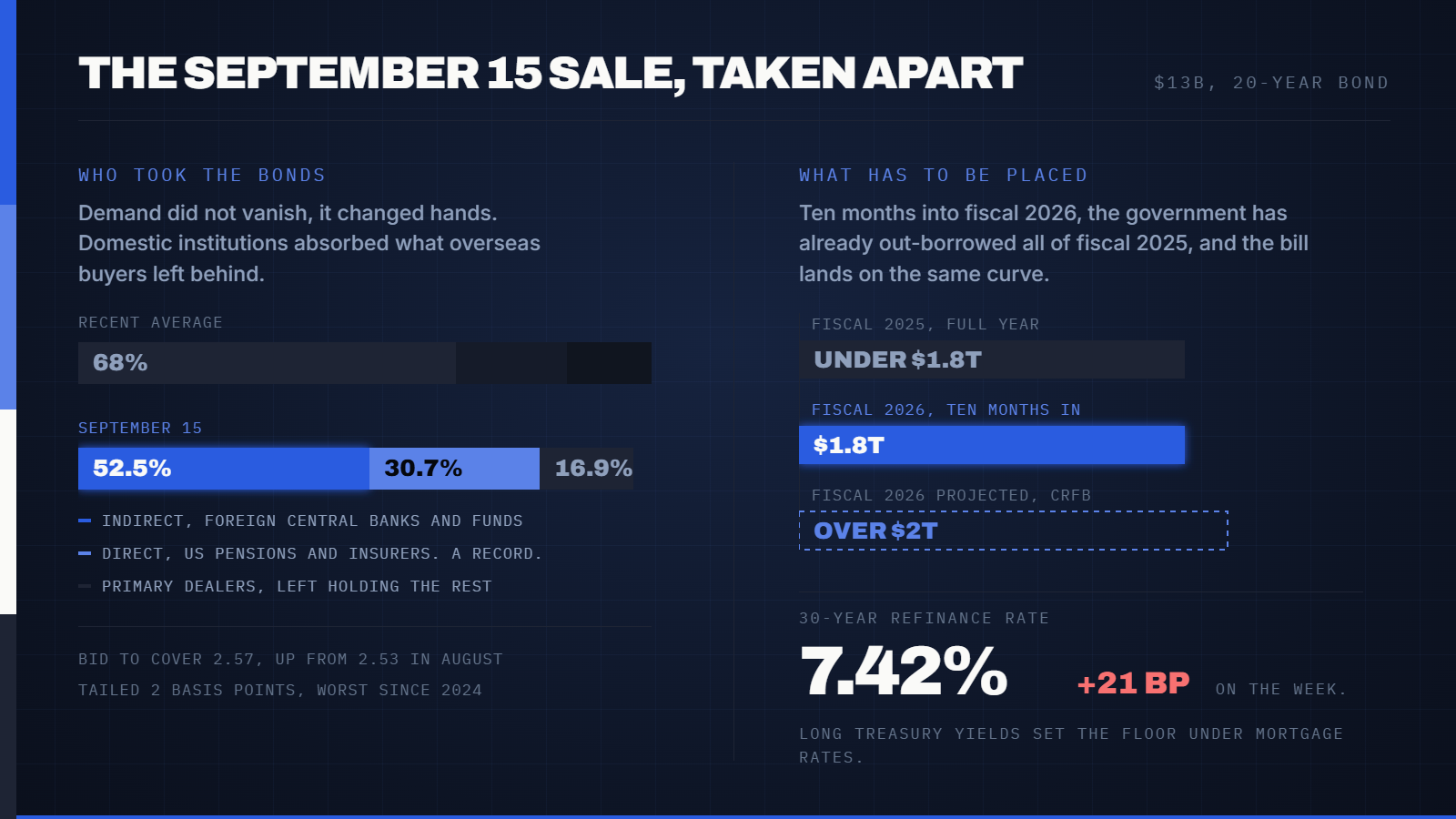
Thirteen billion dollars in new 20-year Treasury bonds went up for sale on September 15, and foreign buyers showed the least interest they ever have for this maturity. Indirect bidders, the Treasury's catchall category for overseas central banks and large international funds, took just 52.5% of the offering, the lowest share in the six years since the 20-year bond was reintroduced. The yield needed to clear the sale came in at 5.42%, a fresh high for the tenor.
Two other auctions earlier that same week told a completely different story. The 10-year note sold on September 9 at a 4.834% yield with indirect bidders taking 79.2% of the offering. The 30-year bond, sold the next day, drew 79.5% indirect demand at a 5.308% yield. Treasury Secretary Scott Bessent had testified only hours before the 20-year sale, telling the House Financial Services Committee that the Treasury had just run two of its most successful bond auctions in 20 years, a comment aimed squarely at those results. The 20-year sale landed that afternoon and undercut the point almost immediately.
What Changed
The bid-to-cover ratio for the 20-year, 2.57, actually rose slightly from August's 2.53, so demand didn't collapse in the way headline coverage suggested. What changed was who showed up to buy. Domestic direct bidders, a category that includes pension funds, insurers and other US institutions buying without a dealer intermediary, took a record 30.7% of the sale. Primary dealers, the banks obligated to bid on every auction whether they want the bonds or not, were left holding 16.9% of the issuance, a share that typically signals unwanted supply rather than natural demand.
The auction also tailed by 2 basis points, meaning the winning yield landed 2 basis points above where the bond was trading in the when issued market just before the sale closed. A tail that size is the worst this maturity has produced since 2024. The timing made it more notable, not less. The Fed's own rate decision landed the very next day, a hike to a range of 3.75% to 4.00% and its first increase in three years, and the Bank of Japan followed within 48 hours with a hike of its own, to a 31-year high. Foreign buyers pulled back from the long end of the Treasury curve in the very week two of the world's largest central banks were about to raise short-term rates, not after.
Why It Matters
None of this is happening against a quiet fiscal backdrop. The US has borrowed $1.8 trillion in the first ten months of fiscal 2026, more than the entire government borrowed in all of fiscal 2025, according to the Committee for a Responsible Federal Budget. At the current pace, full year borrowing will clear $2 trillion. Every dollar of that needs a buyer somewhere, and the 20-year has structurally been the least popular slot on the curve since its reintroduction: too long for banks managing short duration liabilities, too short to match the appetite of pension funds and insurers that prefer 30-year paper. A widening deficit means more of every maturity needs buyers, and this auction is a reminder that the 20-year's usual buyer base doesn't stretch as far as the Treasury needs it to.
The mortgage market felt it within days. The average 30-year refinance rate rose to 7.42% this week, up 21 basis points from the prior week. Long-term Treasury yields set the floor under mortgage rates, and an auction that needs a higher yield to clear pulls that floor up along with it, regardless of what the Fed does with short-term rates. That's the mechanism connecting a bond auction most people never hear about to a monthly mortgage payment.
What to Watch Next
Watch whether domestic buyers keep filling in for foreign demand at the next 20-year sale in October, or whether the Treasury has to offer a still higher yield to draw international buyers back. A second consecutive weak indirect showing would be harder to wave off than a single data point. Also watch primary dealer inventory: banks holding an unusually large share of recent issuance typically try to work it off in the secondary market over the following weeks, and heavy selling there can pressure yields further without a new auction. Finally, keep an eye on whether the 10-year yield revisits the 5% level it hit earlier this month; a return to that level alongside continued weak 20-year demand would suggest this is a durable repricing of US term premium rather than a one auction blip.
The Pulse24 Take
One weak auction isn't a crisis, and the 20-year has always been the market's least loved maturity, so some caution is warranted before reading too much into a single data point. The pattern matters more than any one auction, though. The deficit is on pace to top $2 trillion this year, and the Fed just resumed hiking on top of it. Increasingly, it's domestic buyers stepping in where foreign central banks used to be reliable participants. Bessent's own plan leans on stablecoins soaking up trillions in Treasury demand by 2030, which says something about how seriously Washington already takes this gap. Until a structural buyer like that shows up at scale, every auction where foreign demand disappoints will keep asking the same question: who buys America's debt, and at what yield do they agree to do it.
How we read the data
Curious how we get from raw data to a take like this? Our Trader's Toolkit walks through the tools we lean on.
Explore the Toolkit