Pulse24 Original
Scott Bessent Wants Stablecoins to Buy $3 Trillion in Treasuries by 2030. The Market Shrank This Summer Instead.
September 16, 2026
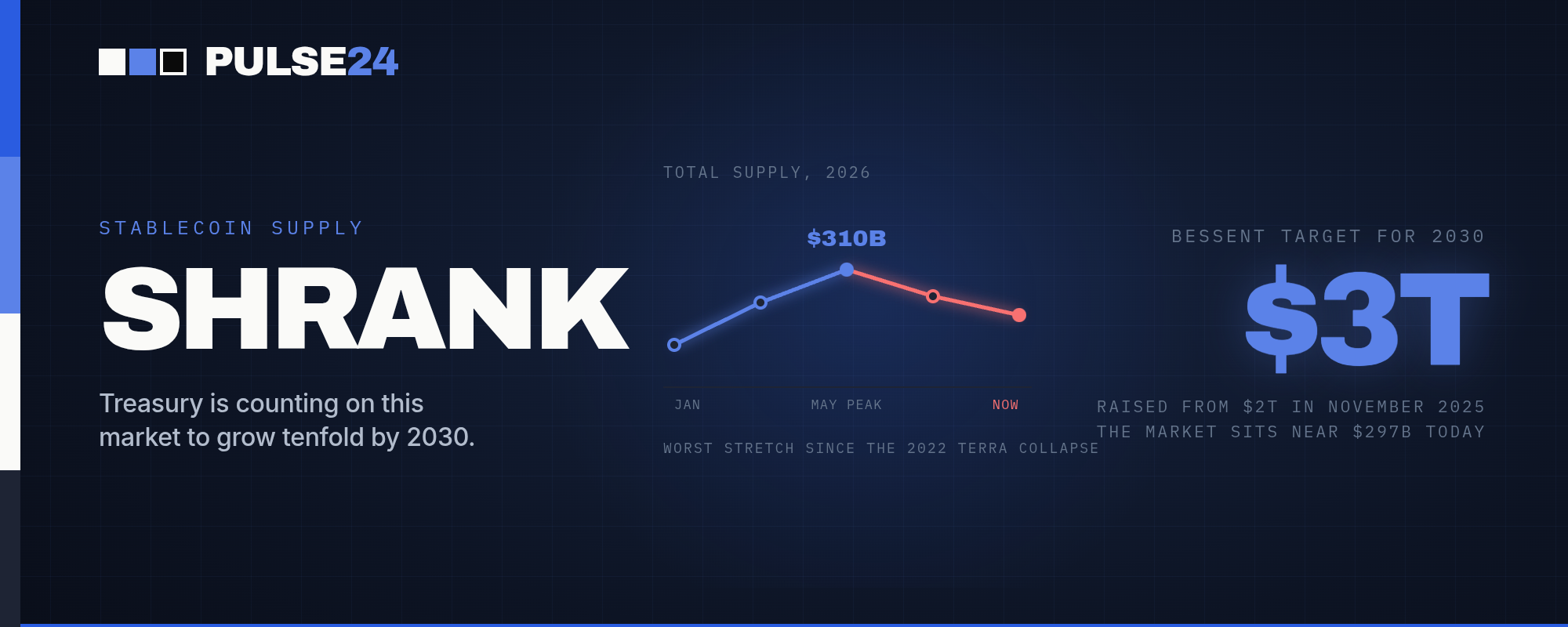
Scott Bessent wants stablecoins to become one of the biggest new buyers of U.S. government debt, growing tenfold to $3 trillion by 2030. The market he's counting on shrank instead this summer, its worst stretch since the 2022 Terra collapse.
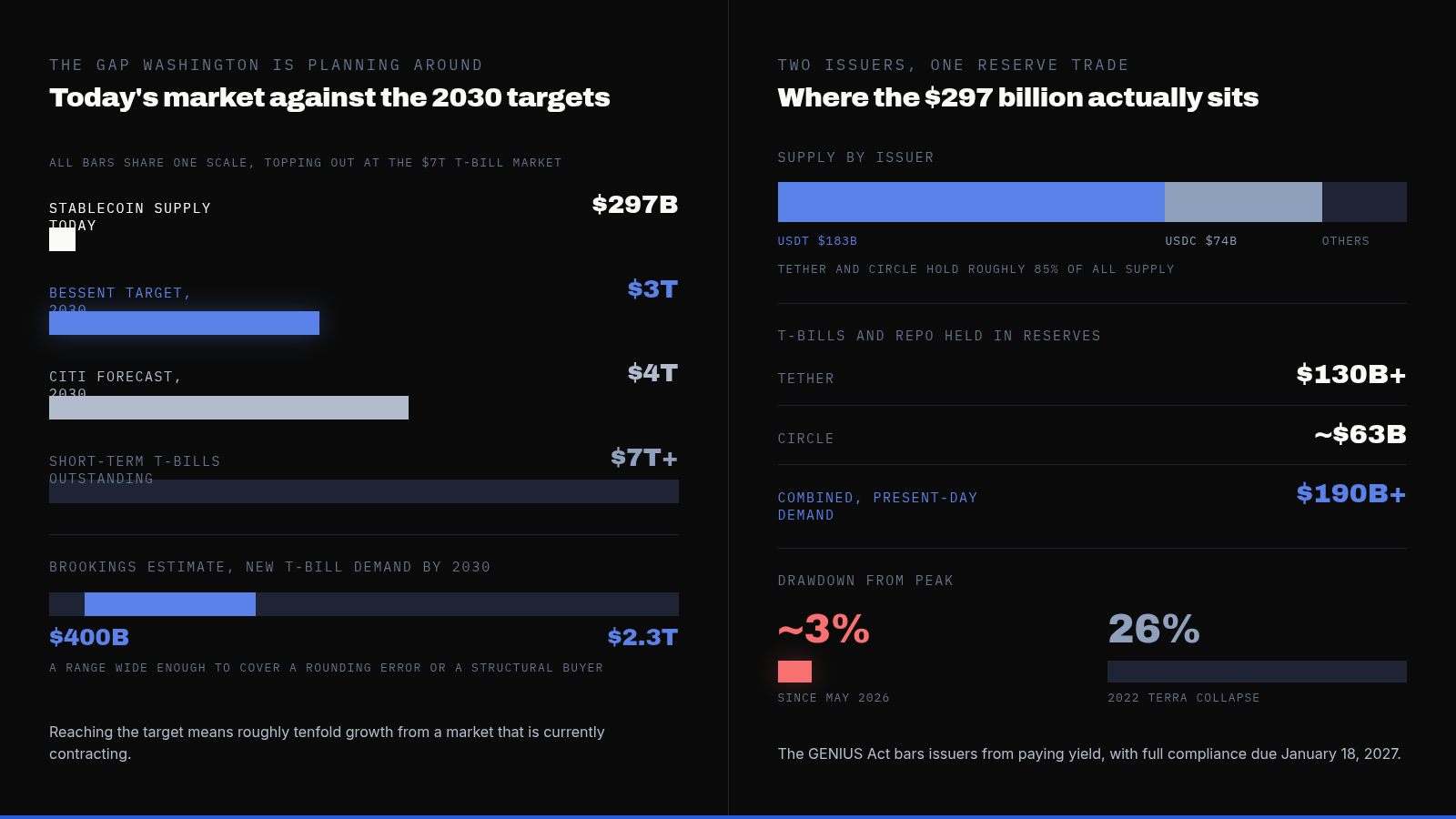
Tether's USDT has slipped to roughly $183 billion, down from close to $190 billion back in May. Circle's USDC sits near $74 billion, off its own spring high by about $6 billion. Add up every stablecoin in circulation and the total sits somewhere between $291 billion and $303 billion this week, depending on which tracker you check, versus a peak above $310 billion five months ago. That's a modest pullback in isolation. It becomes more interesting set against what Washington is counting on this market to do next.
The reason a stablecoin's balance sheet has become a macro story at all traces back to the GENIUS Act, signed into law in July 2025. The law requires issuers to hold reserves almost entirely in cash, Federal Reserve balances, insured bank deposits, short-dated Treasuries, repo agreements, or government money market funds. It also bars issuers from paying holders any interest on their tokens, a provision that was central to how the bill won support from banks worried about deposit flight. Every dollar that flows into a compliant stablecoin, in other words, is a dollar that flows fairly directly into some corner of the Treasury market.
What Changed
Treasury Secretary Scott Bessent has leaned hard on that mechanism as part of his broader plan for financing a growing pile of federal debt. In November 2025, he raised his own stablecoin growth target from $2 trillion to $3 trillion by 2030, framing it as the sector growing roughly tenfold from where it stood at the time. Citi has floated an even higher number, raising its own forecast to $4 trillion by 2030 in a research note. The pitch, repeated in Bessent's public remarks and on his own social media, was straightforward: pass a clear regulatory framework, and private capital would rush in to build a market that just happens to buy a lot of government debt along the way.
The market's actual behavior since GENIUS Act passage complicates that pitch. Stablecoin supply grew for most of 2025 and into early 2026, then peaked in May and has struggled to reclaim that level since, according to data compiled by CoinDesk and KuCoin. The decline is not dramatic on its own; Wincent's Paul Howard called the roughly 3% pullback "a relatively small pullback in what we believe is a long-term growth market," a fraction of the 26% the sector lost during 2022's Terra collapse. But it is the first sustained stall since the law that was supposed to unlock a decade of growth actually took effect, and analysts are starting to ask whether the yield ban that helped pass the bill is now working against the growth the bill was meant to produce.
Why It Matters
Tether's own attestations show more than $130 billion parked in Treasury bills and repo agreements, with Circle holding a similar concentration, around $63 billion, in its own reserves. That is real, present-day demand for government paper, not a projection. Outstanding short-term Treasury bills already total more than $7 trillion, so the current stablecoin sector is a meaningful but not decisive buyer of that market on its own. The scale Bessent is describing would change that. Brookings researchers Nellie Liang and Brent Neiman estimated in August that stablecoin growth could generate anywhere from $400 billion to $2.3 trillion in new Treasury bill demand by 2030, a range wide enough to cover both a rounding error for the Treasury market and a genuinely important new source of financing.
Washington has other levers for managing a debt load that keeps growing regardless of what stablecoins do. The Treasury has already doubled its own bond-buyback program to support demand at the long end of the curve, a sign that officials are not waiting on any single buyer, private or public, to solve the problem. A stalling stablecoin sector does not derail that broader strategy. It does undercut one of the more optimistic assumptions built into how officials talk about it.
What to Watch Next
Market share within the stablecoin sector is shifting even as the total shrinks. Newer regulated entrants, including Paxos-backed Global Dollar's USDG, have been gaining ground on Tether and Circle's roughly 85% combined share, a sign that competition rather than a categorical loss of appetite may explain part of the pullback. Whether that share shift continues, or whether it's accompanied by renewed growth in the total pool, is worth tracking over the next few quarters.
Congress's other major piece of unfinished crypto legislation is also part of this picture. The CLARITY Act, covering broader crypto market structure, has been stuck waiting on Senate votes for over a year, and its fate could shape how much additional institutional money is comfortable entering stablecoin-adjacent markets at all. Watch too for whether this week's Fed decision, and the path of short-term rates from here, changes the calculus for banks and money-market funds that compete with stablecoin issuers for the same pool of short-duration Treasury demand.
The Pulse24 Take
None of this means Bessent's bet is wrong. A 3% pullback from a May peak is not evidence that stablecoins have stopped being useful, and the underlying case for regulated dollar tokens as payment rails has not really changed since GENIUS Act passed. What has changed is that the thesis now has to survive contact with an actual market cycle rather than just legislative momentum and bullish projections.
A financing plan that assumes tenfold growth over five years can absorb a quarter or two of stalling out. It has less room for a pattern. The next few Treasury refunding announcements, and whether officials keep citing stablecoins as a structural buyer of debt or quietly stop mentioning the number, will say more about how seriously Washington still believes its own math than any single month of stablecoin data can.
How we read the data
Curious how we get from raw data to a take like this? Our Trader's Toolkit walks through the tools we lean on.
Explore the Toolkit