Pulse24 Original
Crypto's Rulebook Bill Needs Seven Democratic Votes Tuesday. It's Been Waiting Fourteen Months for Them.
September 15, 2026
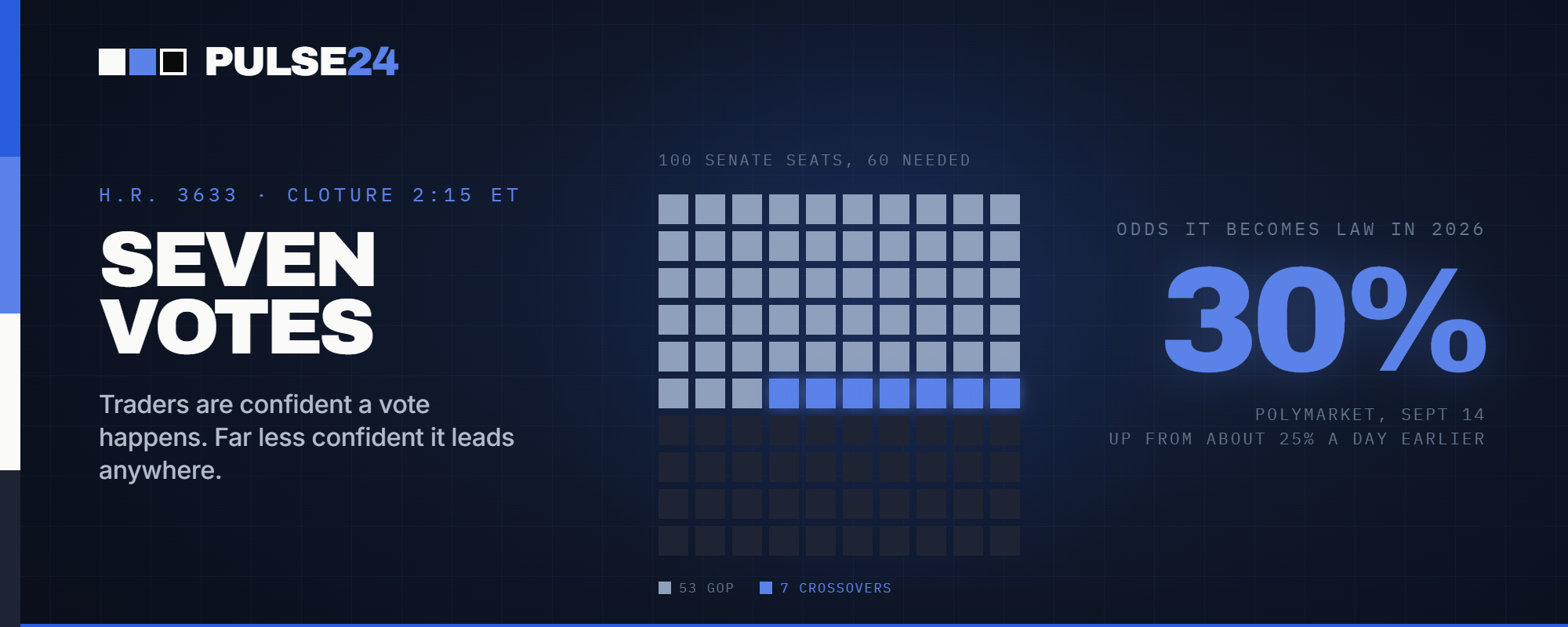
The Senate holds a cloture vote Tuesday on crypto's biggest regulatory bill in over a year, and prediction markets say a floor vote is nearly certain while actual passage odds, though rising fast this week, sit closer to three in ten. Seven Democratic or independent votes stand between the CLARITY Act and its first real test since Pulse24 tracked its August delay.
At 2:15 p.m. Eastern on Tuesday, the Senate takes up a procedural motion crypto markets have been pricing for more than a year. It is the cloture vote on H.R. 3633, the Digital Asset Market Clarity Act, and it needs 60 votes just to open formal debate.
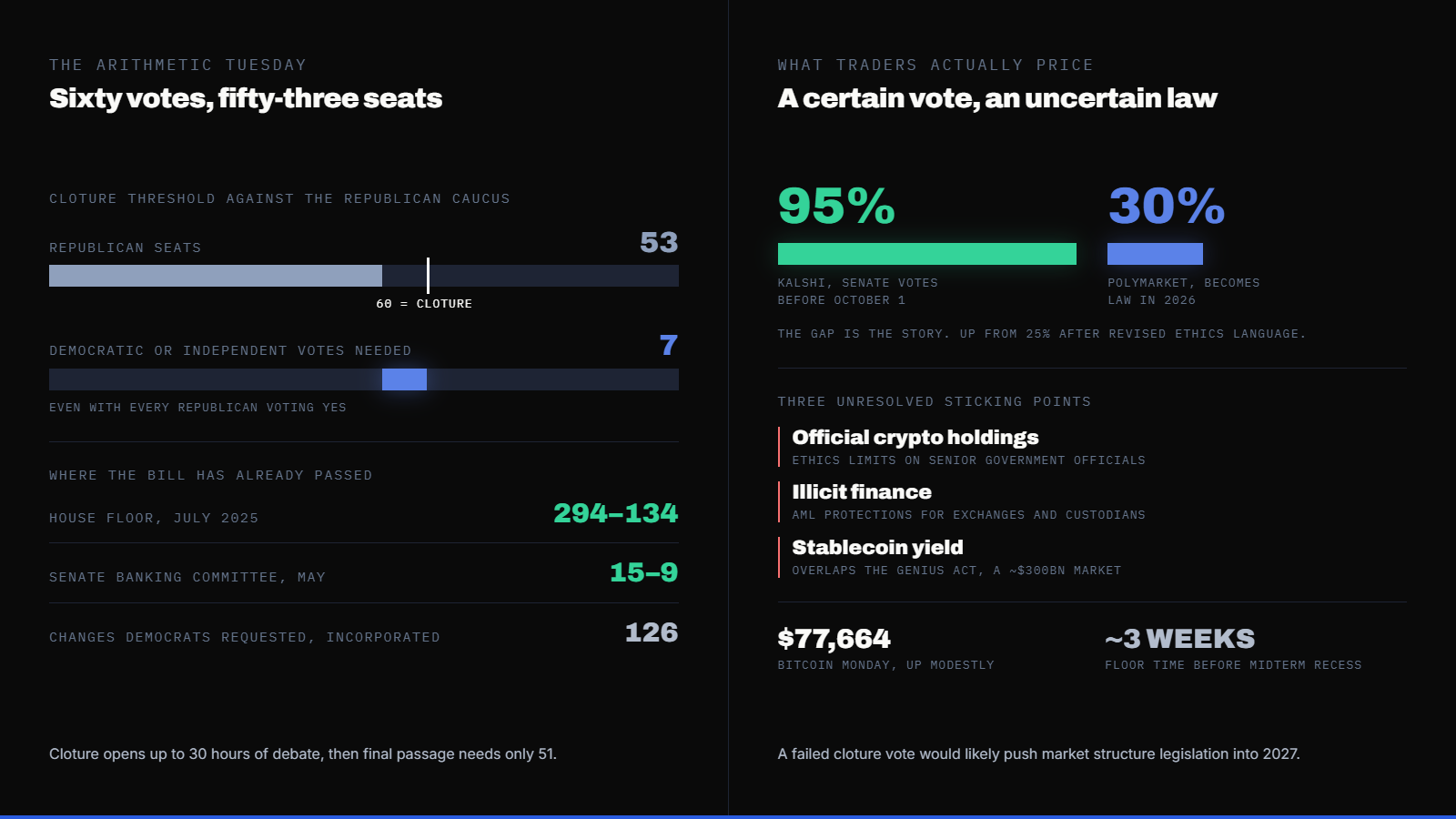
Sixty votes is a tall order in a chamber Republicans control 53 to 47, counting the two independents who caucus with Democrats. Every Republican voting yes still leaves supporters seven votes short, and Senate Majority Leader John Thune filed the cloture motion knowing that math going in.
This is not a new storyline for Pulse24 readers. The bill missed its last pre-recess window on August 10, pushed to September even as Bitcoin ETFs pulled in $853 million that same week. Eleven days later, a short squeeze sent Bitcoin from about $62,884 to $75,000 in five trading days, a rally that lined up partly with renewed momentum behind the bill. By late August, Coinbase had gained 25.6% in a single week, even as the legislation both major exchanges are waiting on slipped toward September again.
What Changed
Thune filed the underlying cloture motion in early August, after Sen. Cynthia Lummis first released a combined Senate text on July 22 merging the Banking and Agriculture committees' work. Lummis, Banking Committee Chair Tim Scott, and Agriculture Committee Chair John Boozman followed with a final version on September 14, one day before the vote, that the senators said incorporates 126 substantive changes requested by Democrats, including new ethics provisions. The bill would settle a jurisdictional question that has shadowed crypto regulation for years: which digital assets and exchanges answer to the Securities and Exchange Commission, and which answer to the Commodity Futures Trading Commission. SEC Chair Paul Atkins has backed the framework publicly. The House already passed its own version in July 2025 by a lopsided 294 to 134 vote, and the Senate Banking Committee cleared a companion text 15 to 9 in May.
Three issues have kept negotiators apart since then. One is ethics language limiting how senior government officials can hold or promote crypto projects. A second covers anti-money-laundering and illicit-finance protections for exchanges and custodians. A third governs how stablecoin issuers can pay yield to holders, a question that overlaps with, but sits outside, the GENIUS Act, the stablecoin-specific law already in effect governing a market now worth roughly $300 billion.
Why It Matters
A cloture vote is not a final passage vote, and the space between those two numbers is where this story gets interesting. A Kalshi contract asking whether the Senate votes on the CLARITY Act before October 1 traded near 95% earlier this month, reflecting how firmly Tuesday's date had been locked in. Polymarket's odds of the bill actually becoming law in 2026 jumped to roughly 30% on September 14, up from about 25% a day earlier, after Senate Republicans released revised ethics language over the weekend that traders read as improving the bill's chances. Traders are confident a vote happens. They are far less confident it leads anywhere.
That gap matters for anyone treating regulatory clarity as a catalyst. Even a successful cloture vote only opens up to 30 hours of floor debate, followed by a simple 51-vote threshold for final passage, leaving room for amendments to reshape or sink the bill after Tuesday. A failed cloture vote would be the cleaner outcome to read, and the worse one for the industry: with roughly three weeks of Senate floor time left before lawmakers break for the midterm recess, backers would likely need to restart the process in 2027.
Bitcoin itself was trading near $77,664 on Monday, up modestly on the day, a sign markets are not bracing for a dramatic move in either direction ahead of Tuesday's vote.
What to Watch Next
The number worth watching Tuesday afternoon is the actual vote count, not just whether cloture passes or fails. The same seven or so Democratic and independent votes needed to clear 60 will likely resurface in the final passage math if the bill advances, so which senators cross over matters more than the top-line result.
Beyond the vote itself, watch whether the ethics and anti-money-laundering provisions get a public compromise text if cloture succeeds. Both were named as the main reasons the July committee markup and the original August floor attempt stalled, and neither has an obvious fix circulating publicly yet.
Exchange-adjacent stocks and stablecoin issuers are likely to carry the clearer market signal, more than Bitcoin's spot price on its own. Coinbase's 25.6% rally in late August happened alongside CLARITY Act momentum rather than any single headline, and a similar pattern could show up again regardless of which way Tuesday goes.
The Pulse24 Take
Regulatory clarity has become an odd kind of catalyst in crypto: priced in gradually, referenced in nearly every rally over the past year, and still not delivered. That is the backdrop Tuesday's vote walks into, and it is worth being precise about what a cloture win would and would not mean. A yes on cloture would unlock the amendment process the bill has been denied twice already, which counts as real progress, though it would not by itself hand the industry the rulebook it has been asking for.
The more useful number here is not the cloture outcome on its own. It is the gap between a near-certain vote and odds of an actual law that, even after this week's jump, sit closer to three in ten than to even money, since that gap says how much uncertainty survives even the best case Tuesday could produce. Headlines framing a successful cloture vote as clarity arriving will likely overstate what a procedural win actually delivers.
The underlying disagreement has narrowed since last year, even if it has not closed. The House passed its version by a wide bipartisan margin, Banking Committee Republicans and Democrats found enough common ground to move a text out of committee 15 to 9, and the SEC chair has publicly backed the framework. Investors trying to position around crypto policy risk are better served tracking the specific ethics and stablecoin-yield language than the vote count on any single Tuesday.
How we read the data
Curious how we get from raw data to a take like this? Our Trader's Toolkit walks through the tools we lean on.
Explore the Toolkit