Pulse24 Original
Bitcoin Just Jumped From $62,884 to $75,000 in Five Days. More Than $2.7 Billion in Short Positions Got Liquidated Along the Way.
August 21, 2026
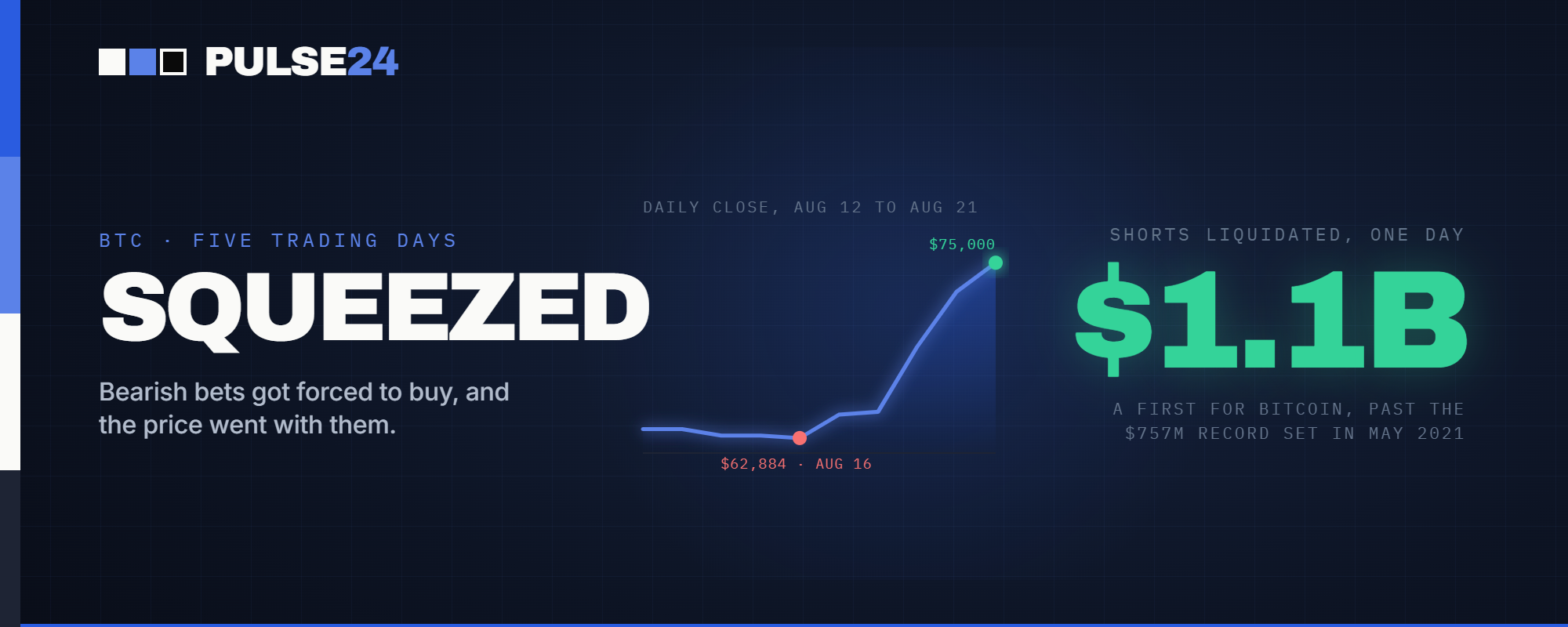
Bitcoin surged roughly 19% in five trading days, from an August 16 low near $62,884 to about $75,000, after a one hour short squeeze on August 19 forced more than a billion dollars of bearish bets to cover. A Clarity Act push from President Trump, returning ETF inflows, and the Treasury's bigger bond buybacks lined up at nearly the same moment, though the rally's technicals are already flashing overbought.
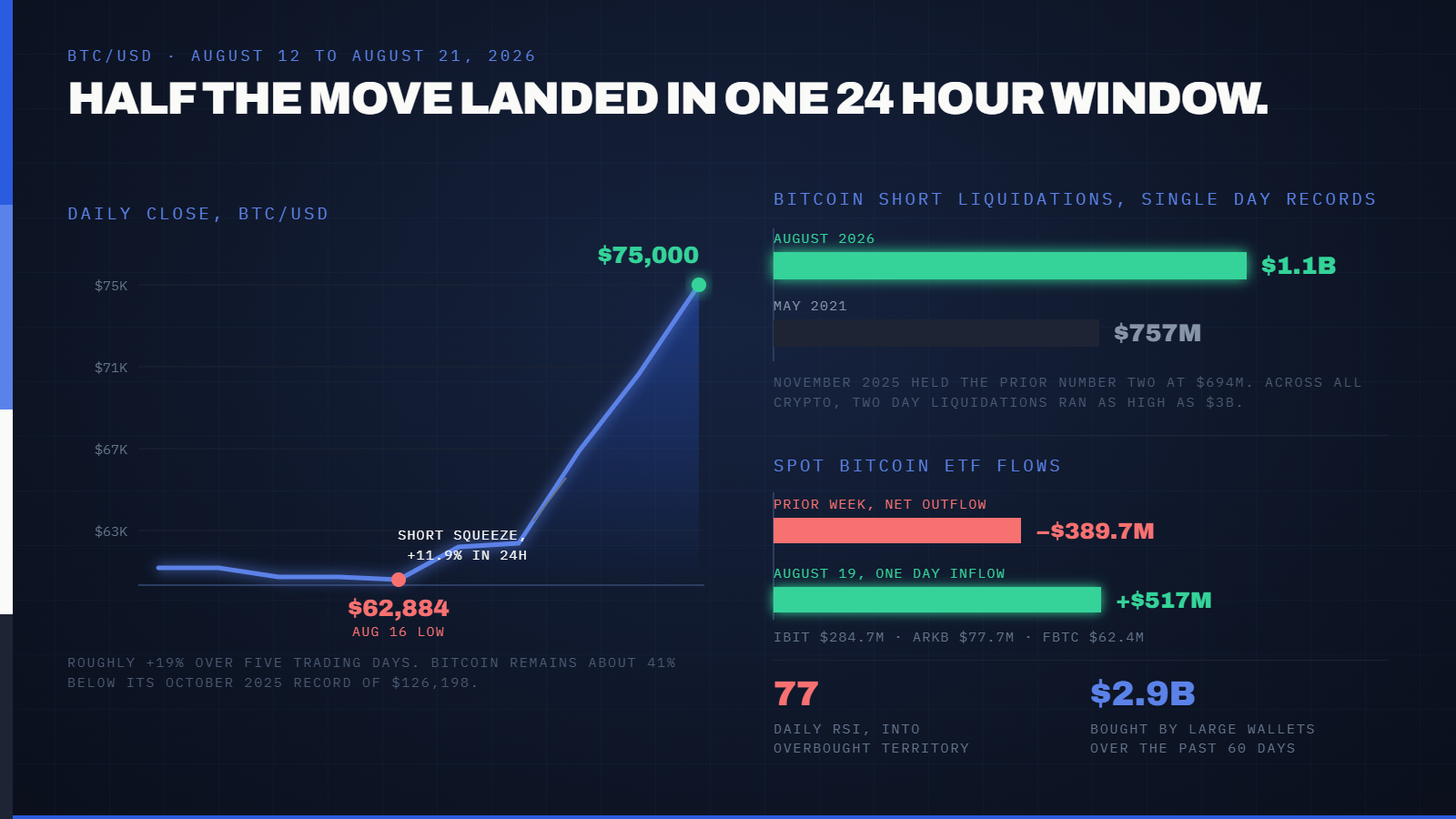
Five days ago, Bitcoin was sitting at $62,883.80, its lowest close of the month. By the morning of August 21, it was trading near $75,000. That's a 19% move in less than a week, and more than half of it happened inside a single 24 hour window.
What Changed
The move started slowly. Bitcoin drifted between roughly $63,000 and $65,000 for most of the week of August 10, unable to hold a rally or break down further. Then, on August 19, the price crossed $69,000 and something snapped. More than $1 billion in short positions were liquidated within about an hour, according to derivatives data, forcing traders who had bet on further declines to buy back into a market already moving against them. By the time the wave finished rolling through the next day, Bitcoin's own short liquidations for the day topped $1.1 billion, the first time that has ever happened, according to K33 Research, well past the prior records of $757 million in May 2021 and $694 million in November 2025. Widen the lens to the entire crypto market, every token, longs and shorts combined, and the two day tally ran as high as $3 billion by some trackers, placing it among the handful of largest liquidation events crypto has ever recorded.
A short squeeze works like a chain reaction. Traders borrow Bitcoin and sell it, betting the price falls so they can buy it back cheaper later. When the price rises instead, exchanges force them to post more collateral or close the position outright, and closing a short means buying. That buying pushes the price higher still, which triggers the next round of forced buying. None of this requires new information. It just requires enough leveraged bets stacked on one side of the trade, and by mid August, the short side had gotten crowded. Similar setups preceded two of Bitcoin's fastest rallies in recent memory. A roughly 50 day stretch of crowded shorts around the FTX collapse in late 2022 gave way to a 48% rally, and a comparable setup after China's 2021 mining ban was followed by a 65% run.
The mechanical squeeze needed a spark, and it got a few. The Treasury said it would at least double the size of its long term bond buybacks, a move aimed at cooling yields that also made risk assets, crypto included, more attractive by comparison. President Trump separately pushed Congress to pass the Digital Asset Market Clarity Act, which would settle a years old fight over whether cryptocurrencies are regulated as securities by the SEC or commodities by the CFTC. The bill cleared an initial procedural hurdle in the Senate on August 8 before stalling ahead of the summer recess, and lawmakers have a three week window to bring it back for a vote once they return in September.
Why It Matters
Squeezes explain why a move happens this fast. They don't usually explain why it lasts. For that, look at the ETF flows. Spot Bitcoin ETFs had just booked their biggest weekly outflow in six weeks, $389.7 million pulled out in the days before the bounce. That reversed hard on August 19, when the same funds took in $517 million in a single day, their largest daily haul since early May. BlackRock's IBIT led with $284.7 million, followed by Ark and 21Shares' ARKB at $77.7 million and Fidelity's FBTC at $62.4 million. Bloomberg data separately shows large wallet holders, the addresses usually described as whales, have accumulated $2.9 billion worth of Bitcoin over the past 60 days. Money moving into ETFs and large wallets before and during a squeeze is a different signal than the squeeze itself. It suggests at least some of the buying came from investors taking positions, not just short sellers being forced to cover.
It's also worth remembering how far Bitcoin still has to climb to matter historically. Even at $75,000, it sits roughly 41% below the $126,198 record it set in October 2025. That record came during a stretch when gold was hitting highs of its own on the exact same cooling inflation data that briefly sent Bitcoin the other direction, a reminder that the two assets don't always move together even when the macro backdrop looks similar for both.
What to Watch Next
The technicals are already stretched. Bitcoin's daily RSI sits at 77, deep in overbought territory, and the one hour reading has pushed above 80. Analysts who track the market are split on what comes next. Some argue that squeeze driven rallies need confirmation from sustained spot market buying, not just derivatives unwinding, before they count as the start of something bigger, and they point to $65,000 to $67,000 as the level that would need to hold on any pullback. Others note that whale accumulation and returning ETF demand were already building before the squeeze hit, which would argue for more durability than a pure short covering rally usually has.
In the near term, watch two things over the next few weeks. First, the Senate's procedural vote on the Clarity Act, expected in the first days of September, which could either remove a chunk of regulatory uncertainty from crypto markets or reset a stalemate that has dragged on for most of the year. Second, whether ETF inflows keep showing up on days Bitcoin isn't already spiking, since that's the clearer sign of demand that doesn't depend on forced buying. Reclaiming and holding $100,000 to $105,000, a level Bitcoin hasn't traded above since earlier this year, is the threshold several analysts point to before calling this more than a bounce.
Zoom out further and the picture gets more divided. Bernstein's research team argues the usual four year Bitcoin cycle has broken down into a longer, institutionally driven bull run, with a $150,000 target for 2026 and roughly $200,000 for 2027, pointing to ETF outflows that stayed under 5% of Bitcoin's recent 30% correction as evidence institutional holders aren't panic selling the way retail did in past cycles. Galaxy Digital's Alex Thorn is similarly bullish further out, calling for $250,000 by the end of 2027 on maturing institutional adoption and Bitcoin's growing use as a hedge against currency debasement, but he's notably declined to pin down 2026 itself, describing it as too chaotic to forecast given the midterm elections, AI spending uncertainty, and macro conditions still in flux. Options markets reflect that same split. Pricing shows roughly similar odds of Bitcoin trading near $70,000 or $130,000 by the middle of next year. None of these targets are promises, and Pulse24 doesn't treat them as one. They're a reminder that even people paid to have a view on Bitcoin don't agree on the next twelve months, only on the direction they'd bet over the next several years.
The Pulse24 Take
The honest answer is that this rally is probably two things at once: a real mechanical short squeeze, and a market that had genuine reasons to catch a bid regardless. The liquidation numbers are large enough that some of this move would have happened no matter what else was in the news that week. But the Treasury's buyback announcement and the White House leaning on the Clarity Act didn't happen in a vacuum, and ETF investors don't typically show up in size just to catch a falling market. What matters going forward isn't whether the squeeze was real. It clearly was. What matters is whether spot buyers stick around now that the easy, forced part of the move is over. A pullback into that $65,000 to $67,000 zone wouldn't undo the case for the rally. It would just be the first real test of it.
How we read the data
Curious how we get from raw data to a take like this? Our Trader's Toolkit walks through the tools we lean on.
Explore the Toolkit