Pulse24 Original
Bitcoin ETFs Just Booked Their Biggest Weekly Outflow in Six Weeks, $389.7 Million. Seven Days Earlier, the Same Funds Pulled In $853 Million, Their Best Week Since April.
August 17, 2026
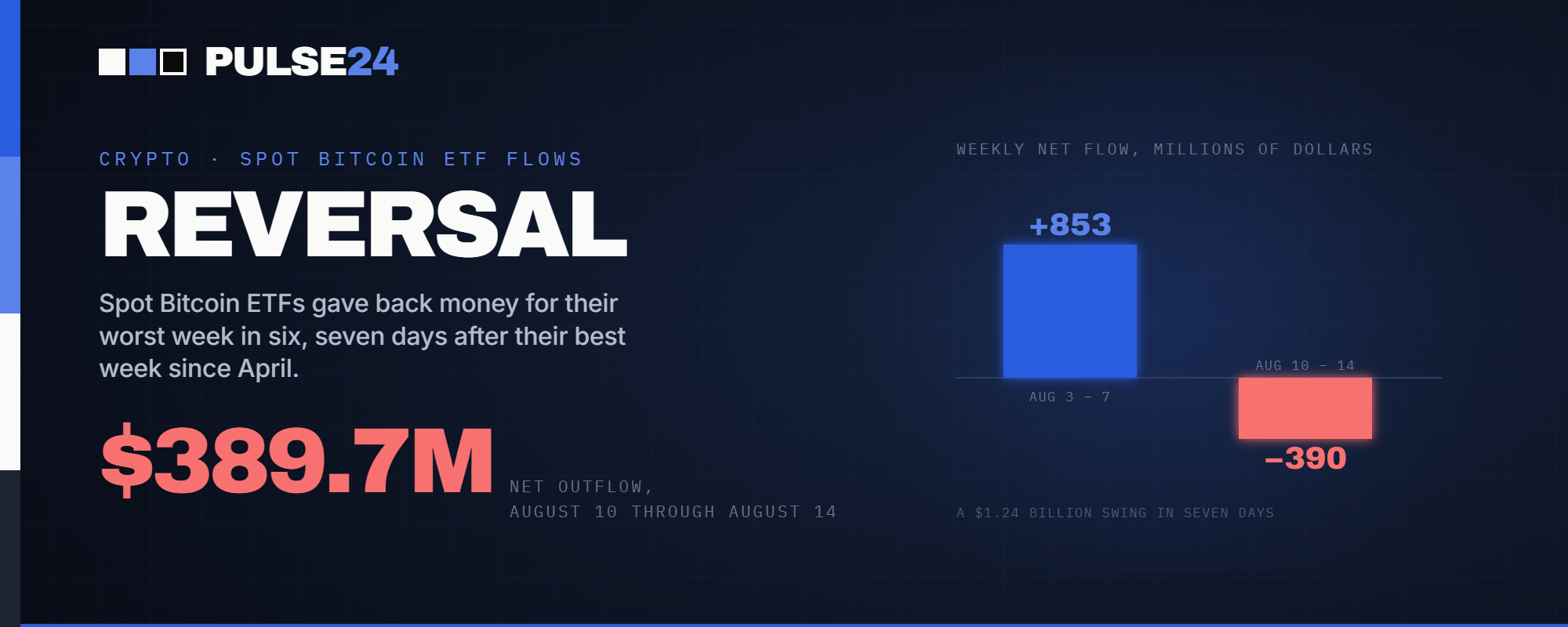
Bitcoin ETFs just booked a $389.7 million outflow, their worst week in six, a sharp reversal from the $853 million they pulled in just seven days earlier. With the CLARITY Act's odds cut to roughly 10% and volatility near a two-year low, flows are increasingly taking their cue from the Fed instead of crypto-specific news.
US spot Bitcoin ETFs lost $389.7 million in the week of August 10 to 14. That figure sits worlds apart from the $853 million the same funds absorbed just seven days earlier, a haul that had been their strongest since April. Four of five trading days that second week closed red, the first three-day losing stretch investors had seen since the end of July.
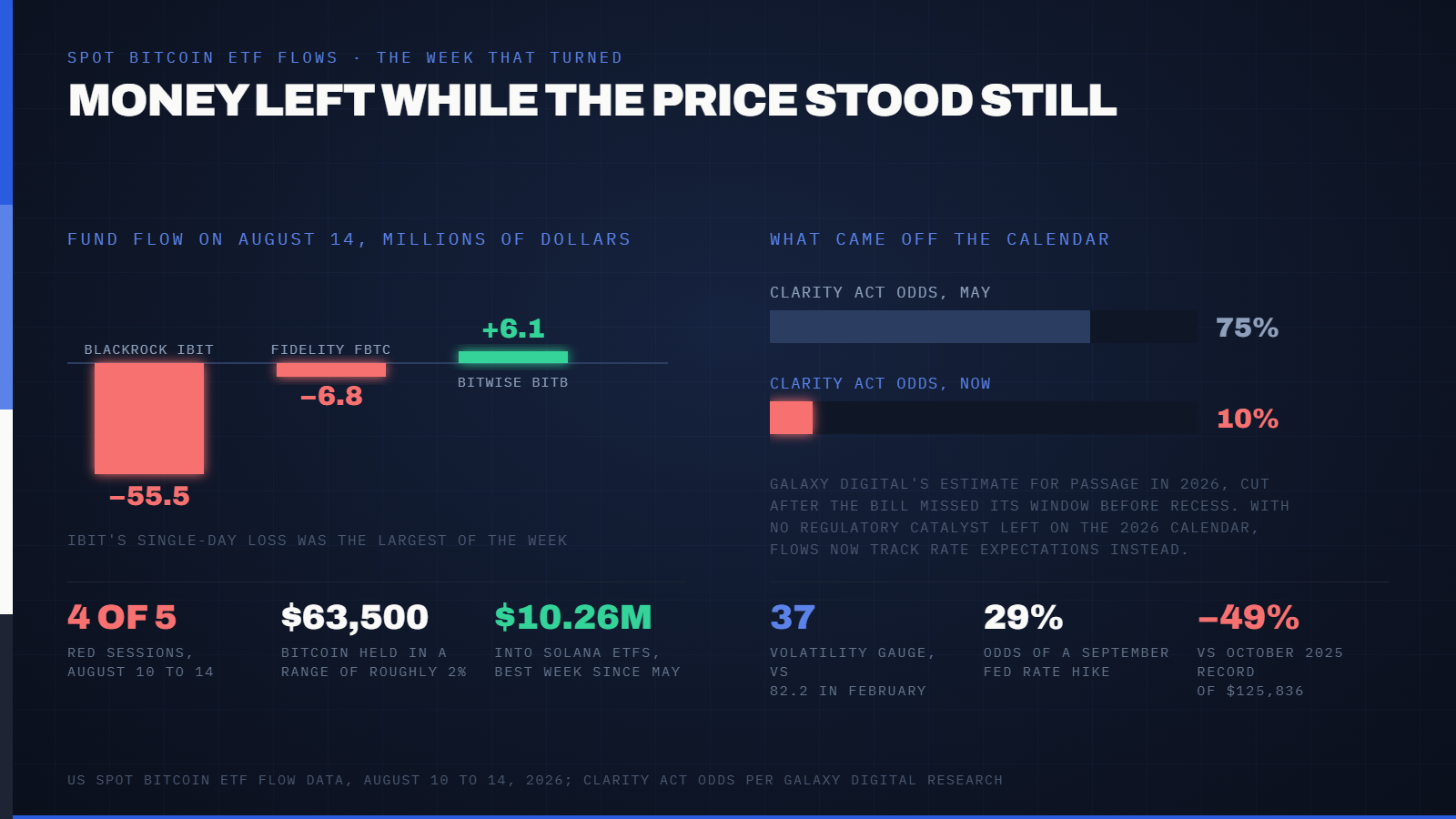
The reversal shows up fund by fund. BlackRock's IBIT, still the largest bitcoin ETF by assets, bled $55.5 million on August 14 alone, the single biggest daily outflow of the stretch. Fidelity's FBTC gave back another $6.8 million that same day. Bitwise's BITB was the lone holdout, taking in $6.1 million while its larger peers lost ground.
What Changed
Bitcoin itself barely moved. The coin traded near $63,500 through most of the week, holding inside a range of roughly 2%, a level of calm that would have been unthinkable during last autumn's run to a record $125,836. That means bitcoin now sits close to half its October 2025 peak, even as the outflows pile up around it.
Volatility tells a similar story. A widely tracked bitcoin volatility gauge sat at 37 on Monday, down from a three-year high of 82.2 in early February. Low volatility usually signals a market waiting for its next catalyst rather than one in genuine distress, and right now bitcoin doesn't have an obvious one on the calendar.
Regulation was supposed to be that catalyst. The CLARITY Act missed its last window to pass before the Senate's August recess, the same week bitcoin ETFs logged that $853 million inflow on hopes Congress would still find a path forward. Those hopes have faded fast. Galaxy Digital's head of research, Alex Thorn, now puts the odds of the bill passing in 2026 at roughly 10%, down from 75% in May.
Not every crypto fund is struggling. Solana ETFs pulled in $10.26 million over the same week, their strongest showing since May, while XRP and HYPE products posted smaller gains of their own. Investors appear willing to rotate into altcoin exposure even as they pull back from the market's largest asset, a split that lines up with bitcoin's recent divergence from gold during this same stretch of subdued trading.
Why It Matters
Thin liquidity amplifies every one of these moves. Notional open interest in bitcoin derivatives is running at nearly double the 24-hour trading volume, according to CoinDesk, meaning a relatively small shift in ETF flows can swing sentiment further than the dollar amounts alone would suggest. That's part of why a $389.7 million outflow, small next to a bitcoin market worth well over $1 trillion, still reads as a meaningful signal to traders watching the tape.
The bigger question is what's actually driving flows now that regulation has stalled. Increasingly, it looks like interest rates rather than crypto-specific news. Institutional demand for bitcoin ETFs has tracked the market's shifting bets on a September Fed rate hike, now priced at just 29% odds after last week's retail sales report, about as closely as it has tracked anything happening inside the crypto industry itself.
What to Watch Next
A few things could shift the picture from here. September brings both the Fed's next rate decision and Congress's return from recess, which puts the CLARITY Act back in play even at long odds. A hike that doesn't happen, or a bill that moves out of committee, could pull volatility back up and ETF flows along with it. Whether Bitwise's contrarian inflow on August 14 was a one-off or the start of allocators buying the dip while BlackRock and Fidelity clients rotate out is also worth tracking. So is the smaller-cap ETF complex: if the rotation into Solana and XRP broadens, it suggests investors aren't leaving crypto so much as reallocating within it.
The Pulse24 Take
Bitcoin's stagnant price action muddies the difference between a market pausing and a market topping. Volatility below 40 and outflows under $400 million are, on their own, unremarkable numbers for a market this size. What stands out is the reversal from $853 million in one direction to $389.7 million in the other in the space of a week, a swing that says institutional conviction is thinner than the headline flow numbers from earlier this summer implied.
The CLARITY Act's collapse from a 75% chance of passing to roughly 10% matters more than the price action might suggest. It removes, at least for this year, the one clean regulatory catalyst that could have pulled new institutional money off the sidelines. Absent that, bitcoin ETF flows look set to keep taking their cues from the Fed rather than from Washington's crypto policy calendar, and investors should expect flows to swing with rate expectations for a while yet.
How we read the data
Curious how we get from raw data to a take like this? Our Trader's Toolkit walks through the tools we lean on.
Explore the Toolkit