Pulse24 Original
The CLARITY Act Missed Its Last Chance to Pass Before Recess. Bitcoin ETFs Pulled In $853 Million the Same Week, Their Best Since April.
August 10, 2026
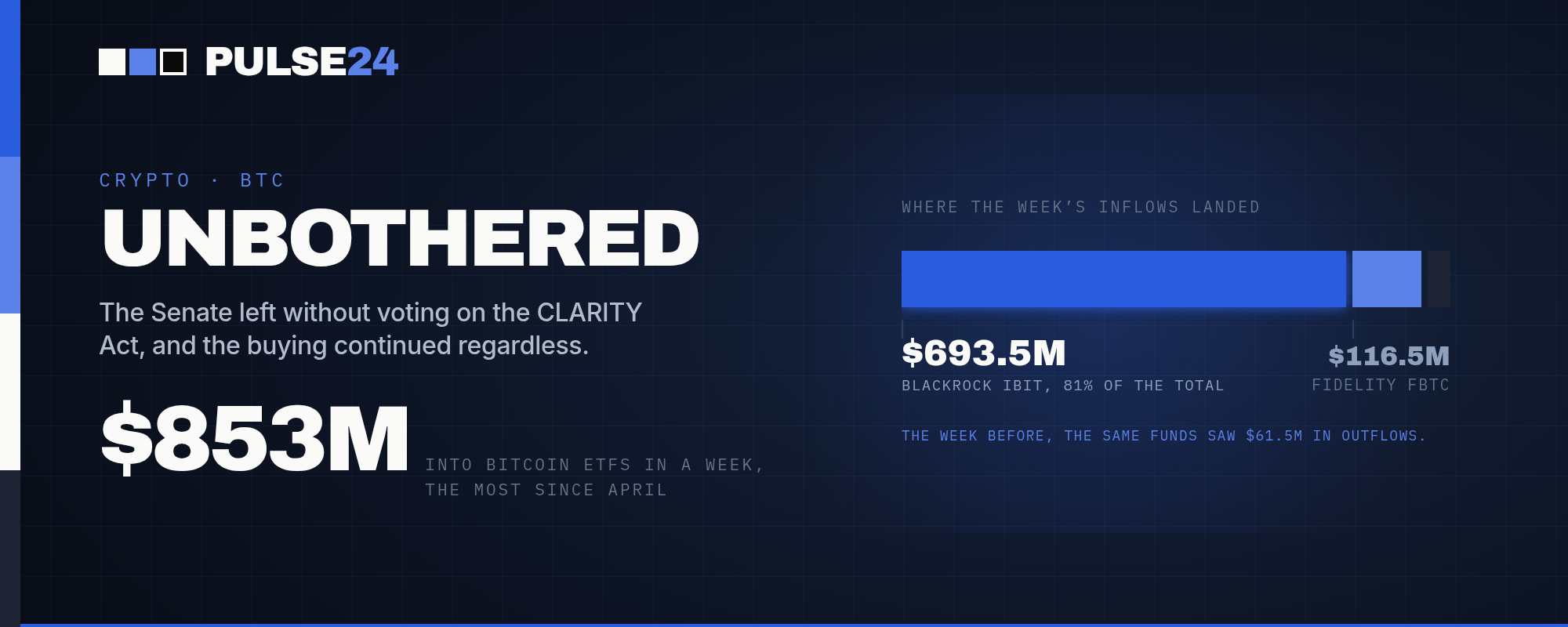
The Senate ran out of time on crypto's biggest regulatory bill and pushed the vote to September. Bitcoin ETFs kept buying anyway, pulling in $853 million in a single week, the strongest stretch since April.
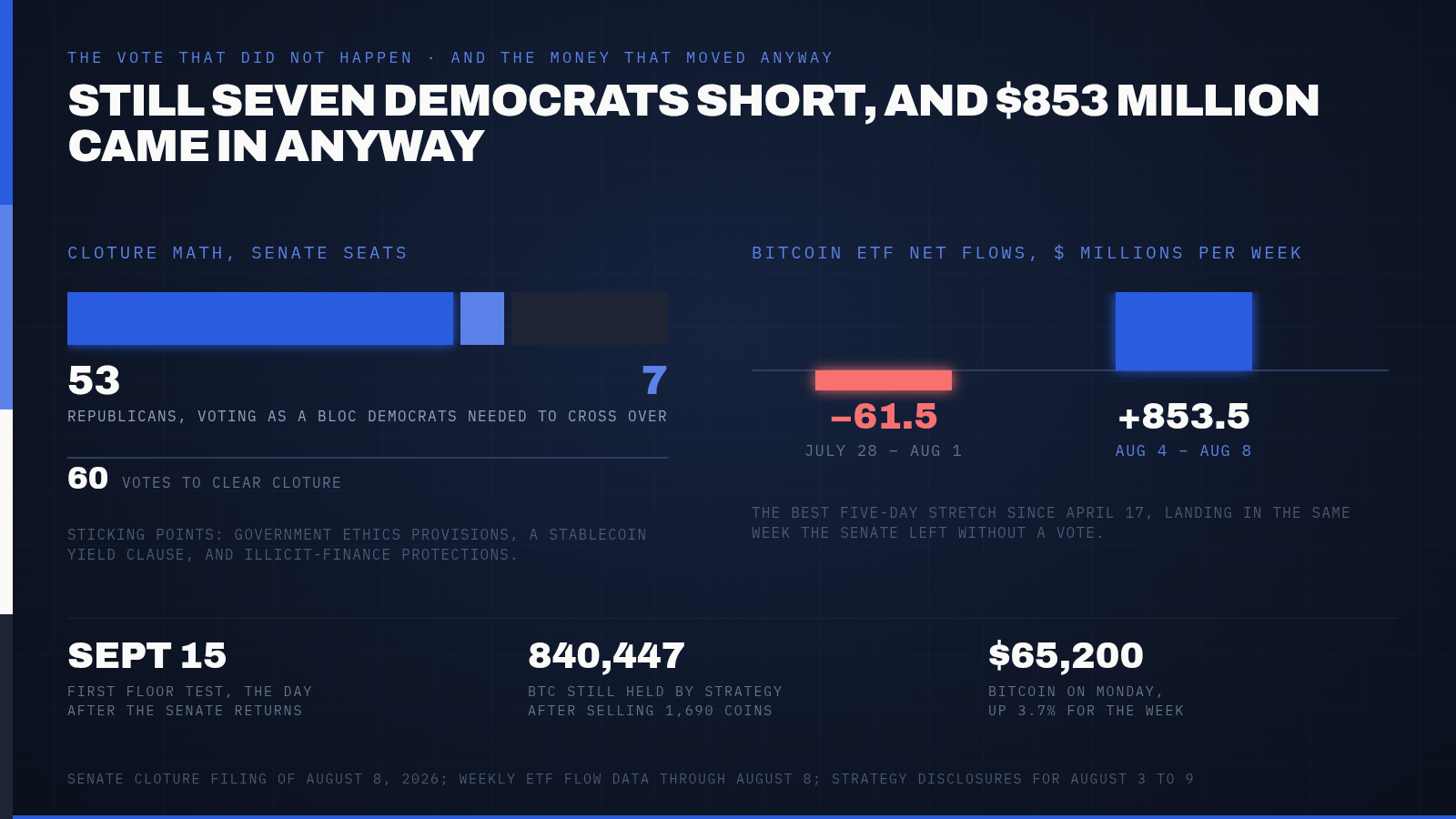
John Thune filed a cloture motion on the CLARITY Act on the morning of August 8. It was the closest the Senate came all month to voting on crypto's biggest piece of pending legislation, and it still wasn't close enough. The filing came too late in the calendar for an actual vote before the chamber broke for recess, which means the bill's first real floor fight now waits until September 15, the day after the Senate returns.
What Changed
Cloture on the CLARITY Act requires 60 votes. Republicans hold 53 Senate seats and are expected to vote as a bloc, meaning Thune needs at least 7 Democrats to cross over. The sticking points haven't moved much since July: government ethics provisions the White House wants softened, a stablecoin yield clause that consumer advocates call a loophole, and illicit-finance protections that some Democrats say still fall short. Thune's cloture filing effectively pre-books the Senate's first week back, since each cloture sequence eats close to a week of floor time and the bill needs two of them to clear.
None of that stopped bitcoin from having a good week. ETFs tracking the token pulled in $853.54 million between August 4 and August 8, their best five-day stretch since April 17 and a sharp reversal from the $61.53 million in outflows the week before. BlackRock's IBIT did most of the heavy lifting, taking in $693.5 million, or roughly 81% of the total. Fidelity's FBTC added $116.5 million, and ARK's ARKB brought in $50.8 million.
There was a seller in the mix too, just not the kind that usually moves bitcoin's price. Strategy, the company formerly known as MicroStrategy, sold 1,690 BTC for $108.6 million during the week of August 3 through 9 at an average price of $64,262 a coin. That brings its total sold this year to 6,948 BTC, spread across four separate transactions since late May. The proceeds went toward repurchasing shares of the company's STRC preferred stock rather than funding new bitcoin purchases, a reversal from the buy-everything posture Michael Saylor built his reputation on. Strategy still holds 840,447 BTC, close to 4% of the eventual 21 million coin supply, and Saylor posted the firm's bitcoin-buy chart with the caption "Doing business" shortly after, which traders read as a hint that another purchase could follow.
Why It Matters
A regulatory setback and a rising price used to be hard to square. Not this cycle. Weak July payrolls data knocked expectations for a September Fed hike down sharply, and the softer dollar that followed has loosened financial conditions that had kept bitcoin pinned through most of the summer. Institutional ETF demand is doing the rest of the work. This week's $853 million in net inflows reversed $61.53 million in outflows from the week before, and it builds on an earlier three-day stretch that pulled in $626 million following the worst month for crypto funds this year. BlackRock's IBIT alone accounted for more than most retail trading platforms move in a month.
That's a shift worth naming. For most of the CLARITY Act's life, headlines about the bill's progress moved crypto prices at least a little, up on momentum, down on delay. That correlation has been fading since midsummer. A Senate recess with no vote landing the same week as the best ETF inflow number since April 17 is about as clean a test as this year has produced, and the correlation didn't hold.
What to Watch Next
September 15 is now the date that matters, when the Senate holds its cloture vote at 2:15 p.m. Eastern. Whether Thune can find 7 Democratic votes will depend on whether the ethics and stablecoin provisions get resolved before then, and aides have described the timeline as workable only if negotiators reach an agreement in the coming weeks rather than starting from scratch. Watch the ETF flow data too. A fifth straight week of inflows would reinforce the idea that institutional demand has decoupled from the legislative calendar, while a reversal would suggest this week's number was more about a softer dollar than a durable shift in appetite. And keep an eye on Strategy's next disclosure. If Saylor's "Doing business" post turns into an actual purchase, it would mark a return to the accumulation strategy the company built its identity on, after two straight months of selling into its own preferred stock obligations.
The Pulse24 Take
Bitcoin rose during a week Congress failed to act on its own legislation, and the market barely reacted to the delay itself. That's the more interesting data point than the price move. It suggests institutional flows through ETFs are now large enough to set the tone on their own, at least in weeks when the dollar is soft and jobs data disappoints. Whether that holds when the backdrop flips (a stronger jobs report, or an actual vote that goes badly) is the real test. Regulatory clarity would still matter enormously for where crypto goes over the next few years, since custody rules, exchange registration, and stablecoin treatment all hinge on some version of this bill eventually passing. But for now, Wall Street's plumbing is proving more important to the daily price than Washington's calendar, and that's worth remembering the next time a CLARITY Act headline hits the wires.
How we read the data
Curious how we get from raw data to a take like this? Our Trader's Toolkit walks through the tools we lean on.
Explore the Toolkit