Pulse24 Original
Bitcoin ETFs Just Pulled In $626 Million Over Three Days. It Follows the Worst Month for Crypto Funds This Year.
August 8, 2026
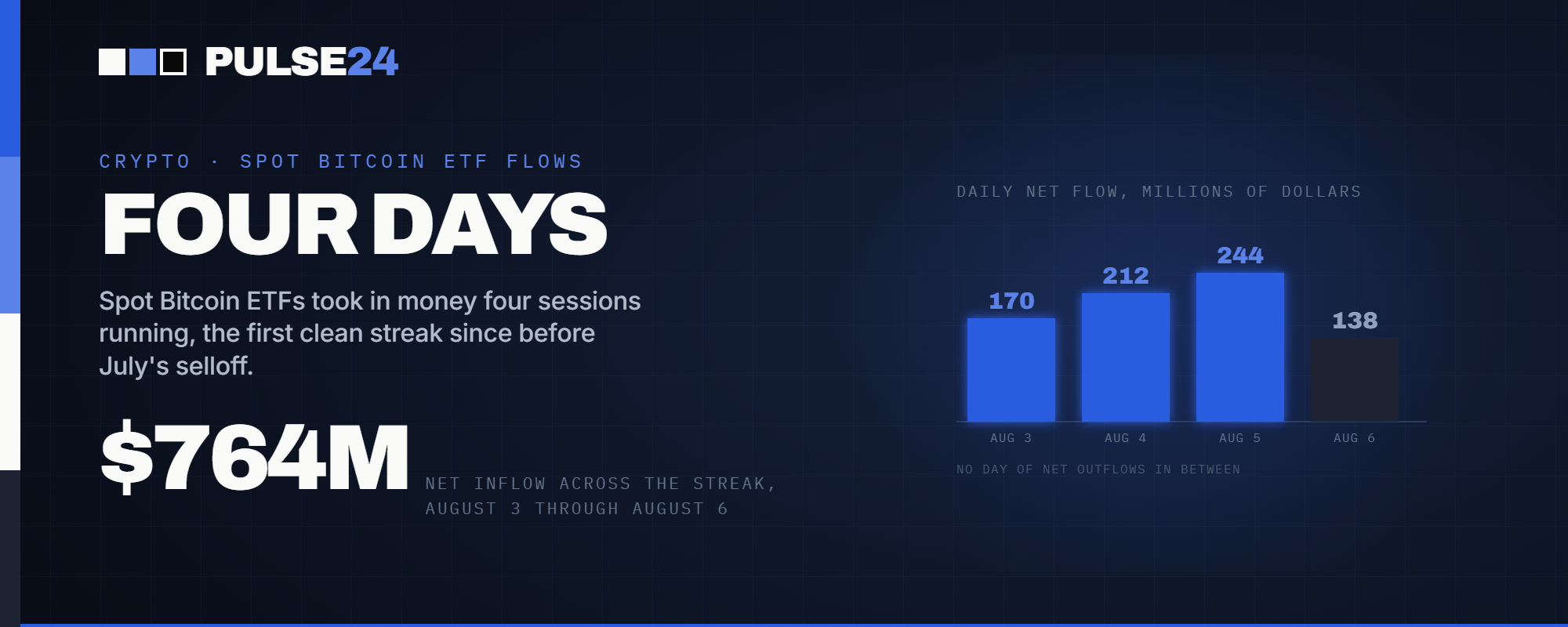
US spot Bitcoin ETFs booked four straight days of net inflows through August 6, with BlackRock's IBIT behind most of the buying. The rebound follows July's worst month for crypto fund flows this year, and the numbers underneath the headline total are more cautious than the price action suggests.
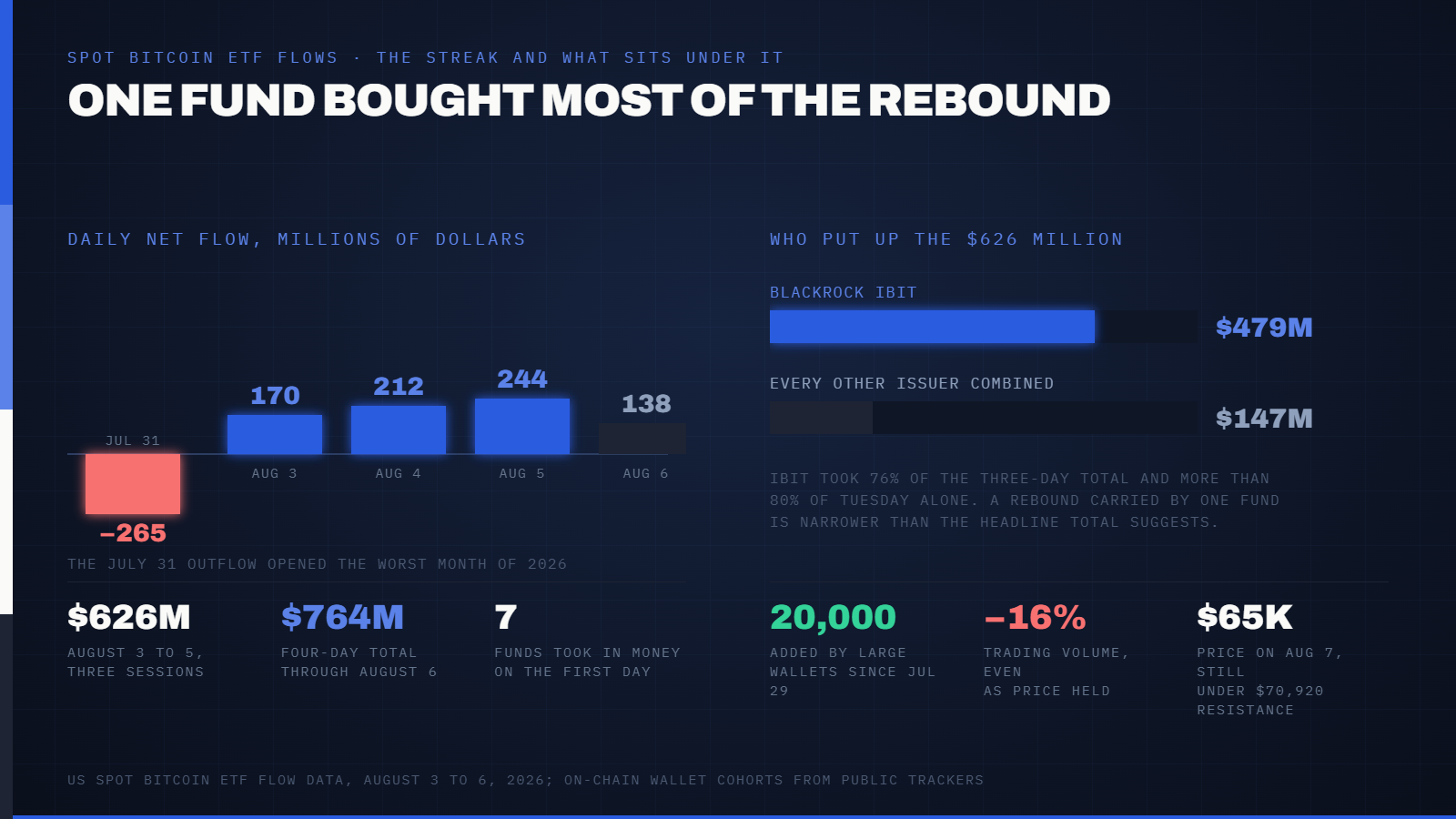
US spot Bitcoin ETFs pulled in $626 million between August 3 and August 5, three consecutive days of net inflows after a July that produced the worst monthly flow numbers the category has seen this year. BlackRock's iShares Bitcoin Trust did most of the work. IBIT alone accounted for $479 million of that three day total, close to 76%, a concentration that shows how much of this rebound is coming from a single fund rather than the category broadly.
The streak arrived in stages. Monday, August 3, brought $170.1 million across seven funds. Tuesday added $211.5 million, with IBIT again responsible for more than 80% of the day. Wednesday was the strongest single session at $244.4 million, closing out the three day, $626 million run. Thursday added a fourth straight day of inflows, a further $137.6 million, pushing the cumulative total since Monday to roughly $764 million without a single day of net outflows in between. That reversal undid a meaningful chunk of the damage from July, when a $265.4 million single day outflow on July 31 helped make it the worst month for Bitcoin ETF flows in 2026.
What Changed
Bitcoin's price has followed the flows, just not by much. The coin traded near $65,000 on August 7, up about 0.8% over 24 hours, still well under the $70,920 resistance level that has turned back every rally attempt since spring.
Wallets holding between 10 and 10,000 BTC, the range analysts use as a rough stand in for funds, family offices, and other non retail holders, added more than 20,000 BTC since July 29, worth close to $1.2 billion at current prices. That is a different signal than ETF flows alone. It suggests some of the buying is happening directly on chain, not just through fund shares.
Leverage also cooled. Twenty four hour liquidations across the market fell about 68% from where they had been running earlier in the summer, which matters because a lot of Bitcoin's sharpest moves this year have been leverage driven rather than spot driven. Fewer forced liquidations generally means less of the price action is coming from traders getting margin called in either direction.
The backdrop helped too. July's payrolls report missed badly enough to cut the Fed's September hike odds nearly in half, and Bitcoin, like gold, tends to catch a bid when the market prices in a less restrictive rate path. A non yielding asset gets relatively more attractive every time the expected path of real rates flattens.
Why It Matters
The timing is notable on its own. This streak follows a spot Bitcoin ETF closing altogether after AI focused funds outperformed it by 39 percentage points, a reminder that money has been rotating out of crypto exposure and into other trades for much of the past year. Four days of inflows do not reverse that pattern by themselves, but they show the rotation is not one directional every single week.
A price that holds up on falling volume can mean one of two things. Either a small group of large buyers is doing enough to move the market without needing broad participation, or the move is fragile and could reverse quickly once those buyers step back. The whale accumulation data points toward the first explanation, but four days is not enough to rule out the second.
What to Watch Next
The next test is whether the streak extends into a second week. ETF flows this volatile have reversed on a single bad headline before, including the $265 million single day outflow that kicked off July's slide. Worth watching is whether IBIT's share of the inflows narrows as other issuers participate. That kind of broadening would be a healthier sign than one fund carrying most of the load. Bitcoin clearing $70,920 and holding above it would mark a more decisive break from the range it has been stuck in since spring. Until then, this reads more like a pause in selling pressure than a resumption of the institutional demand cycle that carried the ETF category through its first two years.
The Pulse24 Take
Four days of positive flows after the worst month of the year is a real change, not a rounding error, and it deserves to be taken on its own terms. What it is not yet is proof that institutional demand for Bitcoin has turned a corner. The concentration in a single fund, the drop in trading volume, and the fact that price is still well below its resistance level all point toward a market that stopped selling more than one that started buying with conviction. Those are different things, and the distance between them is usually where the next move gets decided.
How we read the data
Curious how we get from raw data to a take like this? Our Trader's Toolkit walks through the tools we lean on.
Explore the Toolkit