Pulse24 Original
The First Spot Bitcoin ETF Just Closed. A 39% AI Trade Explains Where the Money Went.
August 6, 2026
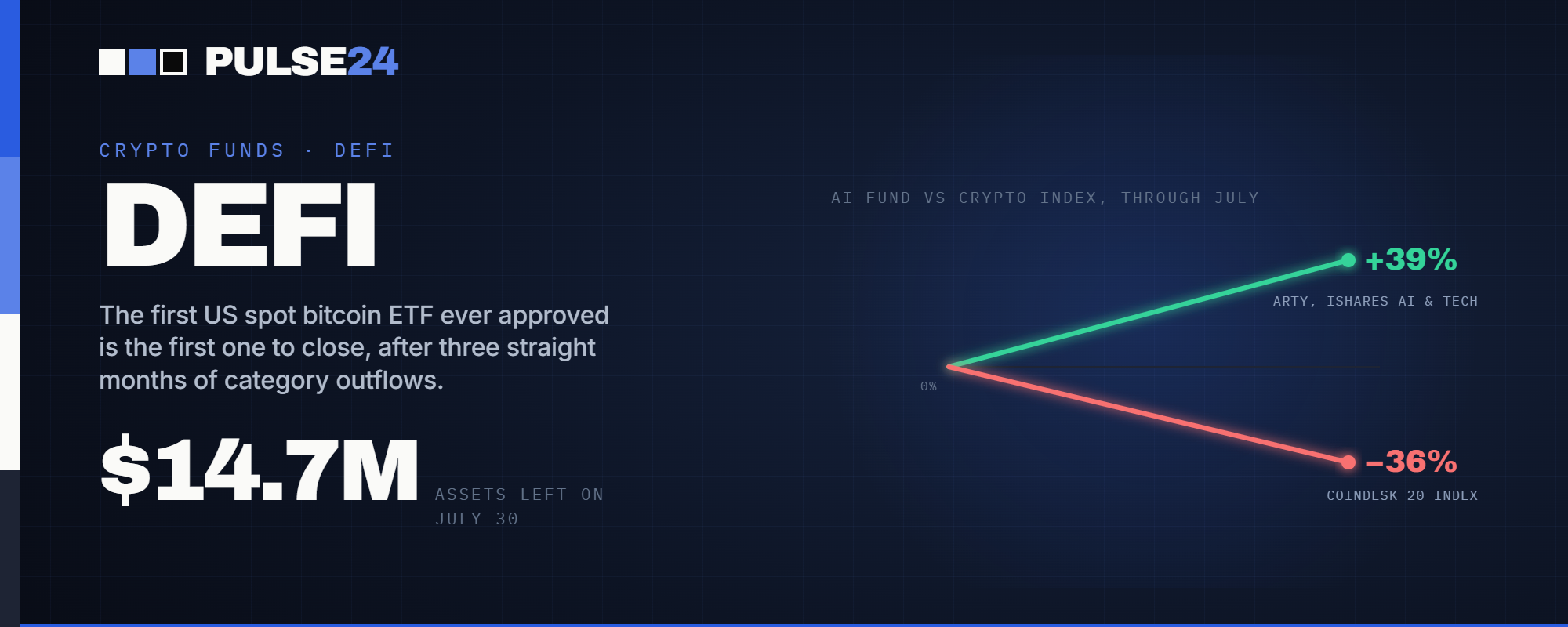
Hashdex is shutting down DEFI, the first US spot bitcoin ETF ever launched, after its assets shrank to just $14.7 million next to BlackRock's $47 billion fund. The bigger story is a 75-point performance gap between AI equities and crypto that explains where institutional capital went instead.
Hashdex told investors on August 3 that it's closing the Hashdex Bitcoin ETF, ticker DEFI. That sentence alone wouldn't normally be worth a headline; small funds close every year. What makes it notable is what DEFI actually is: the first US spot bitcoin ETF ever approved, back when the SEC's 2024 approval of the category felt like a watershed moment for crypto's legitimacy. Now it's the first one to shut down, and the reason has less to do with bitcoin's price than with where else money has been going.
The math behind the decision is blunt. DEFI held $14.7 million in assets as of July 30, next to BlackRock's iShares Bitcoin Trust at $47.08 billion. A fund that small generates almost no fee revenue, making the economics difficult to justify. Hashdex's own announcement pointed to exactly that combination, citing the fund's assets under management, liquidity, operating costs and investor interest, along with its position in the company's broader lineup.
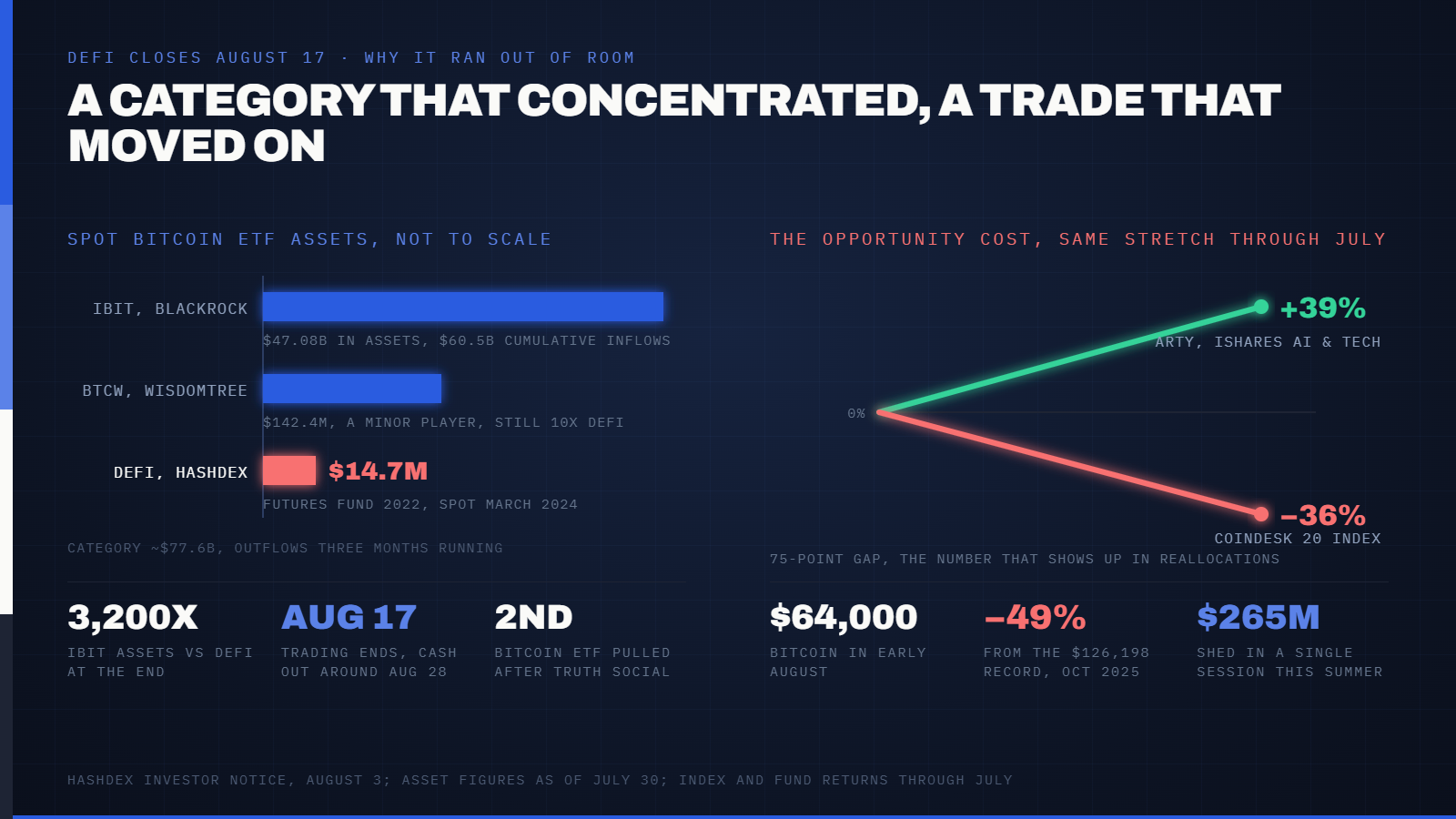
DEFI's timing worked against it from the start. It launched as a bitcoin futures product in September 2022, then converted to a spot fund on March 27, 2024, months after BlackRock, Fidelity and the other early movers had already locked up most of the category's assets and attention. Bloomberg ETF analyst James Seyffart had flagged this kind of shakeout as likely, predicting under-subscribed funds would face closure pressure by late 2026 or 2027. It already happened once before DEFI: Yorkville America Digital pulled its Truth Social branded bitcoin ETF in May 2026 after it never cleared $50 million in assets.
What Changed
Trading in DEFI ends August 17, with the final distribution to remaining shareholders expected around August 28. The more interesting story sits one level up, in what's been happening across the entire spot bitcoin ETF category. Those funds have posted net outflows in each of the past three months, a stretch that included Bitcoin ETFs shedding $265 million in a single trading session while Ethereum funds kept pulling in fresh money. Category-wide assets now total around $77.6 billion, still a large number, but one increasingly concentrated in two or three issuers rather than spread across the fifteen-plus funds that launched in the original approval wave.
One obvious competitor for that capital has been AI equities. BlackRock's own iShares Future AI & Tech ETF, ticker ARTY, gained 39% through July. Over that same stretch, the CoinDesk 20 Index, crypto's broadest market benchmark, fell roughly 36%. Portfolio managers rarely need a philosophical reason to rotate capital. A 75-point performance gap usually does the job. K33 Research head Vetle Lunde put it plainly in a June note: "Much of the market views the opportunity cost of holding BTC as too high while anything AI-related soars."
Why It Matters
Bitcoin as a trade has gotten more expensive to hold. That's the mechanism here, distinct from any judgment on bitcoin as an asset over the long run. The relevant metric for institutional allocators is opportunity cost: when one part of a portfolio is compounding at 39% and another is roughly flat to down over a stretch that also included a jump in Caterpillar's order backlog tied to AI power demand and similar AI-driven strength across industrial names, the weaker asset tends to get trimmed first, regardless of the long-term thesis behind it. That's a mechanical, portfolio-construction reason for outflows, not necessarily a verdict on bitcoin's fundamentals.
It's also a reminder that ETF approval was never a guarantee of survival for every fund that received one. The 2024 spot bitcoin approvals were treated at the time as a single event that legitimized the entire asset class. What's played out since looks more like what happens in most new ETF categories: a handful of first-movers with brand recognition and distribution capture the bulk of the assets, and everyone else competes for what's left until the smallest funds can no longer justify staying open. DEFI is the first casualty of that dynamic among bitcoin ETFs specifically, though the pattern itself isn't new or unique to crypto.
What to Watch Next
Whether DEFI's closure turns out to be a one-off or the start of a wave depends largely on where AI equity returns go from here. If the iShares Future AI & Tech ETF's run cools off or corrects, some of that capital could plausibly rotate back toward bitcoin, especially if the Fed's rate path, still uncertain heading into the August 7 jobs report and the September 15-16 meeting, tilts toward cuts rather than hikes, which would lower the opportunity cost of holding a non-yielding asset. Fund flow data across the smaller bitcoin ETFs, the ones sitting under roughly $200 million in assets, is worth watching for signs that Hashdex's move triggers copycat closures rather than staying an isolated case. Also worth tracking: whether Ethereum ETFs, which have kept notching inflows even as bitcoin funds bled, start facing the same AI-driven competition for capital, or whether staking yield keeps that category insulated for a while longer.
The Pulse24 Take
A $14.7 million ETF closing wouldn't normally be worth writing about. This one is, because it's a clean data point inside a bigger story: capital in 2026 has been chasing AI-linked returns hard enough to make even an asset class as popular as bitcoin look like the wrong place to be parked. Capital doesn't care about narratives. It cares about opportunity cost. When one theme compounds at nearly 40% while another loses more than a third of its value, money moves long before headlines explain why. The closure of DEFI is less about one ETF and more about what institutional portfolios chose to own instead.
How we read the data
Curious how we get from raw data to a take like this? Our Trader's Toolkit walks through the tools we lean on.
Explore the Toolkit