Pulse24 Original
Caterpillar Just Crossed $20 Billion in Quarterly Revenue for the First Time. Its Order Backlog Jumped to $72 Billion on AI Power Demand.
August 4, 2026
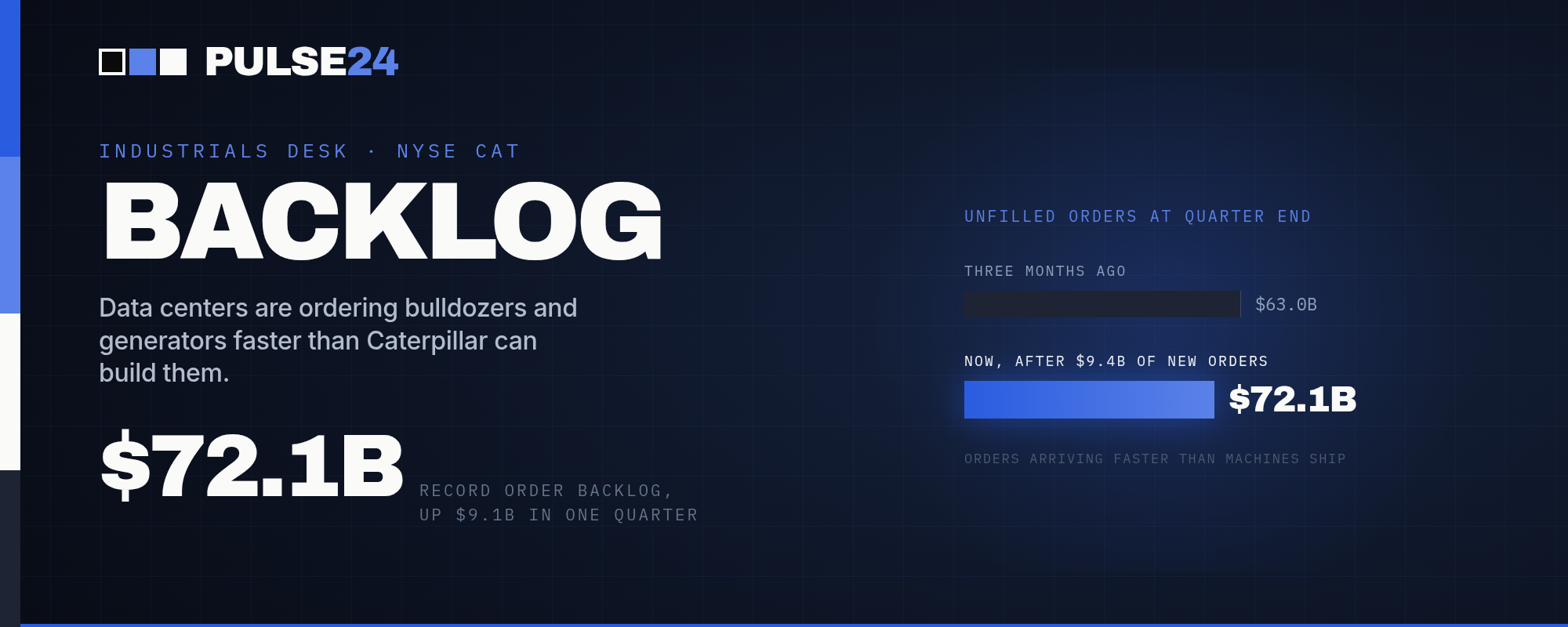
Caterpillar posted $20.5 billion in quarterly revenue for the first time in company history, and its order backlog jumped from $63 billion to a record $72.1 billion as data centers buy up construction equipment and backup generators. The results extend the AI capex story well beyond chipmakers and cloud providers into heavy industrial machinery.
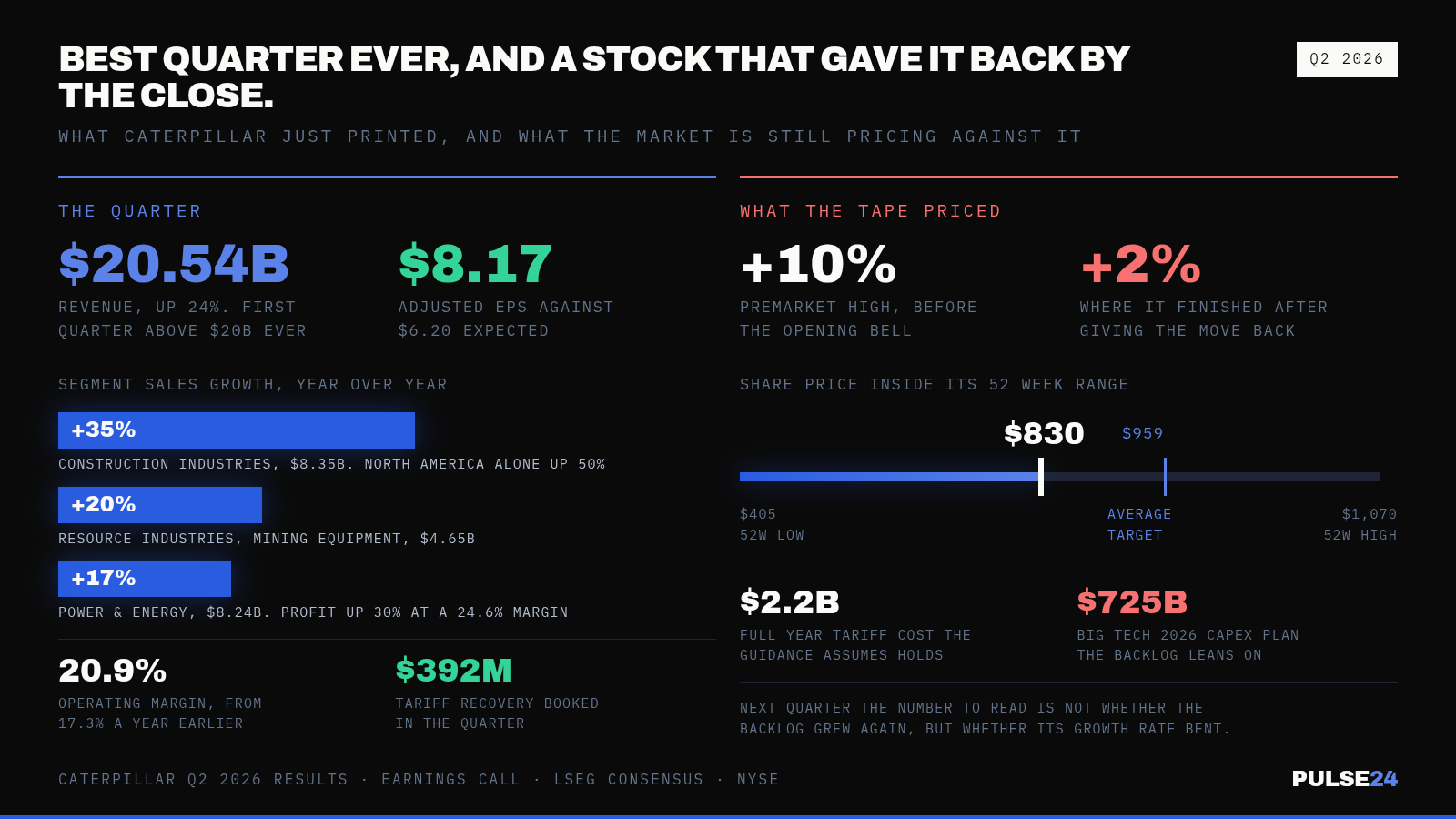
Caterpillar cleared $20 billion in quarterly revenue for the first time in its 100-year history on Tuesday. Second-quarter sales and revenues came in at $20.54 billion, up 24% from a year earlier, and adjusted earnings per share landed at $8.17, roughly $2 ahead of the $6.20 analysts had penciled in. "This is the first time in company history that we have generated over $20 billion in sales and revenues in a single quarter," CEO Joe Creed said on the earnings call.
Every segment grew, but the mix tells the real story. Construction Industries sales rose 35% to $8.35 billion, with North America sales up 50% on their own. Power & Energy sales climbed 17% to $8.24 billion, and segment profit jumped 30% to $2.03 billion at a 24.6% margin, the widest of Caterpillar's three main businesses. Resource Industries, the mining equipment unit, added 20% to reach $4.65 billion. Operating margin across the company expanded to 20.9% from 17.3% in the same quarter last year.
What Changed
The bigger tell sits in the backlog. Caterpillar entered the quarter with a record $63 billion in unfilled orders, and it left with $72.1 billion, after booking $9.4 billion in new business in three months. That's demand piling up faster than the company can build machines to fill it, and executives were direct about where it's coming from: construction equipment ordered for data center buildouts, plus the diesel and gas turbine generators data centers need to keep running before a permanent grid connection is ready. Tariffs, which had been squeezing margins earlier this year, also eased. Caterpillar cut its full-year tariff cost forecast to roughly $2.2 billion and recorded a $392 million tariff recovery in the quarter.
The market reaction was immediate, though it faded as the day went on. Shares jumped as much as 10% in premarket trading, then gave back most of that move during the regular session to finish up closer to 2%, trading near $830 with a market cap around $382 billion. That's still well off the stock's 52-week high above $1,070, but comfortably above its 52-week low near $405, and Wall Street's average price target of roughly $959 implies another 15% of room if analysts are right.
Why It Matters
Caterpillar makes bulldozers, mining trucks and diesel engines. It has been read as a bellwether for the industrial economy for decades precisely because none of its revenue comes from software or cloud contracts. When a company like that says data centers are its fastest-growing source of demand, that's a different kind of evidence for the AI capex cycle than another chipmaker or hyperscaler beating estimates. It shows the spending has moved past GPUs and server racks into the physical infrastructure needed to actually run them, including the power grid fights Texas and Oregon regulators are now having with data center operators.
It also broadens the AI trade for investors who have been chasing chip and cloud names for most of this year. Caterpillar's Power & Energy segment, largely diesel and gas generators plus turbines, is now growing faster in profit than its legacy construction business, and at a wider margin. That is a meaningful shift for a company whose earnings used to track global construction and mining cycles almost exclusively.
What to Watch Next
The next data points to watch are whether peers in power generation, Cummins and GE Vernova among them, report similar order strength when they update guidance, and whether Caterpillar's backlog visibility extends meaningfully into 2027 or is front-loaded into the next few quarters. Investors have already started questioning whether the broader AI capex build is outrunning itself; Big Tech's roughly $725 billion 2026 spending plan has drawn its own investor pushback in recent weeks. If that spending slows, the equipment orders sitting in Caterpillar's backlog would be an early place to see it.
Tariff policy is the other swing factor. Caterpillar's forecast assumes its $2.2 billion tariff cost estimate holds, and any new trade action on steel, aluminum or finished machinery would flow straight into that number.
The Pulse24 Take
The AI infrastructure story has mostly been told through chip earnings and cloud capex tables. Caterpillar's quarter adds a less obvious chapter: a 100-year-old machinery maker just posted its best results ever, partly because data centers need bulldozers to build sites and generators to power them before the grid catches up. That is a sign the buildout is real enough to be reshaping demand well outside technology itself.
It is also a reminder that this cycle can cut both ways. Caterpillar's stock already trades well above where it started the year, and a chunk of that move assumes data center demand keeps compounding at its current pace. Its own history with construction and mining cycles suggests that kind of demand rarely grows in a straight line forever. The backlog is the number worth watching next quarter, not just whether it grew again, but whether the growth rate is starting to bend.
How we read the data
Curious how we get from raw data to a take like this? Our Trader's Toolkit walks through the tools we lean on.
Explore the Toolkit