Pulse24 Original
Bitcoin ETFs Shed $265 Million in a Single Session. Ethereum Funds Just Notched a Fourth Straight Week of Inflows.
August 2, 2026
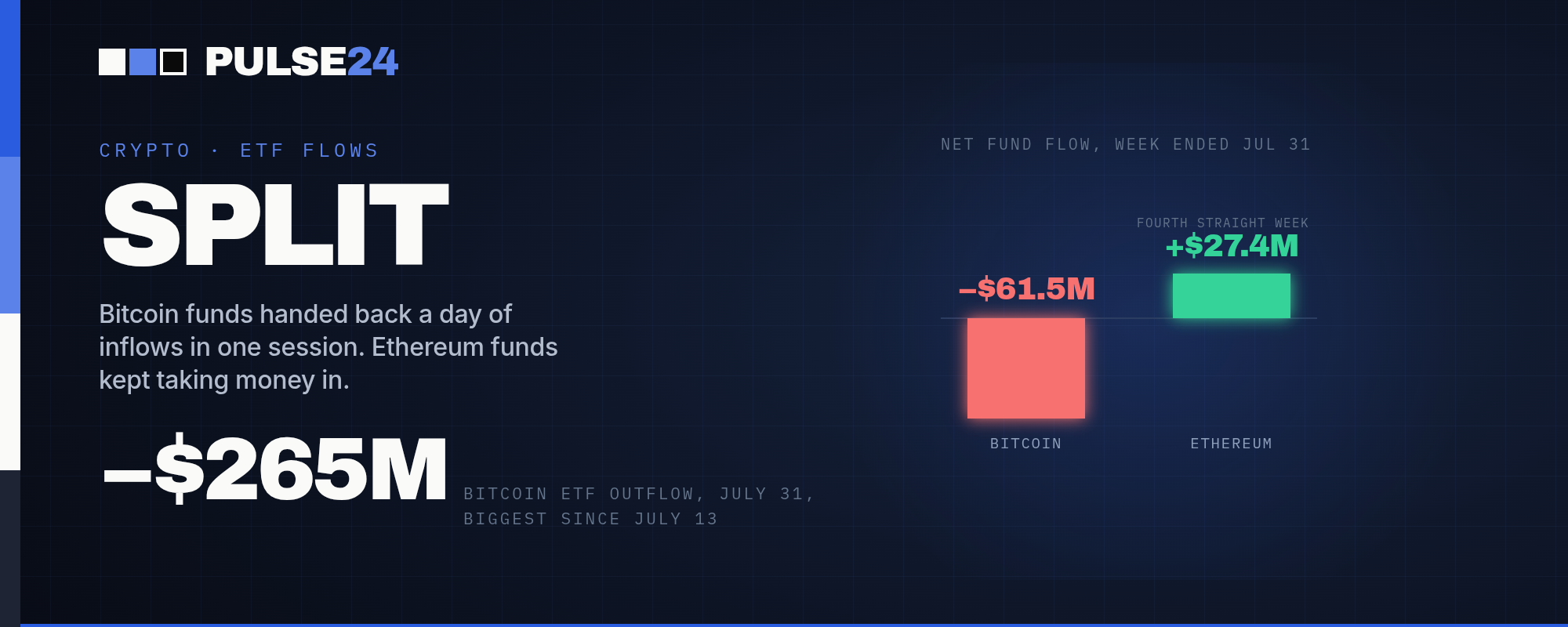
Bitcoin ETFs posted their biggest one-day outflow since July 13 right as the Fed's most hawkish dissent since 2016 and a stalled Clarity Act reshaped crypto positioning. Ethereum funds kept pulling in cash anyway, extending their inflow streak to four weeks.
ETF flow figures below come from fund-tracking services that aggregate daily creation and redemption activity across issuers, the standard way these numbers get reported since fund managers don't publish flows directly each day.
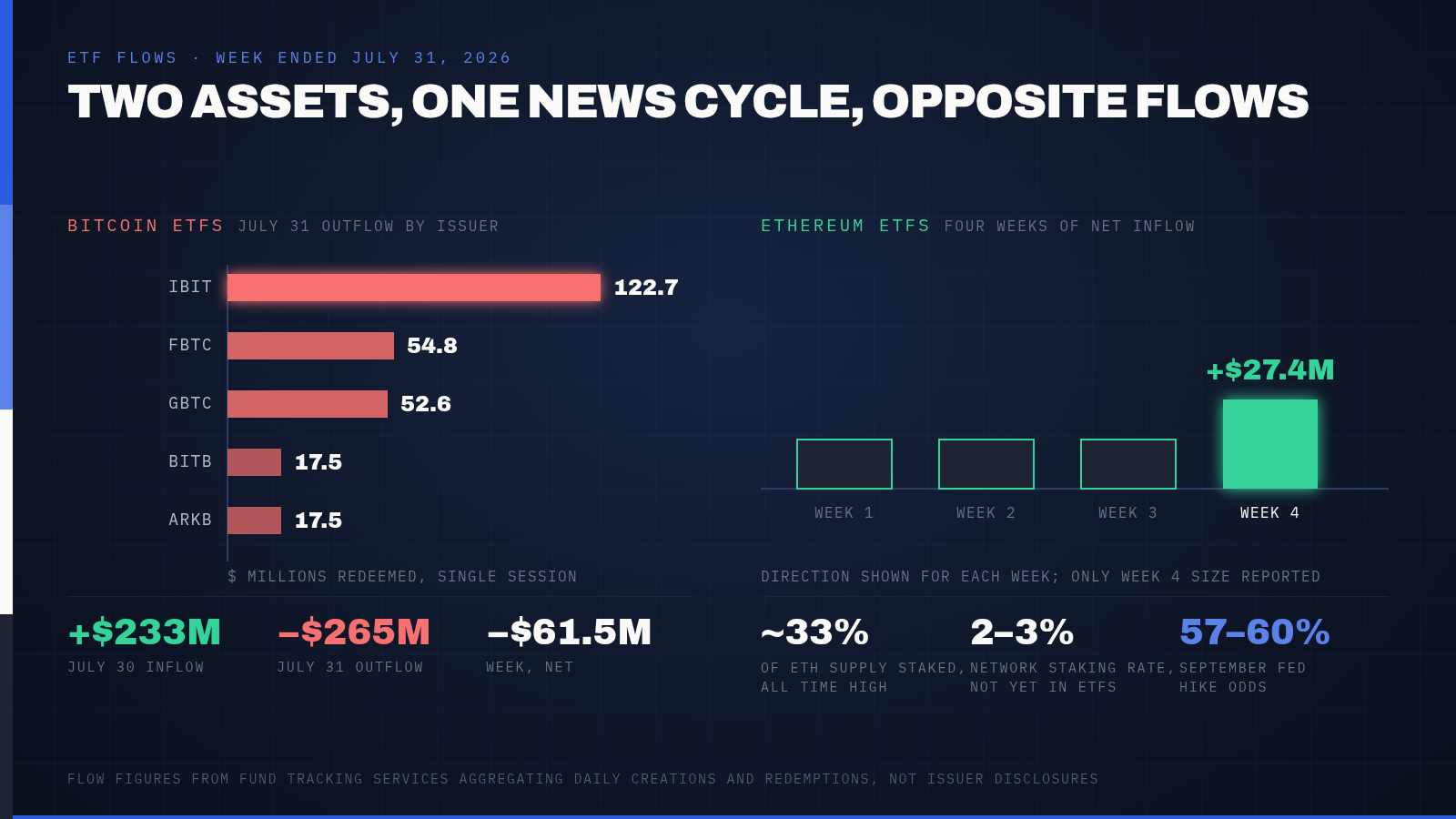
BlackRock's iShares Bitcoin Trust gave back $122.66 million on Friday, July 31. Fidelity's Wise Origin Bitcoin Fund lost another $54.78 million. Grayscale's Bitcoin Trust shed $52.63 million, and Bitwise's BITB and Ark Invest's ARKB gave up roughly $17.5 million apiece. Add it up and Bitcoin ETFs handed back $265.37 million in a single trading session, the largest one-day withdrawal from the group since July 13.
The timing is what makes it notable. A day earlier, on July 30, those same funds had pulled in $233.15 million, with BlackRock's IBIT responsible for $183.41 million of that total on its own. One session wiped out almost the entire prior day's gain and then some. Bitcoin's spot price moved the same direction: it fell 2.93% on July 31 to $62,929.27, before clawing back most of that loss over the weekend to trade near $64,700.
What Changed
Two developments in the days before the outflow explain most of it, and neither one starts with crypto. The first is the Fed's 9-3 vote to hold rates at 3.50% to 3.75% on July 29. What moved markets wasn't the hold itself, it was who dissented. Cleveland's Beth Hammack, Minneapolis' Neel Kashkari, and Dallas' Lorie Logan all voted for an immediate quarter-point hike, the first time three policymakers have dissented in the same direction since September 2016. Fed Chair Kevin Warsh described the committee's posture afterward as practicing "watchful thinking, not watchful waiting." Futures markets read that as a real signal: odds of a September hike climbed to somewhere between 57% and 60%, up sharply from where they sat before the meeting.
The second development is regulatory. The Digital Asset Market Clarity Act, the bill meant to settle which federal agency oversees crypto trading, cleared the House more than a year ago and passed the Senate Banking Committee in May. It has not moved since. Senate Majority Leader John Thune confirmed the bill won't get floor time before lawmakers leave for their August 7 recess, and passing cloture still requires 60 votes that Republicans' 53 seats don't cover on their own. Prediction markets have priced in the stall: Polymarket's odds of 2026 passage sat at 82% in February and had fallen to 28% by July 30, with Galaxy Digital cutting its own estimate to 30% over the same stretch.
Both of those landed in the same 48-hour window Bitcoin ETFs saw their outflow. Ethereum funds didn't follow. They took in $27.42 million for the week, extending a run that Ethereum's case against Bitcoin has been building for months, to four consecutive weeks of net inflows even as the broader crypto tape wobbled.
Why It Matters
A hawkish Fed and a stalled market-structure bill hit Bitcoin and Ethereum through different channels, which is why they didn't move the same way. Bitcoin has no yield of its own, so higher real rates raise its opportunity cost directly, the same mechanical pressure that's been pushing the 30-year Treasury yield to its highest level since 2007 and squeezing other long-duration assets. When September hike odds jump, holding a non-yielding asset gets marginally less attractive, and Friday's redemptions look like a fairly ordinary repricing rather than a panic.
Ethereum's inflows have a different driver. Roughly a third of circulating ETH is now locked in staking, an all-time high, which thins the supply actually available to trade and makes price more sensitive to whatever demand does show up. Institutional flows into Ethereum have kept building even as ETH trails Bitcoin on price this year, which points to real diversification rather than one asset simply substituting for the other. Staking-enabled ETF products remain unapproved, but issuers have said adding a yield component, at a network staking rate currently running in the 2% to 3% range, would turn the funds into something closer to a fixed-income product, and positioning ahead of that possibility looks like part of what's keeping Ethereum allocations sticky even as Bitcoin gets hit with rate-driven outflows.
What to Watch Next
The next scheduled Fed decision lands September 15-16, and the July and August CPI reports due before then will do most of the work of confirming or undercutting the current hike odds. On the regulatory side, whether Senate leadership revisits the Clarity Act after the August 7 recess, and whether any of the seven to ten Democratic votes needed for cloture materialize, will matter more to crypto positioning than any single day's price move. Bitcoin's recovery back toward $64,700 over the weekend is worth tracking too. It's a smaller round-trip than the move that first pushed it above $64,000 earlier this year, but a repeat break below $63,000 alongside another day of heavy ETF redemptions would suggest Friday's outflow was the start of a trend rather than a one-day rebalancing.
The Pulse24 Take
One session of ETF outflows doesn't make a trend, and Bitcoin's price recovering most of Friday's drop by Sunday is a reminder not to over-read a single day of fund flows. What's more interesting is that Bitcoin and Ethereum reacted to the same 48 hours of news in opposite directions. That's not typical. It suggests investors are starting to price the two assets on different logic: Bitcoin as a macro asset that gets squeezed when rate-hike odds rise, and Ethereum as something closer to a yield-bearing bet on network usage and a still-unapproved staking product. Whether that split holds through a September Fed decision and whatever's left of the Clarity Act's chances this year is the more useful question than Friday's headline number.
How we read the data
Curious how we get from raw data to a take like this? Our Trader's Toolkit walks through the tools we lean on.
Explore the Toolkit