Pulse24 Original
Coinbase Stock Gained 25% This Week. Binance Spent the Same Five Days Explaining a UAE Employee Probe to the New York Times, While the Bill Both Exchanges Are Waiting on Slipped to September Again.
August 24, 2026
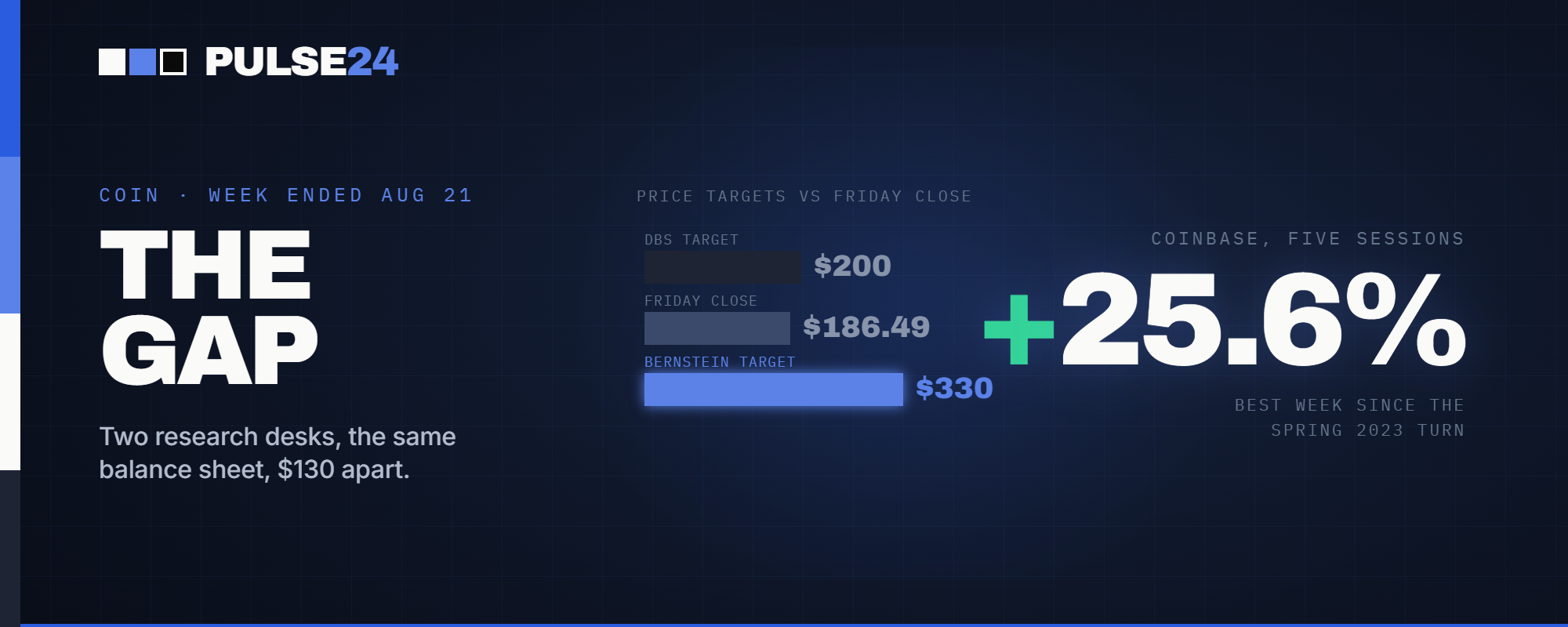
Coinbase stock jumped 25.6% this week to $186.49 while Binance confirmed two employees were questioned by UAE authorities over client fund flows. The CLARITY Act both exchanges are waiting on won't get a Senate vote until mid-September at the earliest.
Coinbase closed Friday at $186.49, a 25.6% gain for the week and its best five day run since Bitcoin's spring 2023 turn. Binance, the exchange most people still associate with the largest number in crypto trading volume, spent the same five days fielding questions from the New York Times about two employees pulled aside by authorities in the United Arab Emirates. Neither event alone explains the gap that opened between the two companies this week. Together, they point to something worth tracking as crypto matures: its largest venues are starting to trade on how exposed they are to regulators, not just on how much volume they clear.
What Changed
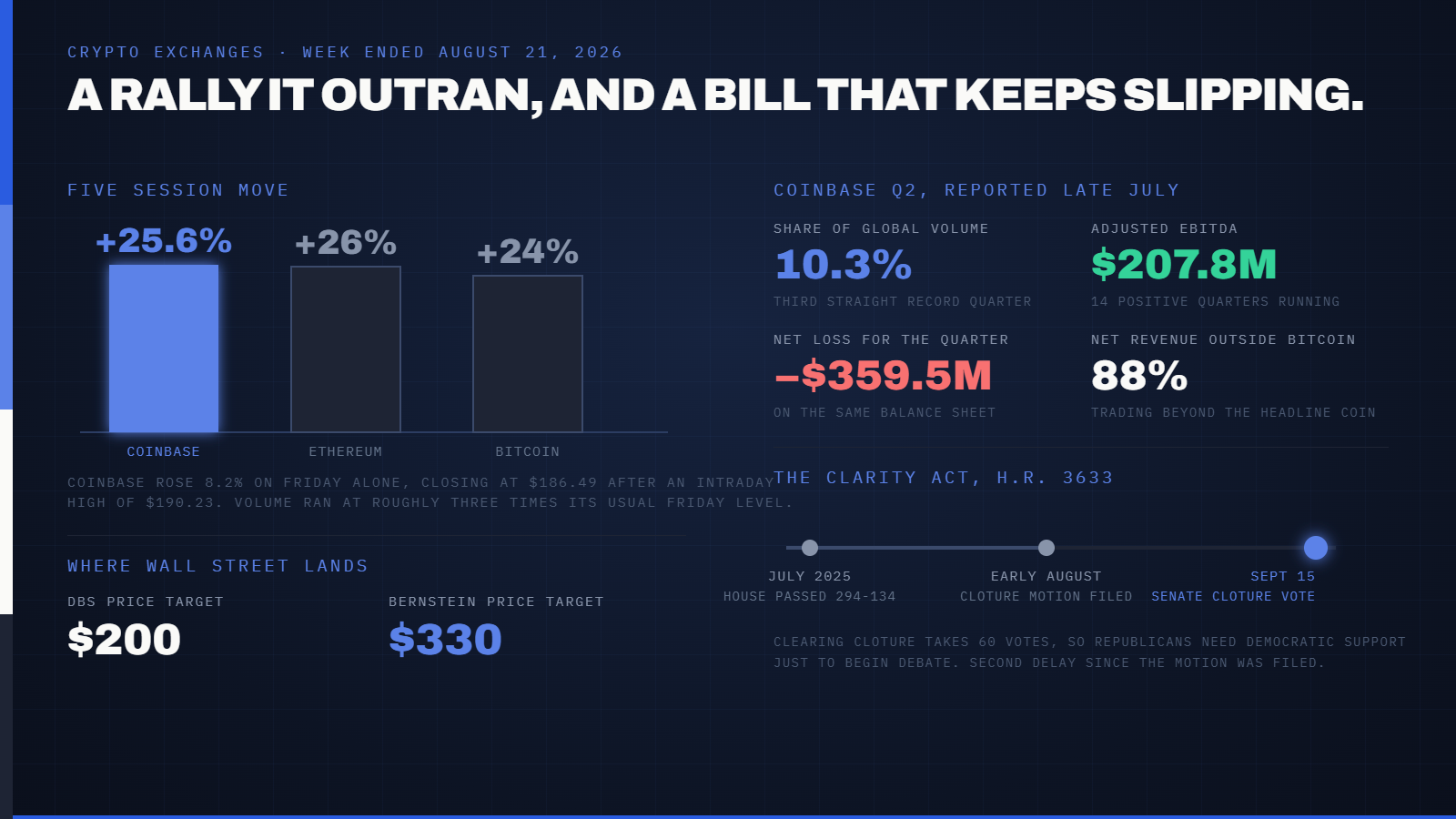
Bitcoin closed above $75,000 on Friday, touching an intraday high of $79,400, a gain of roughly 24% since Monday and its strongest week since March 2023. Ethereum climbed alongside it, approaching $2,400 for a weekly gain near 26%. Much of that move traces back to Wednesday, when the Treasury said it would at least double the size of its long term bond buybacks, the same announcement that lifted gold and risk assets broadly and helped feed the short squeeze that carried Bitcoin from a five day low near $62,884 toward $75,000 earlier in the week.
Coinbase moved further than either coin it trades. Shares gained 8.2% on Friday alone, touching an intraday high of $190.23 after closing Thursday at $172.35, before settling at $186.49. Volume ran at roughly three times the stock's usual Friday level. Some of that is straightforward beta: Coinbase's revenue leans heavily on trading activity, so a week with Bitcoin and Ethereum both up more than 20% tends to show up amplified in the stock. Beta alone doesn't explain why Coinbase outran the coins it trades by such a wide margin, though, or why the move accelerated on the same week its closest large competitor was fielding uncomfortable questions from regulators in the Middle East.
The New York Times reported Thursday that two Binance employees had been briefly detained and questioned by authorities in the United Arab Emirates in recent weeks, in connection with what the company later described as an inquiry into third party fund flows passing through a Binance client money account. Binance says the employees were not the focus of any investigation, were released, and that the company is cooperating with Dubai Police. Bloomberg followed the next day with its own reporting describing new scrutiny in what has generally been a crypto-friendly jurisdiction for the exchange. None of this amounts to a formal charge, and UAE authorities haven't confirmed what offense, if any, is being examined. For an exchange that operates largely outside the framework U.S.-listed Coinbase answers to, though, even an unresolved inquiry becomes a data point for anyone trying to judge counterparty risk.
Why It Matters
Regulatory clarity for crypto exchanges was supposed to arrive this year in the form of the CLARITY Act, the market structure bill the House passed in July 2025 by a 294 to 134 vote. Senate Majority Leader John Thune filed a cloture motion on the underlying bill, H.R. 3633, before lawmakers left for their August recess, but the chamber didn't take it up before leaving town. The Senate reconvenes September 14, and the cloture vote itself is now locked in for Tuesday, September 15 at 2:15 p.m. ET, the first full day lawmakers are back. Clearing that hurdle takes 60 votes, meaning Republicans need Democratic support just to begin debate, and even a successful cloture vote wouldn't resolve fights over stablecoin yield rules, anti-money-laundering language, and ethics provisions covering officials' own crypto holdings.
Coinbase CEO Brian Armstrong called the delay disappointing on social media, while crediting Thune's commitment to bring the bill up in September. President Trump separately pushed for what he called a fair version of the bill at a White House event Armstrong attended earlier this month. None of that changes the legal ground either exchange operates on today. What has shifted is how investors seem to be pricing the two companies relative to each other. A bill that hasn't passed can't hand Coinbase a formal advantage over Binance, but a market that expects it to eventually pass, paired with a fresh story about Binance's regulatory exposure, is enough to widen the gap in how the two get perceived.
That perception carries real numbers behind it on Coinbase's side. The company's Q2 report, released in late July, showed a record 10.3% share of global crypto trading volume, its third straight quarter setting that mark, according to CFO Alesia Haas. Adjusted EBITDA came in at $207.8 million, extending Coinbase's streak to 14 straight quarters of positive adjusted EBITDA, even as the company posted a net loss of $359.5 million for the period, with 88% of net revenue coming from trading outside Bitcoin itself. Growing market share while losing money on one measure and turning a profit on another is a genuinely mixed signal, and Wall Street has priced it that way. DBS holds a $200 price target on the stock, essentially a hold call from Friday's close. Bernstein sees $330, more than 70% above where shares finished the week. Two research desks looking at the same balance sheet and the same regulatory backdrop shouldn't land that far apart, and the size of the gap says more about how unsettled this story still is than either number does on its own.
What to Watch Next
Three things will decide whether this week's divergence holds or reverses. First, whether the UAE inquiry into Binance produces anything beyond the employee questioning already reported, since an escalation into formal enforcement would be a different story than a routine inquiry that quietly closes. Second, whether the Senate actually takes up the CLARITY Act in its first days back in September, given that Thune's cloture filing only guarantees a chance at a vote, not the votes themselves. Third, whether Coinbase's stock can hold gains built partly on a competitor's bad headlines once those headlines fade, since a rally that leans on someone else's stumble tends to give some of it back once that story moves past the front page.
Coinbase's own valuation gap is worth watching too. A $130 spread between DBS's and Bernstein's price targets is unusually wide for a company this size, and it should start narrowing once the CLARITY Act's fate becomes clearer in September, whichever direction that goes.
The Pulse24 Take
It's tempting to read this week as proof that regulation-friendly platforms are pulling ahead of offshore-style exchanges, but the timeline doesn't quite support that conclusion yet. The CLARITY Act hasn't passed. The UAE inquiry into Binance hasn't produced a charge. What actually moved this week was sentiment, helped along by a genuine crypto rally that lifted trading volume at every exchange regardless of where it's licensed. Coinbase getting the bigger lift than Binance is a real, measurable divergence, but calling it a structural shift assumes the story ends here. September will tell us more than August did. If the Senate votes and the bill clears its first hurdle, Coinbase's premium starts to look earned. If it stalls again, this week's gap may turn out to be a headline-driven blip that narrows once the news cycle moves past a UAE inquiry that never became anything more.
How we read the data
Curious how we get from raw data to a take like this? Our Trader's Toolkit walks through the tools we lean on.
Explore the Toolkit