Pulse24 Original
The Fed Raised Rates Wednesday. Two Days Later, the Bank of Japan Did Too, to a 31-Year High.
September 18, 2026
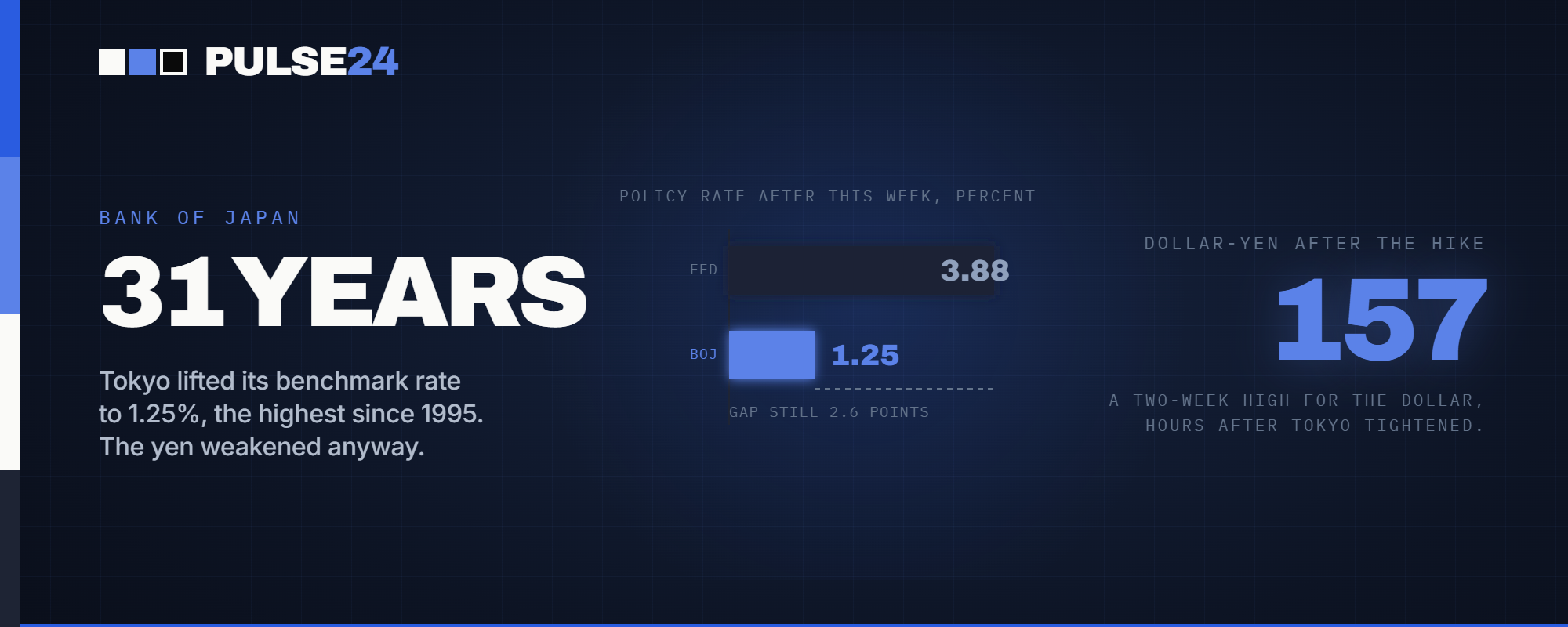
Japan's central bank lifted its benchmark rate to 1.25%, the highest level since 1995, two days after the Federal Reserve's own hike. The yen weakened on the news anyway, a reaction that says more about what's coming next than the move itself.
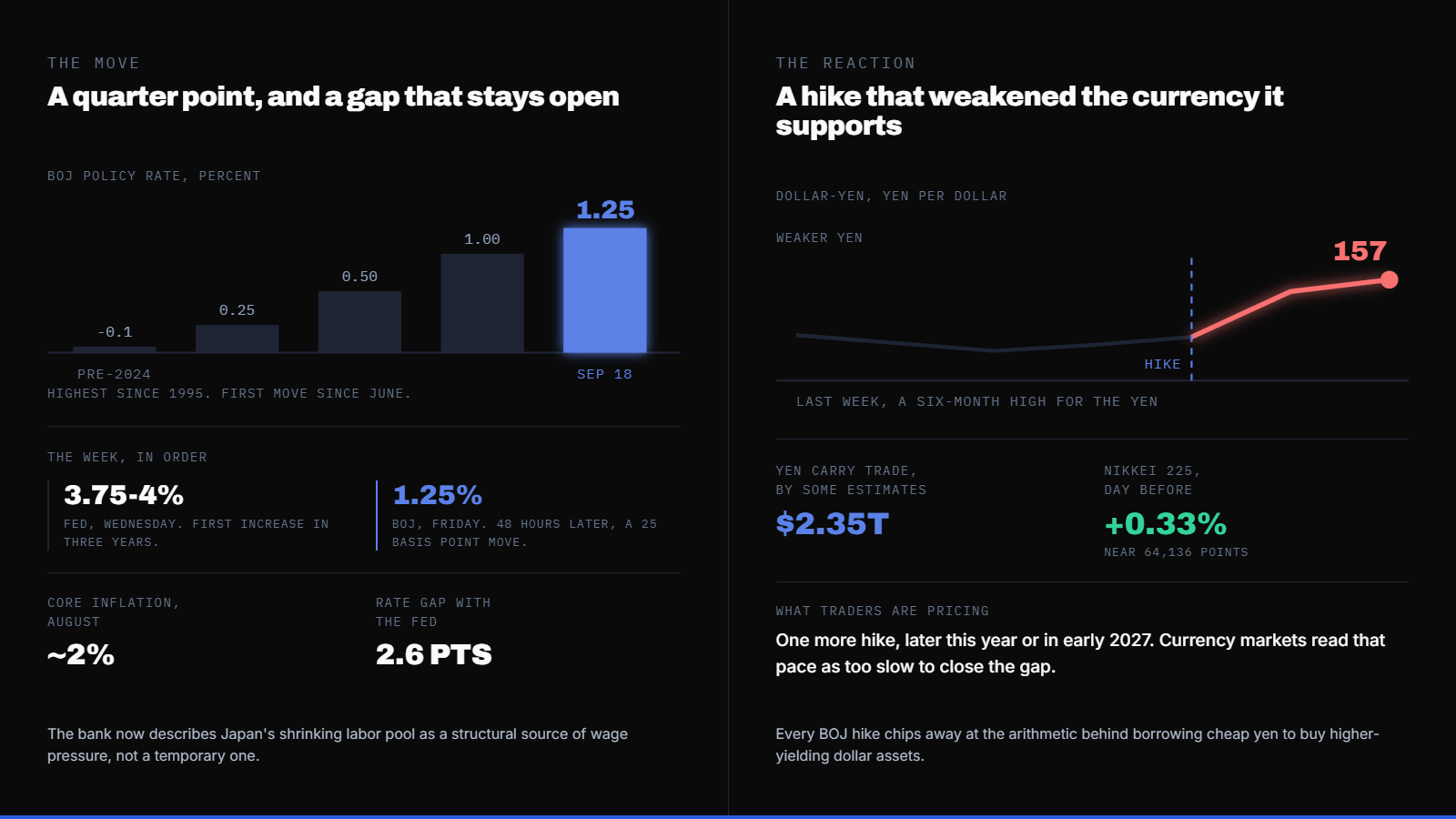
Japan's policy rate crossed 1.25% on Friday, a level the country hasn't touched since 1995. The Bank of Japan raised its benchmark rate a quarter point from 1.0%, its first move since June, capping a week in which two of the world's most important central banks tightened policy within 48 hours of each other.
What Changed
BOJ policymakers voted to lift the short-term rate to 1.25% at the end of a two-day meeting, citing inflation that has held stubbornly near the bank's 2% target through August. Rice, groceries, and energy costs have all been climbing, and Japanese households have noticed.
The bigger question was timing. The Federal Reserve raised its own rate to 3.75%-4% on Wednesday, its first increase in three years, and that added pressure on Tokyo to keep pace. A widening gap between the world's two largest bond markets tends to pull capital toward the higher-yielding one, and for most of the past two years that's meant capital drifting away from Japan and into the dollar.
BOJ Executive Director Koji Nakamura offered a different justification in the bank's post-meeting commentary: a shrinking labor pool that's lifting wages structurally, not temporarily. Japan's workforce has been contracting for years, and Nakamura's framing suggests the bank now sees that shortage as a lasting source of inflation pressure rather than a side effect of the post-pandemic recovery. For an institution that spent decades treating any inflation reading above zero as a fluke, that's a real shift in language.
The move had been telegraphed for days. The yen touched a six-month high against the dollar last week, and traders spent that stretch positioning for exactly this outcome: a hawkish Fed followed by a hawkish BOJ.
Why It Matters
The yen fell anyway, and that's the part worth sitting with. The dollar touched roughly 157 yen within hours of the announcement, a two-week high for the greenback and the opposite of what a rate hike is supposed to do to a currency.
Selling a currency into a rate hike sounds backward until you look at the reasoning. Traders had already priced in Friday's move; the real question was pace, not direction. The BOJ's language pointed to another hike as soon as later this year, or in early 2027, a pace international investors read as cautious rather than aggressive. A quarter point today with a vague promise of maybe one more next year doesn't close a rate gap that still leaves Japan's benchmark more than two and a half percentage points below the Fed's.
That gap is what's been fueling Japan's carry trade for years: the practice of borrowing cheap yen to fund purchases of higher-yielding dollar assets. That trade has swollen to roughly $2.35 trillion by some estimates, and every BOJ hike chips away at the arithmetic that makes it profitable. Friday's move didn't break the trade. It just made it a little less comfortable.
Japan's Nikkei 225 was little changed heading into the decision, sitting near 64,136 points the day before, up a cautious 0.33% as investors waited to see which way the announcement would break. Exporters, whose earnings get squeezed when the yen strengthens, had the most riding on the outcome.
What to Watch Next
Two things matter more than Friday's headline number now. First, whether the BOJ actually delivers the next hike analysts are penciling in for later this year or early 2027, or whether Governor Kazuo Ueda's traditionally dovish tone in press briefings pushes that timeline out again, as it has before. Second, whether the yen's muted reaction hardens into something sharper. Currency markets have a habit of ignoring a policy shift for weeks before repricing all at once, and a sudden yen rally would ripple through Japanese exporter earnings and the carry trade positions still funding parts of the AI infrastructure buildout in the US.
Japanese inflation data in the coming months will also test Nakamura's demographic argument. If wage growth keeps climbing even as global energy prices cool, that's a structural story the BOJ can't hike its way out of quickly.
The Pulse24 Take
A rate hike that weakens the currency it's meant to support is a signal, not a contradiction. Markets aren't saying the BOJ got the decision wrong. They're saying the size of the move doesn't match the size of the gap it's trying to close. Japan spent the better part of three decades near zero rates, and unwinding that takes more than a quarter point and a promise to maybe do one more next year.
The more interesting question isn't whether Japan raises rates again. It's whether the rest of the world adjusts its yen-funded bets before Japan forces the issue.
How we read the data
Curious how we get from raw data to a take like this? Our Trader's Toolkit walks through the tools we lean on.
Explore the Toolkit