Pulse24 Original
Memory Chips Are Now 23% of a Laptop's Bill of Materials, Up From 16% a Year Ago. Global PC Shipments Are Falling the Fastest in a Decade.
September 22, 2026
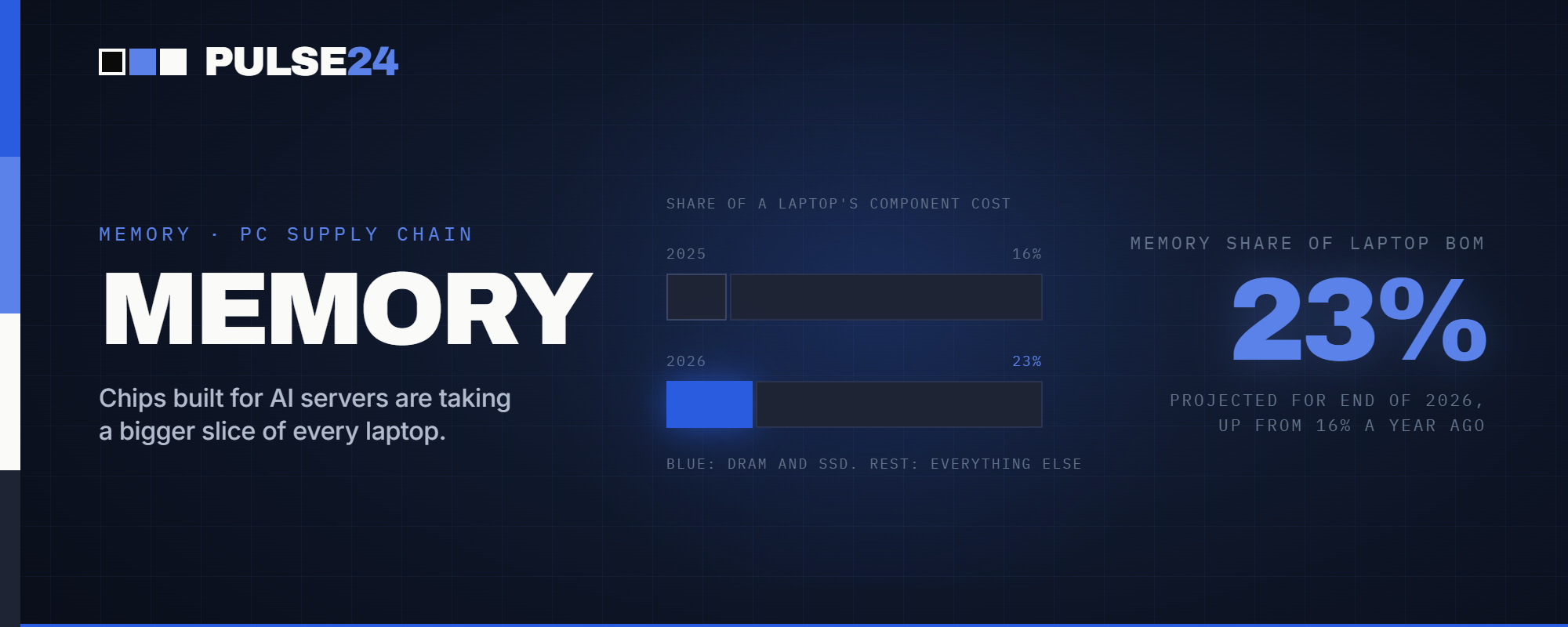
Memory built for AI servers is eating into laptop and phone budgets, with combined DRAM and SSD costs up roughly 130% this year and the sub-$500 laptop on track to disappear by 2028. A fresh TrendForce reading shows the first signs of cooling, though contract prices haven't caught up yet.
Sixteen percent. That was memory's share of a typical laptop's bill of materials a year ago, according to Gartner data reported by Tom's Hardware. By the end of 2026, that share is projected to hit 23%, with combined DRAM and SSD costs up roughly 130% over the same stretch. Laptop prices overall are running about 17% above 2025 levels, and the culprit isn't a chip shortage in the traditional sense. It's a chip surplus that keeps getting routed somewhere else.
The memory business has spent 2026 reorganizing itself around artificial intelligence servers, and consumer electronics is absorbing what's left over. Samsung, SK Hynix, and Micron control most of the world's DRAM and NAND flash supply, and all three have spent the year prioritizing high-bandwidth memory and server DRAM for hyperscale data centers over the SO-DIMMs and mobile chips that go into phones and laptops. The result is a price cycle that started in AI infrastructure budgets and is now showing up on store shelves.
What Changed
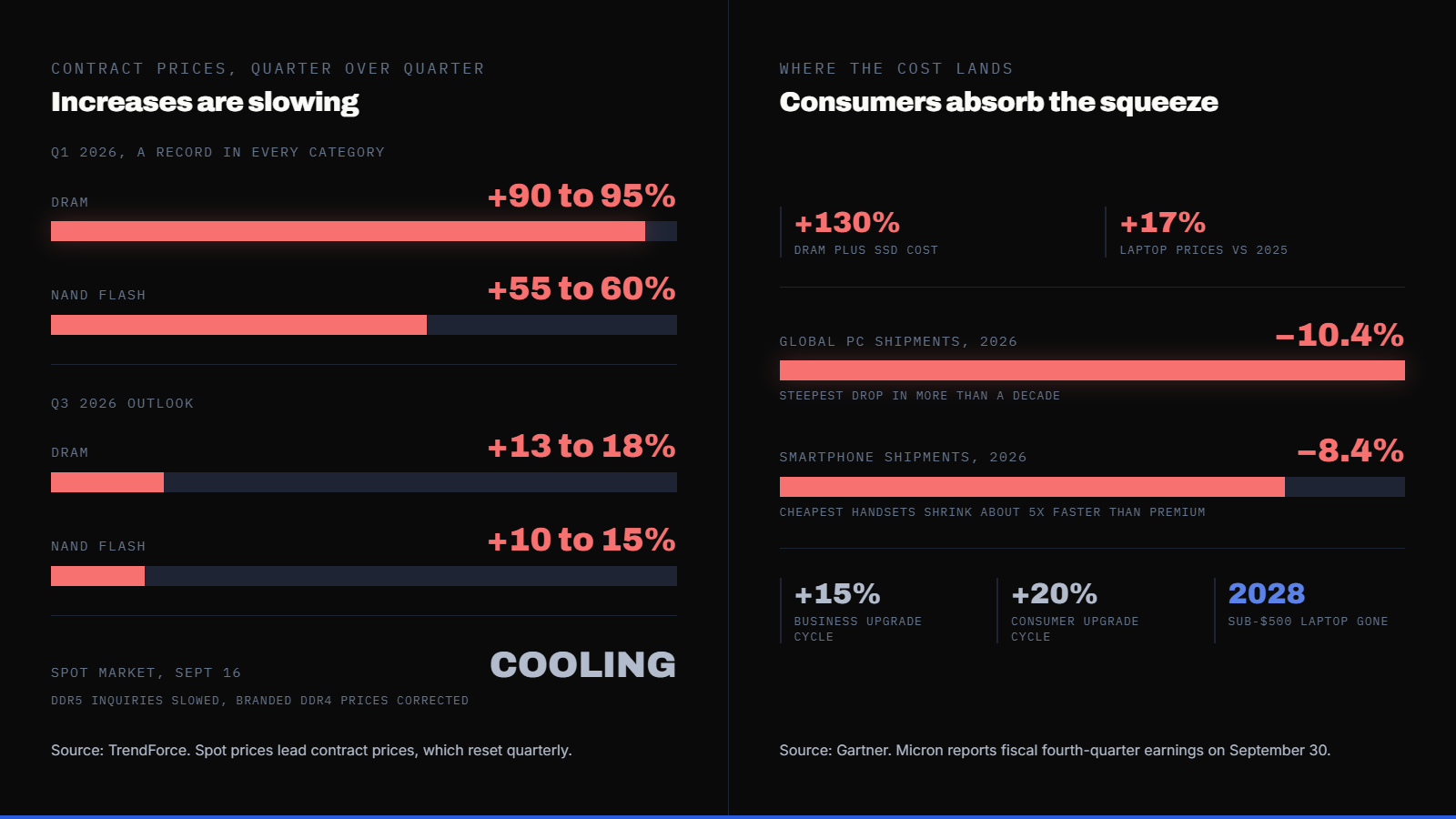
TrendForce called the first quarter of 2026 a record across the board. Conventional DRAM contract prices rose 90% to 95% quarter over quarter, PC DRAM cleared 100%, and server DRAM climbed roughly 90%, the largest quarterly increase the firm has on record. NAND flash wasn't far behind, with contract prices up 55% to 60% and enterprise SSDs up 53% to 58%. TrendForce attributed the surge to what it called a global memory supply and demand imbalance driven by persistent AI and data center demand.
That pace has since slowed, though prices haven't stopped climbing. TrendForce's outlook for the third quarter puts DRAM up 13% to 18% quarter over quarter and NAND up 10% to 15%, meaningfully cooler than the first quarter's numbers but still a real increase layered on top of an already elevated base. The firm points to three forces behind the deceleration: consumer buyers hitting an affordability ceiling, a high comparison base from the prior quarter's spike, and smartphone brands adopting what TrendForce describes as increasingly conservative procurement strategies.
A more recent signal suggests the top may be forming. TrendForce's spot-price update from September 16 reported that buyer inquiries for DDR5 chips slowed and that branded DDR4 2Gx8 chips saw what the firm called relatively pronounced price corrections, though it noted no clear buying interest has emerged yet to absorb the available supply. Spot prices move ahead of contract prices, which are typically negotiated quarterly between suppliers and large buyers, so a cooling spot market doesn't guarantee contract prices follow immediately. It's an early signal worth tracking rather than a confirmed turn.
Why It Matters
The AI side of this story is straightforward. Hyperscale data center operators building gigawatt-scale AI infrastructure need enormous amounts of server memory, and Nvidia's own push into custom high-bandwidth memory design is part of why memory makers keep shifting capacity toward server-grade products. x86 general-purpose servers running RDIMM configurations remain the primary platform for the agentic AI workloads hyperscalers are racing to deploy, and TrendForce expects that server demand to stay strong through 2027 as CPU availability improves. When a cloud provider needs to rent capacity from a competitor just to keep its own services running, memory allocated to AI servers isn't going into a laptop instead.
The consumer side is where the AI boom's costs become visible to people who never bought an AI subscription. Gartner senior director analyst Ranjit Atwal said the shift "removes vendors' ability to absorb costs, making low-margin entry-level laptops nonviable." Global PC shipments are projected to contract 10.4% in 2026, the steepest drop in more than a decade, and smartphone shipments are set to fall 8.4%, with the cheapest handsets shrinking roughly five times faster than premium models. PC upgrade cycles are stretching too, by about 15% for businesses and 20% for consumers, as buyers hold onto older hardware rather than pay up. Gartner now expects sub-$500 laptops to vanish from the market by 2028, and the timeline some manufacturers had for cheaper AI-capable PCs is slipping to that same year.
None of this means the memory makers are struggling. Elevated prices on constrained supply are good for margins even when unit volumes fall, which is exactly the tradeoff Samsung, SK Hynix, and Micron have been making all year. Consumers and the PC and smartphone makers selling to them are the ones absorbing the squeeze, first through thinner margins and increasingly through higher sticker prices.
What to Watch Next
Micron reports fiscal fourth-quarter results on September 30, and its commentary on both server and consumer memory demand will be the first real data point since the September spot-price cooling began. If Micron and its peers signal that server allocation is easing even slightly, that would mark a meaningful shift after a year of AI demand crowding out nearly everything else. TrendForce's own commentary around the September spot data describes current conditions as showing early signs of cooling, with buyers turning more cautious on both DDR4 and DDR5, but the firm stops short of calling a clean turn, which points to continued volatility rather than a clean resolution either way.
The bigger question is whether the entry-level PC and smartphone markets Gartner expects to shrink actually do, or whether manufacturers find ways to hold the line through late 2026 and into 2027. Either answer says something about how durable AI's claim on global chip supply really is, and how long consumer electronics has to keep paying for it.
The Pulse24 Take
This is what an AI infrastructure boom looks like once it stops being an abstraction. Every gigawatt of AI data center capacity that gets built needs memory chips, and memory supply doesn't expand as fast as capital does. Something has to give, and for most of 2026 that something has been the consumer electronics supply chain, first in manufacturer margins and now increasingly in the prices shoppers see.
The September 16 spot-price data is the first real hint that the cycle might be topping, but one week of softer DDR5 inquiries isn't a trend on its own. Memory markets have overshot and corrected sharply before, in both directions. Until contract prices, not just spot quotes, start moving the other way, the more durable story is still the one Gartner is describing: a market where cheap laptops and budget phones quietly stop being something manufacturers can afford to make.
How we read the data
Curious how we get from raw data to a take like this? Our Trader's Toolkit walks through the tools we lean on.
Explore the Toolkit