Pulse24 Original
Broadcom's AI Chip Revenue Tripled Last Quarter. Nvidia's Newest Memory Design Targets the One Partnership It Doesn't Have.
September 15, 2026
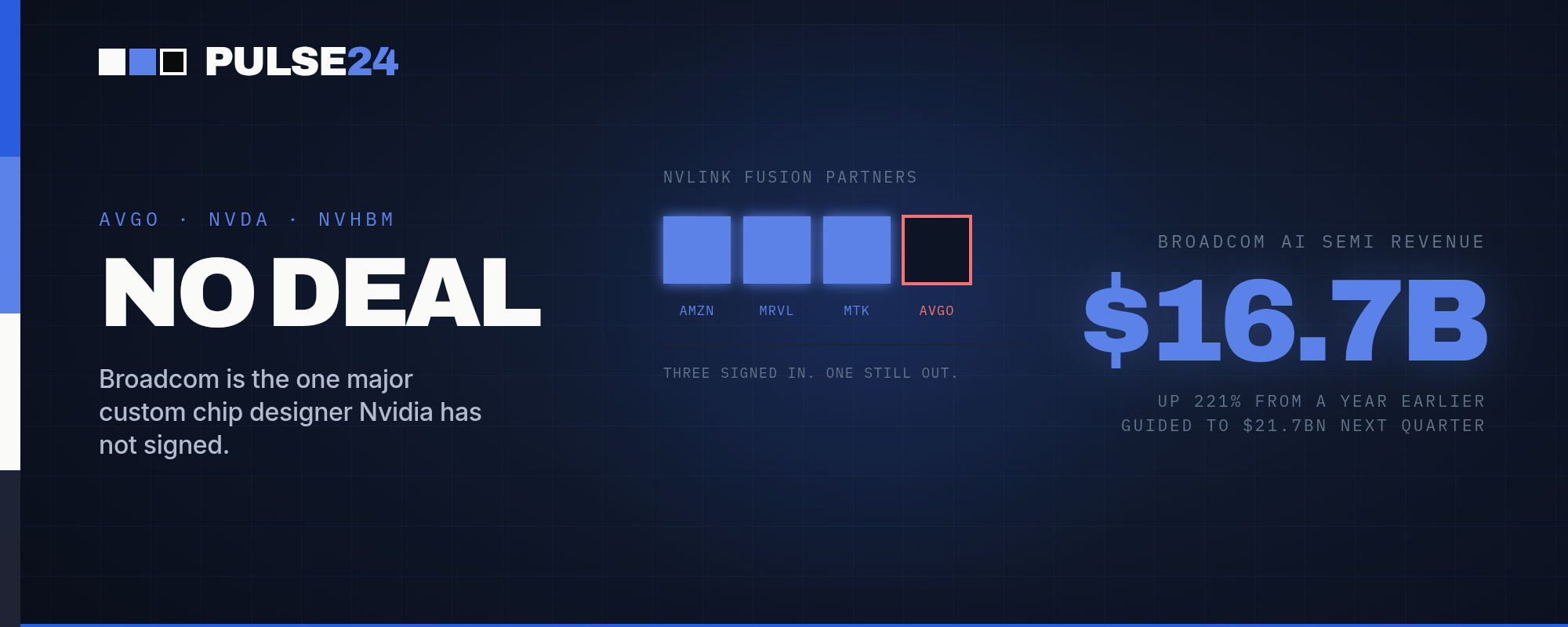
Nvidia quietly redesigned how AI chips talk to memory, and the new architecture reaches into territory Broadcom has mostly had to itself. The timing lands a week after Broadcom reported a record AI semiconductor quarter.
Nvidia published a blog post on August 26 describing a new way to build memory for AI chips. A week later, on September 2, Broadcom reported $16.7 billion in AI semiconductor revenue for the quarter, up 221% from a year earlier, part of $29.6 billion in total revenue growing 86%. Nvidia's design change and Broadcom's earnings call are more connected than the seven days between them suggests.
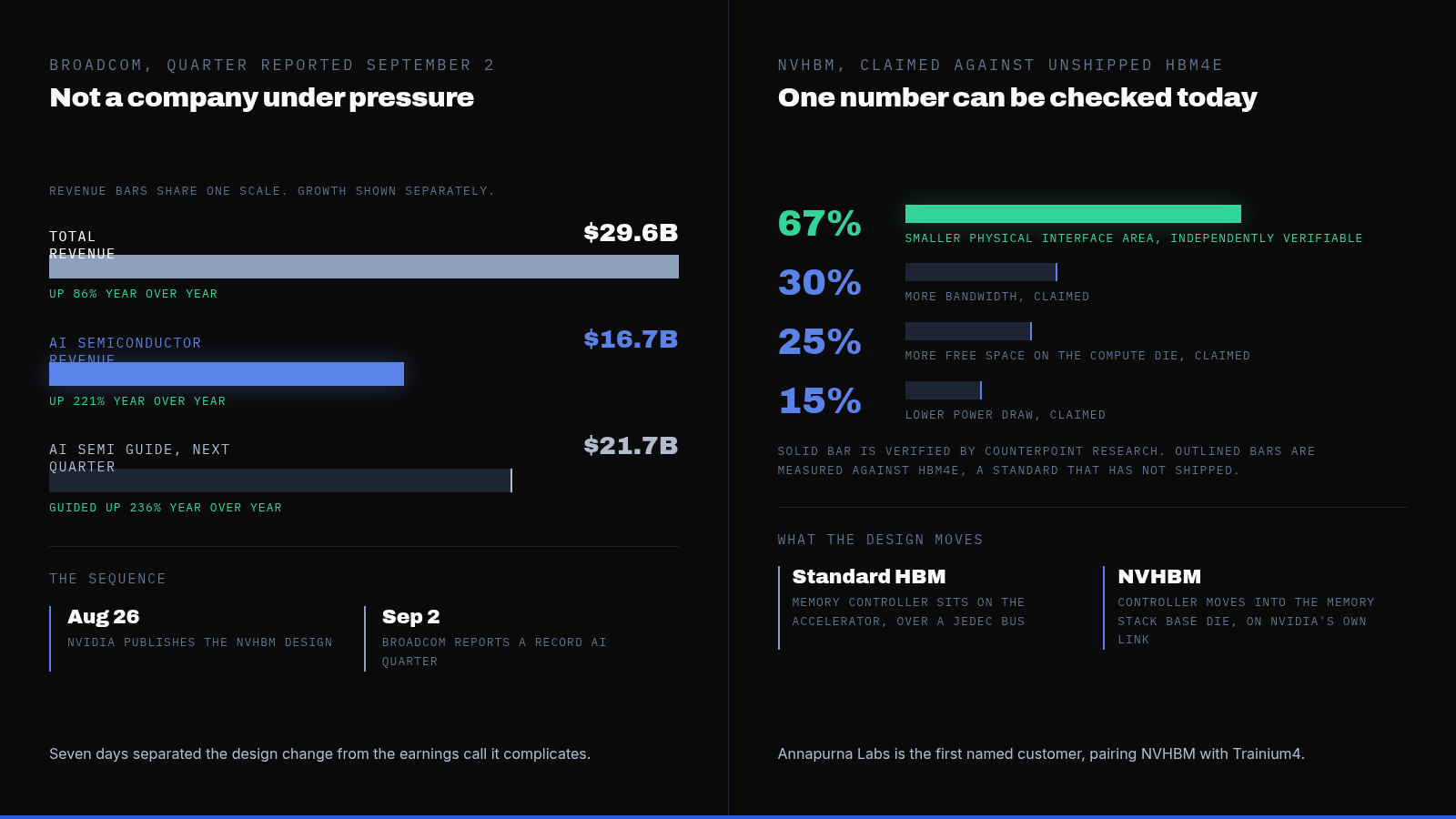
The August post introduced NVHBM, Nvidia's custom version of high-bandwidth memory built for its NVLink Fusion ecosystem. Instead of leaving the memory controller on the AI accelerator chip, where every other HBM implementation puts it, Nvidia moved the controller into the base die of the memory stack and replaced the industry-standard JEDEC memory bus with its own proprietary connection. Custom AI chip design, the business of building processors for Amazon, Google, and Meta as alternatives to Nvidia's own GPUs, has largely belonged to Broadcom and, to a smaller degree, Marvell. NVHBM gives Nvidia a way into that business without designing a single custom accelerator itself.
What Changed
Amazon's Annapurna Labs is the first customer Nvidia has named, and it plans to pair NVHBM with Trainium4, the chip design unit's next-generation processor. Nafea Bshara, the Annapurna Labs vice president, described NVHBM as "a new architectural approach to advancing high-bandwidth memory performance and efficiency." MediaTek has also adopted NVLink Fusion, and Marvell brought its own custom HBM and die-to-die interconnect work into NVLink Fusion when it joined the partnership in May 2025. Nvidia is positioning NVHBM as a standard other memory makers can build to, not a one-off product for Nvidia's own use, which is what would make it consequential for competitors if adoption spreads.
On paper, the performance case is straightforward. Nvidia says NVHBM delivers up to 30% more bandwidth and 15% lower power draw than standard HBM4E, while freeing up to 25% more space on the compute die itself. Counterpoint Research isn't convinced all of that holds up yet. The research firm points out that HBM4E hasn't shipped, so Nvidia is comparing its new design against a standard that exists mostly on paper, and calls the 67% reduction in physical interface area the only claim in the announcement it can independently verify right now.
Why It Matters
Broadcom's numbers from September 2 are genuinely strong. AI semiconductor revenue of $16.7 billion this quarter, up 221% from a year earlier, inside $29.6 billion of total revenue growing 86% year over year, is not a company under pressure. Broadcom guided next quarter's AI semiconductor revenue even higher, to $21.7 billion, up 236% year over year. That's what makes the NVHBM timing worth paying attention to. Broadcom built its custom chip franchise by giving hyperscalers an alternative to buying GPUs from Nvidia at Nvidia's prices. If Nvidia can offer comparable memory performance to those same hyperscalers as part of its own ecosystem, the case for going the full-custom route gets a little weaker at the margin, even if it doesn't disappear.
This isn't happening in isolation from the rest of the memory market. South Korean DRAM exports are now worth about two-thirds their weight in gold, and Nvidia's own supply contracts help explain why: the company's purchase commitments for memory jumped from $119 billion to $279 billion in a single quarter, a jump buried inside its own August earnings report. A buyer with that much leverage over the memory supply chain has every incentive to control more of how that memory actually connects to its chips, not just how much of it gets bought.
Analysts covering the announcement have noted that Broadcom is, for now, the only major custom AI chip design company without a direct Nvidia partnership. That's a notable gap for a company this size, and it isn't obvious whether closing it would look like a partnership, a licensing arrangement, or nothing at all. What is clear is that Nvidia now has a credible technical argument to offer hyperscalers who might otherwise have gone the full-custom route, an argument that didn't exist three weeks ago.
What to Watch Next
Broadcom's next earnings call is the first real test of how much this matters. Watch for direct questions about NVHBM and how management frames the durability of its custom silicon moat. Adoption is the other thing to track: right now NVHBM has one named chip customer in Annapurna Labs and one additional platform partner in MediaTek. A longer list by the fourth quarter, particularly among hyperscalers currently building custom chips with Broadcom, would move this from a theoretical threat to a concrete one. A list that stays at two names would look more like Nvidia hedging a bet than reshaping the industry.
Counterpoint's skepticism deserves its own follow-up. HBM4E hasn't shipped, so Nvidia's headline bandwidth and power numbers can't be checked against real silicon yet. Whether those claims hold up once the chips are actually running will matter as much as who signs on to use them.
The Pulse24 Take
Broadcom didn't do anything wrong here. Its September 2 numbers were about as strong as a chip company's numbers get, and nothing about NVHBM changes what it reported that day. What changed is the assumption sitting underneath Broadcom's premium valuation, that custom silicon design is a moat Nvidia can't easily cross into. Nvidia just showed one way across, even if it hasn't proven yet that the bridge holds weight.
None of this means Broadcom's custom chip business is suddenly at risk. Hyperscalers don't rewrite years of chip design roadmaps because of one blog post, and Counterpoint's questions about unshipped benchmarks are a real caveat, not a technicality. But investors pricing Broadcom's custom silicon franchise as untouchable by Nvidia now have a specific, dated reason to ask whether that's still true. Three weeks ago, they didn't.
How we read the data
Curious how we get from raw data to a take like this? Our Trader's Toolkit walks through the tools we lean on.
Explore the Toolkit