Pulse24 Original
Nike Lost $207 Billion in Market Value. Four AI Infrastructure Stocks Took Its Spot in the S&P 100.
September 27, 2026
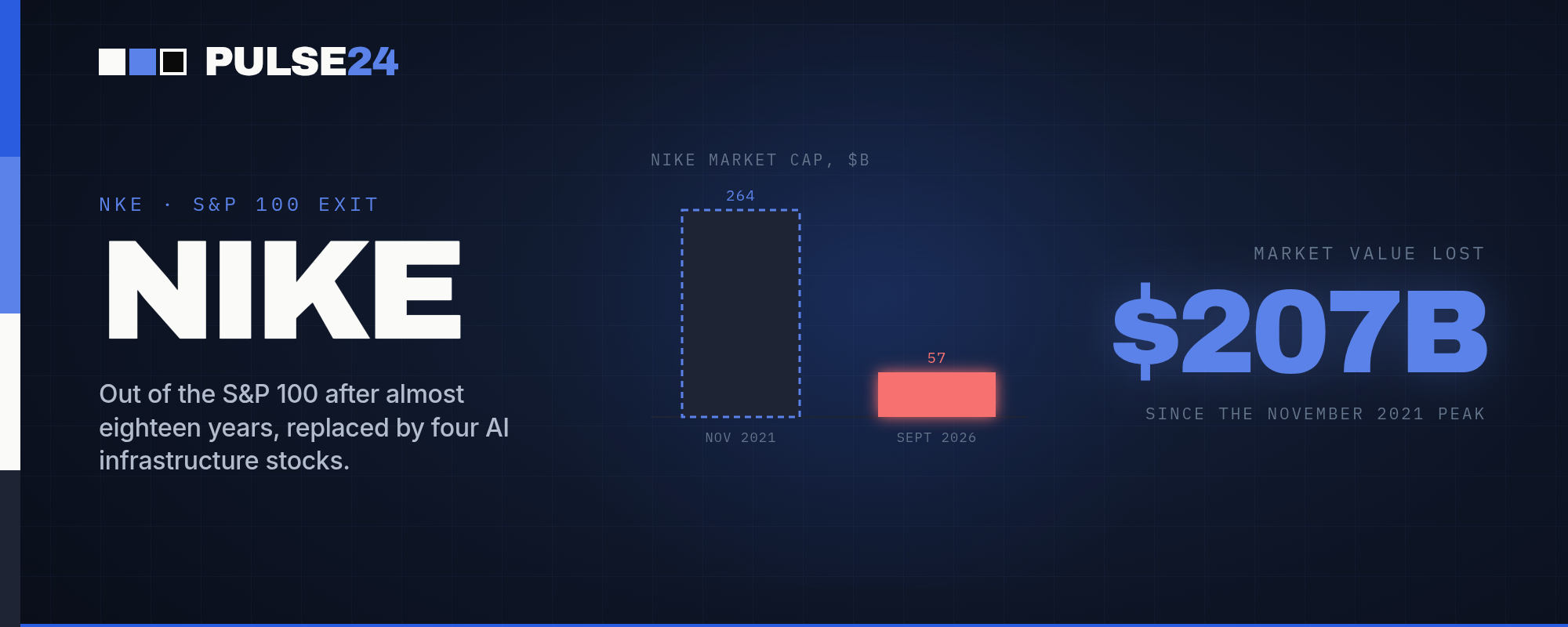
Nike's eighteen-year run in the S&P 100 ended on September 21, replaced in a single trading session by Dell, Palo Alto Networks, Arista Networks, and Sandisk. The swap says as much about where capital is flowing as it does about Nike's own turnaround problem.
Nike joined the S&P 100 in December 2008, the same month General Motors was fighting for survival during the financial crisis. The sneaker company held its seat in that index for almost eighteen years. On September 21, it lost that seat in a single trading session, replaced by Dell Technologies, Palo Alto Networks, Arista Networks, and Sandisk. None of the four make apparel. All four sell something used to build, run, or secure AI infrastructure.
What Changed
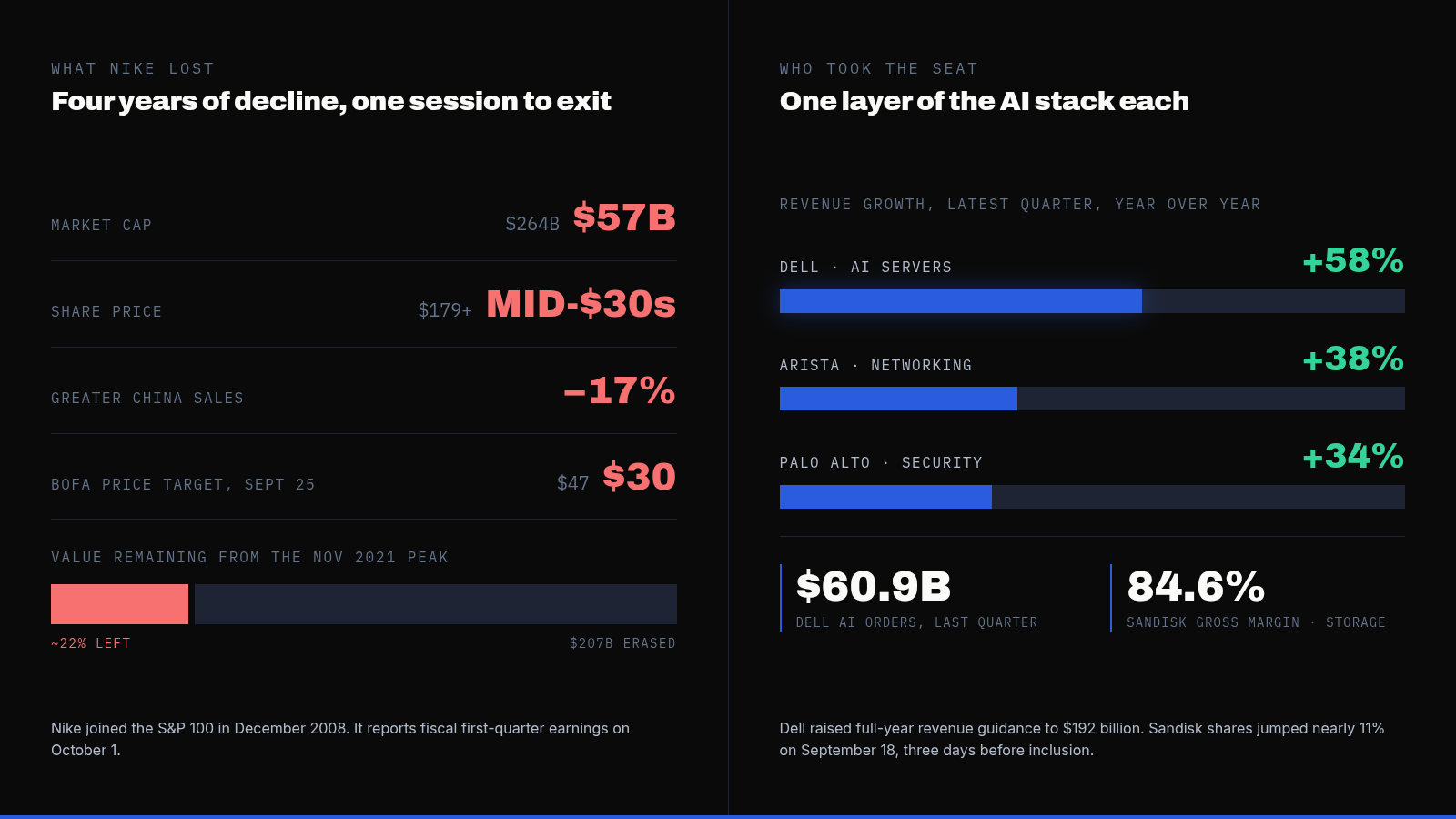
S&P Dow Jones Indices announced the swap earlier in September and made it effective at the market open on September 21. Nike's market capitalization had fallen to about $57 billion from a peak near $264 billion in November 2021, a drop of roughly 78% driven by inventory backlogs, a stumbling direct-to-consumer strategy, and a 17% sales decline in Greater China. The stock traded in the mid-$30s that Friday, down from a 2021 high above $179. Simon Property Group, Honeywell Aerospace, and Colgate-Palmolive left the index in the same reshuffle, though Nike's exit drew most of the attention given how long it had held its seat.
The four replacements tell a fairly specific story about where growth is concentrated right now. Dell's infrastructure business, the unit that sells AI servers to cloud providers and enterprises, grew revenue 89% year over year last quarter to $31.8 billion, and the company now expects AI server sales to roughly triple this year to $74 billion. Arista Networks, which builds the networking gear that connects those servers inside a data center, grew revenue 38% last quarter and guided to 40% growth for the year. Palo Alto Networks, added for its cybersecurity platform rather than anything AI-specific, still grew revenue 34% as enterprises spend more to secure the infrastructure they're building. Sandisk makes the NAND flash memory that stores the data those systems train on, and its inclusion lands in the middle of the same memory supercycle that has pushed Micron's stock up sharply this year, with gross margins that reached 84.6% in its most recent quarter as memory prices climb.
Why It Matters
Index membership isn't just a symbolic honor. Funds that track the S&P 100, along with options and derivatives tied to it, have to buy the stocks going in and sell the ones coming out to match the benchmark. That mechanical flow doesn't determine long-term value, but it does add real buying pressure to Dell, Arista, Palo Alto Networks, and Sandisk in the near term, and it removed a source of passive demand for Nike at the exact moment its business fundamentals were already weak. Sandisk shares had already jumped nearly 11% in a single session on September 18, three days before their official debut in the index, a move that reflects anticipation of the inclusion combined with broader excitement around its AI-adjacent memory business.
The bigger point is what the swap says about capital allocation across the economy. The S&P 100 is supposed to represent the largest, most liquid companies in the American market, and for almost two decades that included a consumer brand built on advertising and retail distribution. It now includes four companies whose growth is tied directly to the buildout of AI data centers, each occupying a different layer of that stack: compute, networking, security, and storage. That is a real shift in what counts as a blue-chip business, not just a reshuffling of index weights. It also leaves the S&P 100 more concentrated in a single theme than it was a month ago, which cuts both ways if AI infrastructure spending ever slows.
What to Watch Next
Nike reports fiscal first-quarter earnings on October 1, and that report will say more about whether the stock has found a floor than the index exit did. Bank of America's September 25 downgrade, which cut its price target to $30 from $47 and flagged that Nike's dividend could exceed net income under its lowered earnings estimates, suggests at least some analysts think the bad news isn't finished. On the other side, watch whether Dell, Arista, and Sandisk can grow into their new index weight. Arista trades at a forward price-to-earnings ratio near 37, well above the market average, so any slowdown in AI infrastructure orders would hit that stock harder than it would a cheaper name. The next full index rebalance will show whether this quarter's swap was a one-time correction or the start of a pattern.
The Pulse24 Take
Framing this as old economy losing to new economy is easy and mostly wrong. Nike's problems trace back to years of direct-to-consumer missteps and inventory mismanagement, not some inevitable consequence of an AI-driven economy. The four companies replacing it aren't cheap either. Arista's valuation already prices in years of continued growth, and Sandisk's memory business is riding a supercycle that has historically been prone to sharp reversals once supply catches up with demand.
What the index swap does capture accurately is where the market's attention and capital are pointed this year. When S&P Dow Jones Indices needed a liquid, large-cap replacement for an underperforming consumer name, it reached for AI infrastructure four times over. That is worth watching not because it predicts Nike's future or guarantees Dell's, but because it is a clean, quantifiable snapshot of how much the market's definition of a blue-chip company has moved in less than two decades.
How we read the data
Curious how we get from raw data to a take like this? Our Trader's Toolkit walks through the tools we lean on.
Explore the Toolkit