Pulse24 Original
Wall Street Can't Agree on Micron's Value. Price Targets Range From $1,100 to $2,200.
September 24, 2026
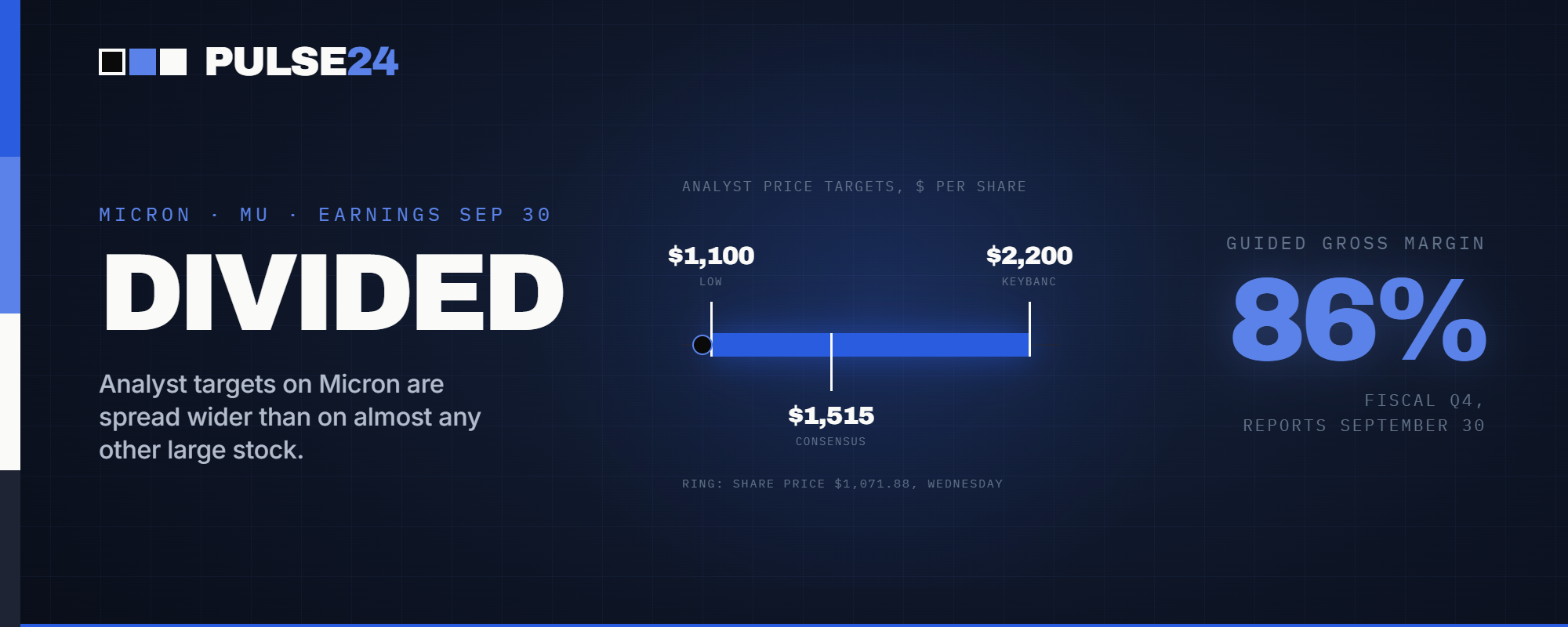
Analyst price targets on Micron span from $1,100 to $2,200, one of the widest ranges attached to any large-cap stock right now. The stock's own swings this week, up 5% Tuesday and down 2.2% Wednesday, suggest investors are about as divided heading into September 30 earnings.
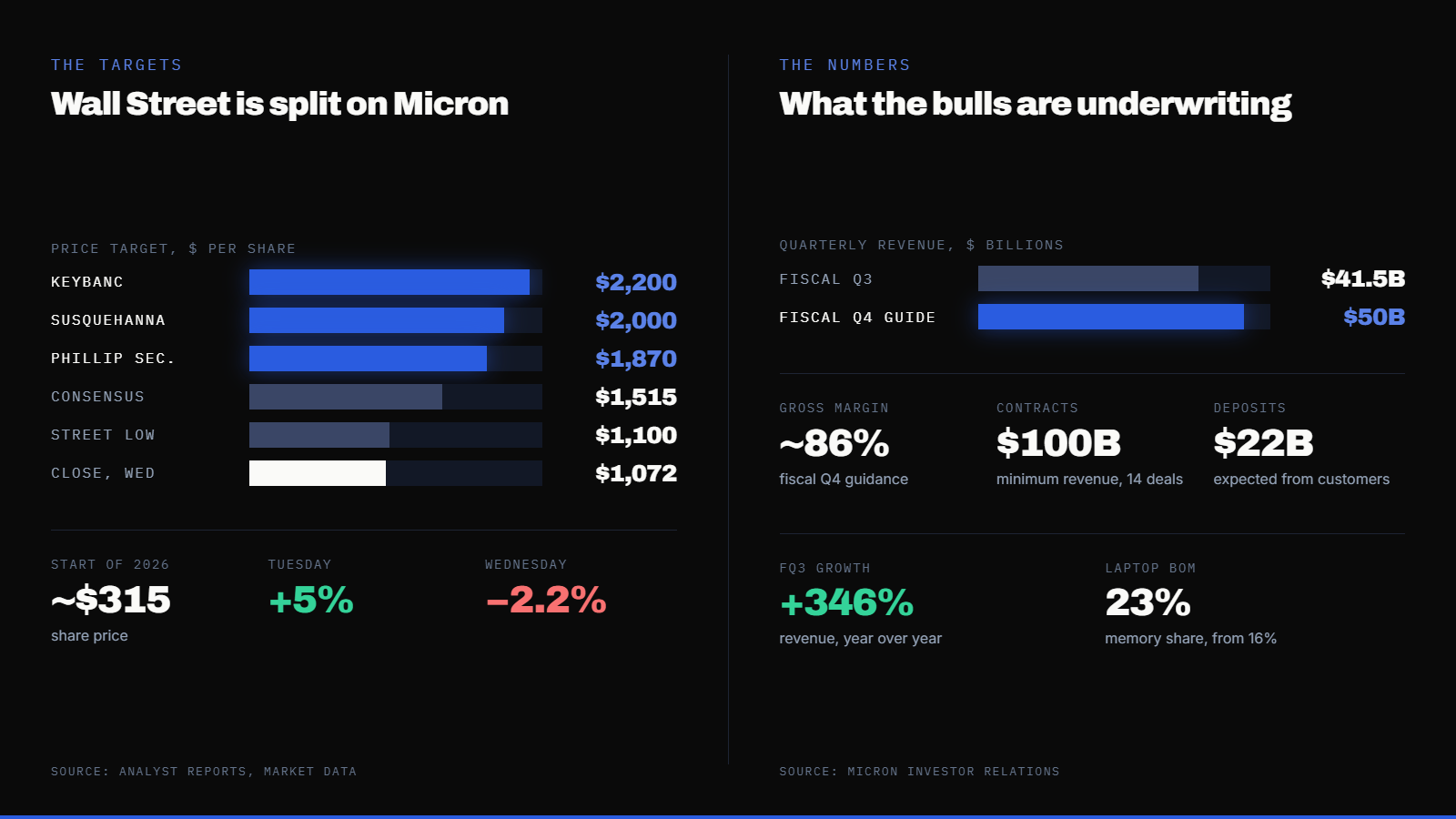
Micron Technology's price targets on Wall Street span from $1,100 to $2,200, one of the widest ranges attached to any large, actively covered stock right now. KeyBanc's John Vinh holds the Street-high number, last reiterated in mid-July. Susquehanna set its own target at $2,000 in late June, and Phillip Securities followed with $1,870 in July, both citing the same catalyst: a set of long-term supply contracts Micron signed after reporting record fiscal third-quarter results. Those targets are still standing as Micron heads into fiscal fourth-quarter earnings on September 30, even as the stock itself has been anything but steady this week, adding 5% on Tuesday and giving back 2.2% on Wednesday.
What Changed
The stock has been volatile heading into the print. Micron shares closed at $1,071.88 on Wednesday, down 2.2% for the day, after adding 5% on Tuesday. The stock started 2026 near $315, so even Wednesday's pullback leaves it up several hundred percent for the year. The bull case attached to Micron's stock traces back to its fiscal third-quarter results, reported in June: revenue of $41.46 billion, up 346% year over year, with adjusted earnings of $25.11 per share and net income of $28.24 billion, comfortably ahead of analyst estimates. That print is what triggered Susquehanna's jump to $2,000 and Phillip Securities' eventual jump to $1,870, both pointing to something less obvious than the headline growth numbers.
Micron has signed 16 Strategic Customer Agreements, 14 of which carry a combined $100 billion in cumulative minimum revenue, calculated at minimum committed volumes and minimum contract prices, running mostly through 2030 with automotive deals set at three years. Micron expects those agreements to bring in $22 billion in cash deposits and related financial commitments. The contracts include take-or-pay clauses and pricing floors, which means a meaningful share of Micron's revenue for the rest of the decade is already locked in regardless of where spot memory prices go from here.
Phillip Securities reached its target through a similar argument. Analyst Yik Ban Chong expects the memory shortage to persist beyond 2027, pointing to how long it takes to bring new fabrication capacity online. That view lines up with what South Korea's chip exporters have already been signaling: a 259% jump in a single month's chip exports doesn't look like a one-quarter blip. It looks like a supply chain that has been running behind demand for close to two years.
Why It Matters
The bull case rests heavily on Micron's own guidance: $50 billion in revenue and gross margin near 86% for the current quarter, among the richest levels the company's memory business has ever posted. Margins that high have historically been the exception in an industry known for brutal boom-and-bust cycles, where oversupply has punished DRAM and NAND makers roughly every few years since the 1990s. If 86% margins hold, and the contract backlog behind them is real, it suggests the AI buildout has changed the industry's underlying structure rather than just extended one favorable demand cycle.
That shift shows up well beyond Micron's own income statement. Laptop makers are already absorbing it: memory now accounts for 23% of a laptop's bill of materials, up from 16% a year ago, and PC shipments are falling at their fastest pace in a decade partly as a result. When a component supplier's margins expand this much this fast, someone downstream is paying for it, and in this case it's PC and server buyers competing with AI data centers for the same wafers.
What to Watch Next
September 30 is the near-term test, but it may not be the most important one. Micron has already told investors what to expect this quarter, and the guidance is public. The bigger unknown is what management says about fiscal 2027 gross margins when it reports. The analysts behind the Street's highest targets are effectively betting those margins hold near current levels or expand further. If Micron instead signals margin compression, even a modest one, the gap between the roughly $1,515 consensus target and the $2,200 Street-high figure becomes the story, and it likely closes from the top down rather than the bottom up.
The supply side gives the bulls some cover. SK Hynix, Micron's largest HBM rival, has told investors its memory capacity is essentially sold out for 2026, and Samsung has said a new production line at Pyeongtaek won't reach mass production until 2028. Neither fact determines what happens on September 30, but both help explain why analysts are willing to underwrite Micron's growth for several more years instead of treating this quarter as the peak.
The Pulse24 Take
A price-target range stretching from $1,100 to $2,200 says Wall Street does not share a model for what happens next, not that anyone has cracked the code. Targets set back in June and July, like Susquehanna's and Phillip Securities', tend to look either prescient or dated by the time the next earnings report lands, and Micron's next one arrives September 30. What is different about the bull case built over the summer is that it does not rest only on spot memory prices staying elevated forever. It rests on contracts that already lock in volume and pricing through most of the rest of the decade. That does not resolve which end of the $1,100-to-$2,200 range is closer to right. It does mean the bet is more specific than "AI demand is strong," and specific bets are easier to check on later. September 30 is the next checkpoint.
How we read the data
Curious how we get from raw data to a take like this? Our Trader's Toolkit walks through the tools we lean on.
Explore the Toolkit