Pulse24 Original
South Korea's Chip Exports Jumped 259% This Month. AMD's Market Cap Crossed $1 Trillion the Same Day.
September 22, 2026
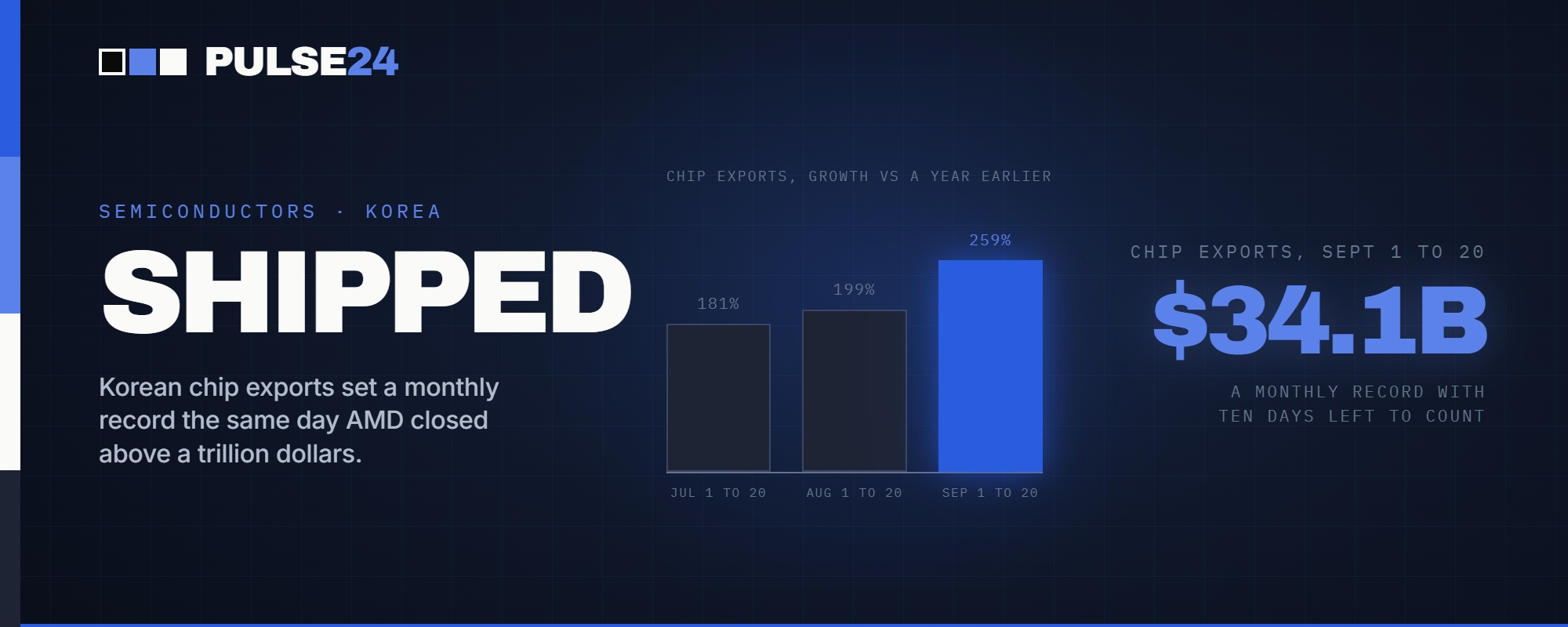
South Korea's semiconductor exports hit $34.12 billion in the first three weeks of September, up 259% from a year earlier, the same day AMD's stock hit an all-time high that briefly pushed its market cap above $1 trillion. The export invoice and the stock reaction are describing the same AI demand cycle from opposite ends of the supply chain.
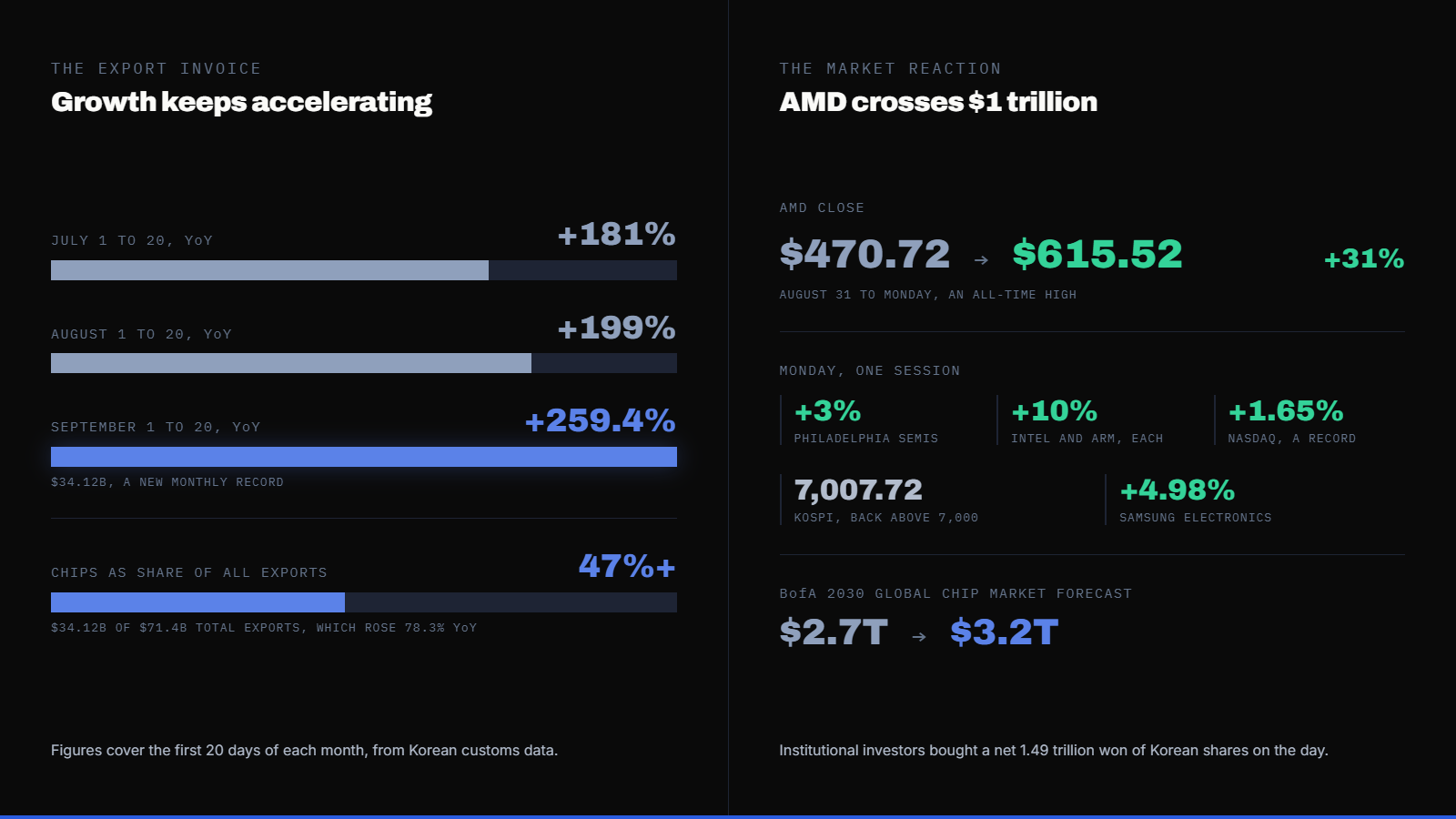
South Korea shipped $34.12 billion worth of semiconductors in the first 20 days of September, according to customs figures released this week. That's a 259.4% jump from the same three-week window a year earlier, and it's the highest monthly total the country has ever recorded, with ten days still left to count. Chips now make up more than 47% of everything South Korea sells to the rest of the world, a concentration that would have looked reckless in almost any other decade.
The reaction showed up in a different currency the same day. AMD closed at $615.52 on Monday, an all-time high, after touching an intraday peak near $616. The close held comfortably above the roughly $612 level that market cap trackers pegged as the threshold for AMD's valuation to clear $1 trillion, a milestone the company had never reached before. Three weeks earlier, on August 31, AMD had closed at $470.72. The stock is up roughly 31% since then, and it wasn't the only chipmaker having a good week.
Two numbers, an export invoice from Seoul and a market cap milestone in New York, are describing the same demand cycle from opposite ends of the same supply chain. One measures what's actually shipping. The other measures what investors are willing to pay for a claim on future shipments. Both moved in the same direction on the same day, which is the kind of confirmation that doesn't happen every cycle.
What Changed
Monday's session was broad in a way the AI trade hasn't always been. The Nasdaq closed up 1.65%, a record high, adding 438.54 points. The S&P 500 rose 1.06% and the Dow gained 0.42%. The Philadelphia Semiconductor Index, a tighter read on the sector, surged more than 3%. Intel and Arm Holdings, two chipmakers that had spent much of the year trailing Nvidia and AMD, each jumped 10% in the same session. Zoom out to the trailing month and the pattern holds: Intel has rallied more than 35% since late August, AMD and Arm are each up nearly 30% over the same stretch, and Nvidia, already the largest company in the group, still managed to add more than 4% on top of a much bigger base.
Seoul told a similar story from the export side. The KOSPI closed at 7,007.72, up 1.65% and back above the 7,000 mark for the first time in seven trading sessions. Samsung Electronics led the index higher, closing up 4.98% at 274,000 won after touching a 5.36% intraday gain. SK Hynix added 0.59% to close at 1.87 million won. The Kosdaq, home to smaller and mid-cap names, rose 1.11% to 836.27. The Korean won strengthened to 1,381 against the dollar, and institutional investors bought a net 1.49 trillion won of shares, a sign the move wasn't just retail enthusiasm.
The export data behind all of it has been accelerating for months, not just this week. South Korea's chip exports grew 181% year over year in the first 20 days of July. That accelerated to 199% in the first 20 days of August, when chips reached what was then a record 47.2% share of total exports, worth about $26 billion. September's 259.4% reading builds on both. Total South Korean exports for the first 20 days of the month came to $71.4 billion, up 78.3% year over year, meaning semiconductors alone are now doing most of the work in the country's trade balance.
Why It Matters
Three weeks ago, this rebound looked lopsided. AMD had climbed 156% from its April low while Broadcom had managed just 1% over the same stretch, a gap that raised fair questions about how many chipmakers were actually participating in the AI buildout versus riding alongside it. Monday's session narrows that gap. Intel and Arm, both of which had lagged, posted some of the day's biggest gains, and the move showed up across an entire national stock market rather than in two or three US tickers.
The export numbers matter more than the stock prices, because they're harder to talk your way into. A rally driven by valuation multiples can deflate as fast as it inflates. A rally confirmed by customs data, actual chips leaving actual ports bound for actual data centers, is a different kind of evidence. It doesn't prove the AI infrastructure buildout is rational at every price. It does suggest the underlying demand hasn't slowed down, which matters given how many investors spent August and early September bracing for exactly that.
Samsung and SK Hynix are worth watching for a second reason. They're the same two companies whose decision to prioritize server memory over consumer chips has pushed laptop bill-of-materials costs up sharply this year. The export boom and the PC price squeeze are the same allocation decision, viewed from two different angles. Every wafer of high-bandwidth memory that goes into a data center is a wafer that isn't going into a laptop, and right now the export invoices show which side of that trade is winning.
A few other threads fed Monday's optimism. A report that SK Hynix is exploring a potential arrangement with Intel added to the sense that the industry's biggest names are consolidating around AI infrastructure rather than competing against it. Meta's early-September launch of Muse, a personal AI agent, gave server CPU suppliers another data point for enterprise demand. And BofA analyst Vivek Arya raised his 2030 global chip market estimate to $3.2 trillion from $2.7 trillion, pointing to data center, advanced logic, and memory equipment spending that shows little sign of slowing.
What to Watch Next
Xi Jinping is scheduled to begin a state visit to Washington on September 24, with a state dinner expected to draw AI and technology executives among the attendees. Markets have already priced in some optimism about the meeting easing US-China tech tensions, and any concrete signal on chip export policy, tariffs, or trade terms coming out of those talks could move semiconductor stocks further in either direction.
South Korea's full September trade figures won't be final until the government publishes its end-of-month report in early October, and the first 20 days of a month don't always hold their shape through the last ten. Whether the 259% growth rate survives to the final tally is the next real checkpoint on whether this is a durable acceleration or a favorable rounding of the calendar.
The broader question is whether Monday's broadening, Intel and Arm joining Nvidia and AMD instead of trailing them, continues or reverses. A rally that's still concentrated in two or three names is more fragile than one where the gains are spread across a dozen suppliers, equipment makers, and foundries. Monday looked like the second kind of day. The next few sessions will show whether it was a pattern or a one-off.
The Pulse24 Take
The AI infrastructure story has had plenty of moments that felt like vibes ahead of fundamentals. This wasn't one of them. Export invoices don't get restated for sentiment, and $34 billion in semiconductors leaving South Korean ports in three weeks is a real number attached to real demand, not a multiple someone assigned to a forecast.
That doesn't mean every stock that moved on Monday deserves the move it got. AMD crossing a $1 trillion valuation and Intel jumping 10% in a single session are the kind of numbers that invite their own scrutiny, and a broadening rally can extend into names whose fundamentals haven't actually changed as much as their share prices have. The distinction worth holding onto is between the trade data, which is backward-looking and hard to fake, and the stock reaction, which is forward-looking and can run ahead of itself. Both told the same story Monday. They won't always.
How we read the data
Curious how we get from raw data to a take like this? Our Trader's Toolkit walks through the tools we lean on.
Explore the Toolkit