Pulse24 Original
156% Versus 1%: The Chip Rebound Isn't as Broad as It Looks.
September 19, 2026
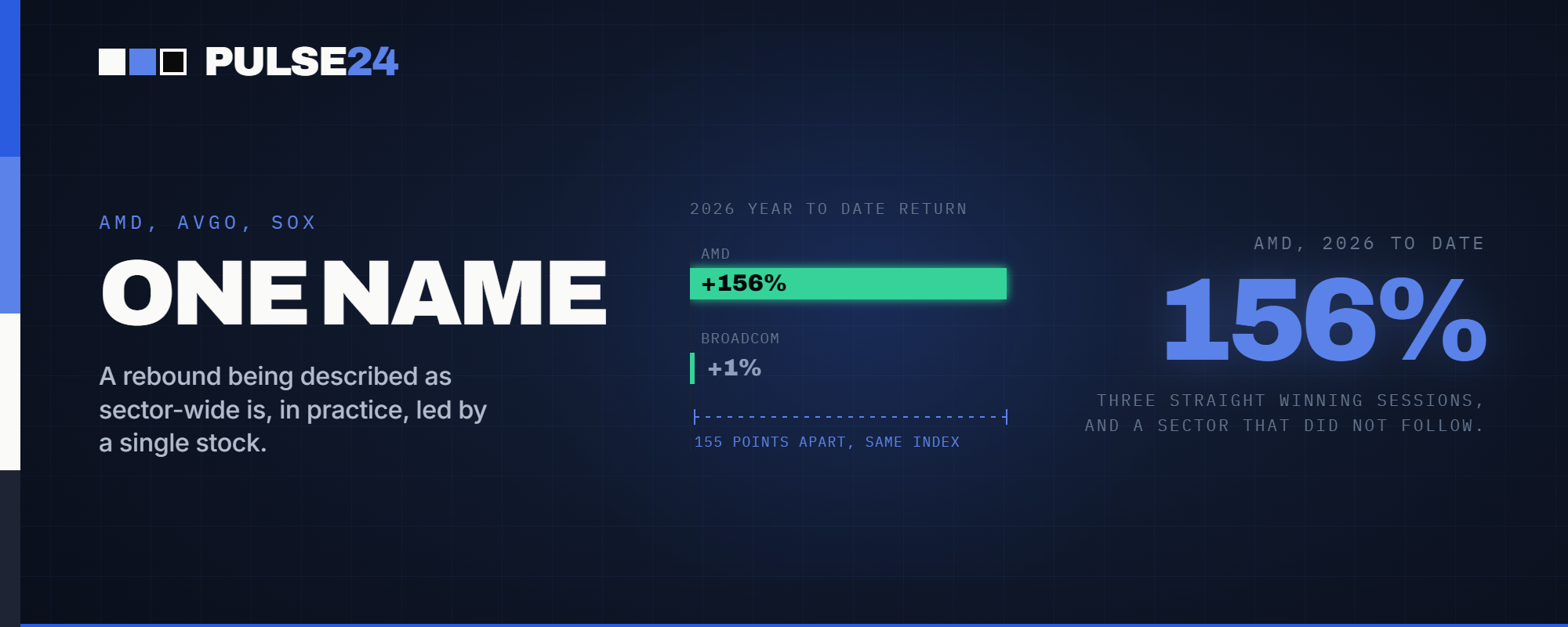
AMD's stock is up about 156% this year, while Broadcom, in the same rebounding sector, sits at roughly 1%. Three strong sessions for chip stocks say less about the sector than about one company's run.
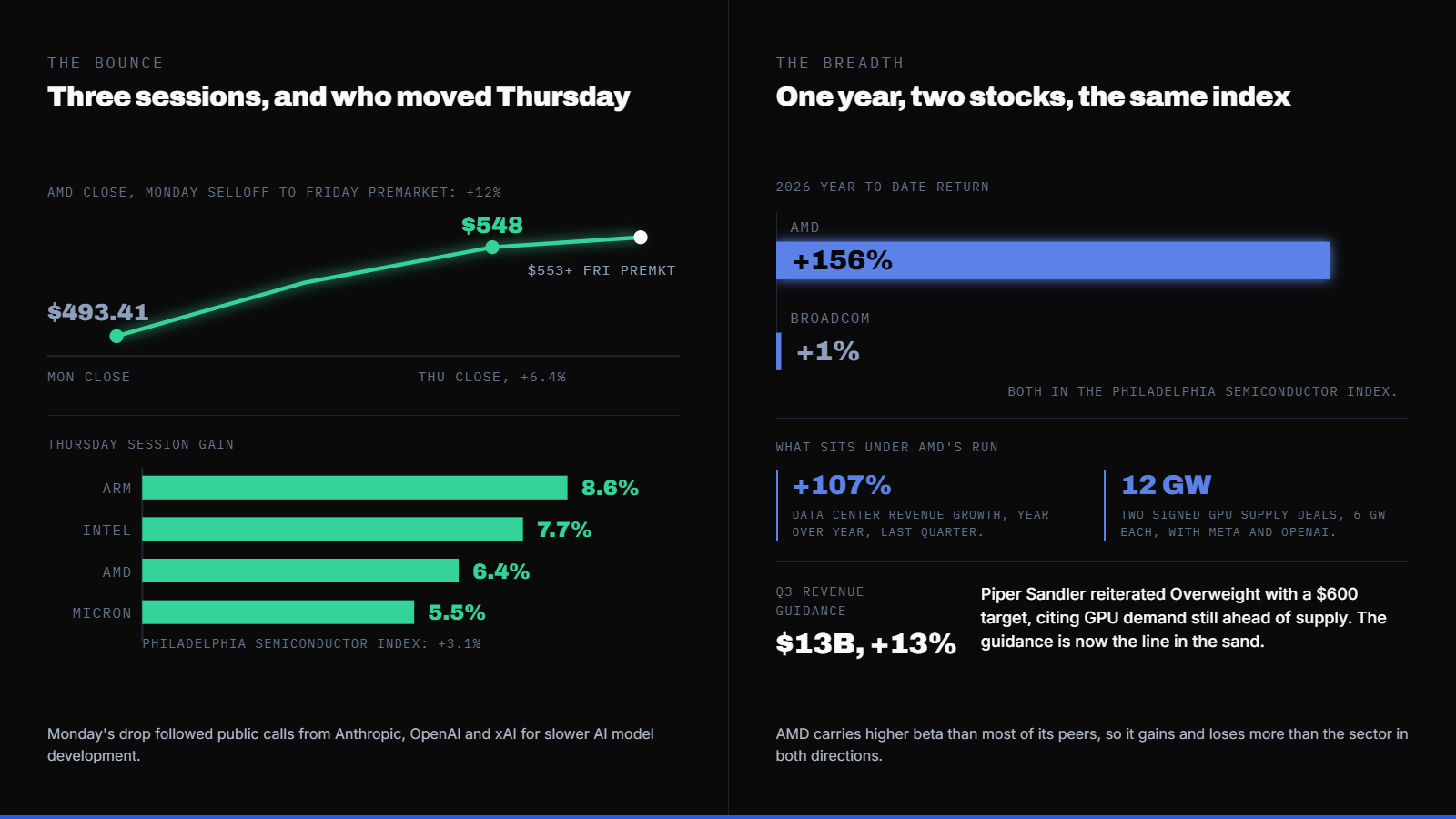
AMD closed near $548 on Thursday, its third straight winning session and its sharpest single-day gain in weeks. Three trading days earlier, on Monday, the same stock had fallen to $493.41, caught up in a chip-wide selloff triggered by fears that AI model development itself might slow down. By Friday's premarket, AMD was trading above $553. Nothing about the company's underlying business changed in that stretch. What changed was how much confidence traders were willing to put back into AI-linked hardware, and AMD absorbed most of that confidence by itself.
The broader sector did participate. The Philadelphia Semiconductor Index climbed 3.1% Thursday, and Intel, Arm, and Micron all posted gains north of 5%. But look at where the money actually concentrated and a different picture forms. AMD is up roughly 156% for 2026. Broadcom, sitting in the same index and tied to the same AI infrastructure story, is up only about 1% over the same period. A rebound getting described as sector-wide is, in practice, a rebound led overwhelmingly by one name.
What Changed
The proximate cause of Monday's drop was straightforward. Chip stocks fell nearly 6% that day after Anthropic, OpenAI, and xAI publicly called for slower AI model development, a warning that unsettled anyone holding stocks priced on the assumption that AI compute demand keeps compounding at its current pace. AMD dropped to $493.41 by Monday's close along with the rest of the sector.
The mood had already started shifting earlier in the week. On Tuesday, Piper Sandler reiterated its Overweight rating on AMD and kept a $600 price target, telling clients that demand across AMD's product portfolio remained well ahead of available supply, a note that reads almost like a direct rebuttal to Monday's slowdown thesis. By Thursday, that read looked prescient: Intel jumped 7.7%, Arm rose 8.6%, and Micron added 5.5%, all moving on the same underlying signal that whatever spooked the market Monday hadn't shown up in an actual order book yet.
AMD's own management reinforced that case Thursday. Mark Papermaster, the company's chief technology officer, said AI demand shows no sign of slowing, and that businesses remain in the early stages of adopting the technology even as they grow more selective about which workloads they deploy it on. He pointed to agentic AI, systems that string together multiple tasks and reason across a workflow, as the next place AMD expects meaningful growth to come from.
Why It Matters
The gap between AMD's 156% year and Broadcom's roughly 1% is the more interesting number here, and it says something about how this rebound actually works. AMD carries higher beta than most of its semiconductor peers, meaning its stock swings harder than the sector average in both directions. That cuts two ways. When sentiment turns positive, AMD captures a disproportionate share of the gains, which is exactly what happened this week. When sentiment sours, like it did Monday, the same stock tends to fall hardest of all.
There is real business behind the move, not just momentum trading. AMD's data center revenue grew 107% year over year last quarter, and the company has locked in two separate 6-gigawatt GPU supply agreements, one with Meta and one with OpenAI, that give it a multi-year revenue floor most chipmakers would envy. Its third-quarter guidance points to roughly $13 billion in revenue, about 13% sequential growth, and current Wall Street price targets from Goldman Sachs and Wells Fargo both assume that growth holds.
That is also the risk. A stock priced for that much growth has little room for a disappointing quarter. Micron's own market cap crossed $1.1 trillion earlier this month on similar AI-driven optimism, and Pulse24 noted at the time that a detail buried in Nvidia's own earnings suggested the memory rally's shelf life was shorter than the headline number implied. A similar caution applies here. A three-session bounce, however sharp, does not erase the questions that triggered Monday's selloff in the first place.
What to Watch Next
AMD's next earnings report is the clearest test of whether this week's optimism holds up. The company's guidance of roughly $13 billion in third-quarter revenue is now a line in the sand. Falling short of it, after a week like this one, would likely hit the stock harder than a similar miss would have a month ago, precisely because so much confidence has already been priced back in.
Also worth tracking is whether the rebound broadens beyond a handful of the highest-beta names. If Broadcom, Nvidia, and the rest of the sector start closing the gap with AMD's year-to-date return, that would suggest genuine confidence is returning to AI infrastructure broadly. If the gap keeps widening instead, this looks more like a single-stock story wearing a sector-wide rally's clothing. Any fresh commentary from AI labs about the pace of model development, the same kind of statement that triggered Monday's drop, would be the fastest way to find out how durable this week's gains really are.
The Pulse24 Take
A three-day winning streak led by one high-beta stock is not proof that Monday's fears were wrong, and it is not proof they were right either. AMD's fundamentals are real: the GPU supply deals are signed, the data center revenue is growing, and the guidance backs up the stock's run. But when 156% of a sector's enthusiasm sits in one name and roughly 1% sits in another, the label "chip rally" is doing more work than the underlying data supports. Readers should watch the names lagging AMD as closely as the one leading it. Breadth, not just direction, is what will show whether AI infrastructure spending is actually broadening out or whether the market simply found one stock it feels comfortable getting excited about again.
How we read the data
Curious how we get from raw data to a take like this? Our Trader's Toolkit walks through the tools we lean on.
Explore the Toolkit