Pulse24 Original
Consumer Sentiment Improved to 48.1 in September. Gold Fell to a Session Low Anyway.
September 26, 2026
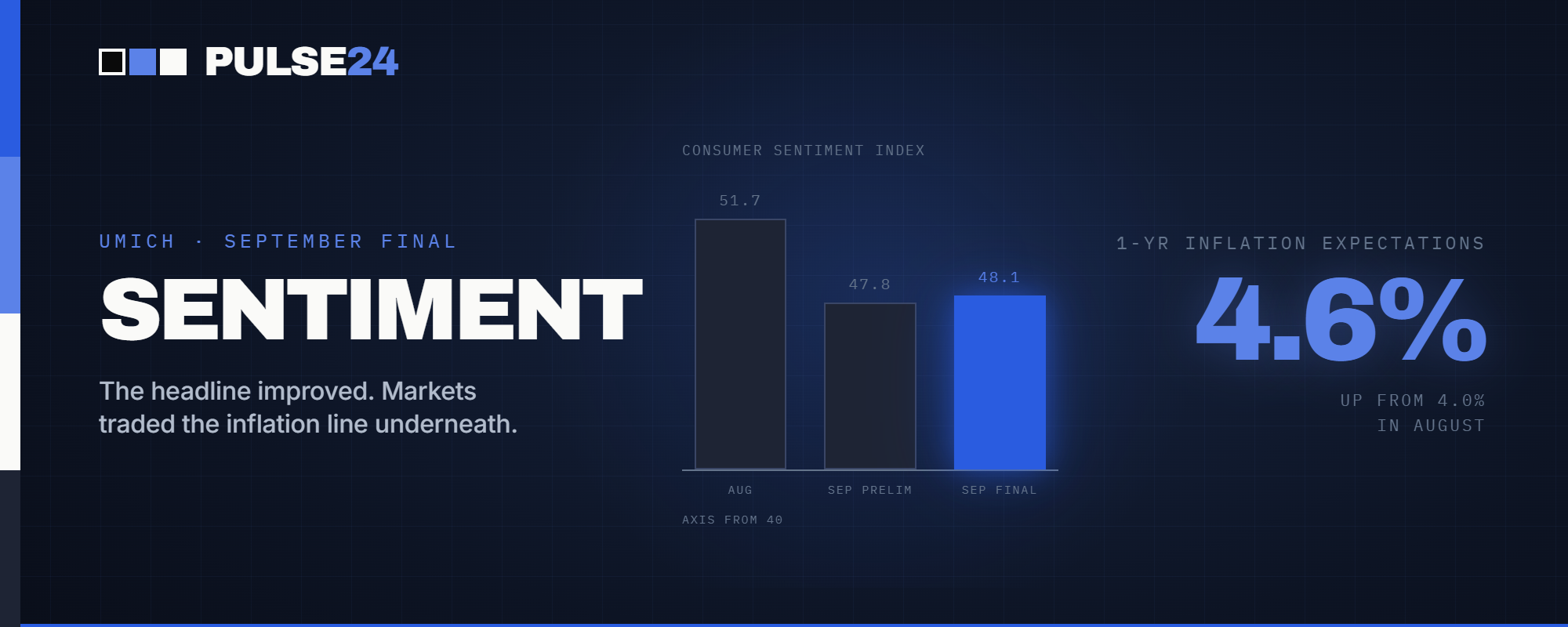
Consumer sentiment edged higher to 48.1 in September, but inflation expectations jumped to 4.6% and gold sold off within minutes of the report's release. The subcomponent investors traded on told a very different story than the headline number.
Consumer sentiment ticked up in September. That should have been the reassuring headline. Instead, gold fell to a session low, the dollar broke out to a two-month high, and Treasury yields kept climbing toward levels last seen before the 2008 financial crisis. The University of Michigan's final sentiment index came in at 48.1, a touch above the preliminary 47.8 and ahead of the 47.6 economists had forecast. Markets barely noticed. What they traded on was buried one line down in the same report.
What Changed
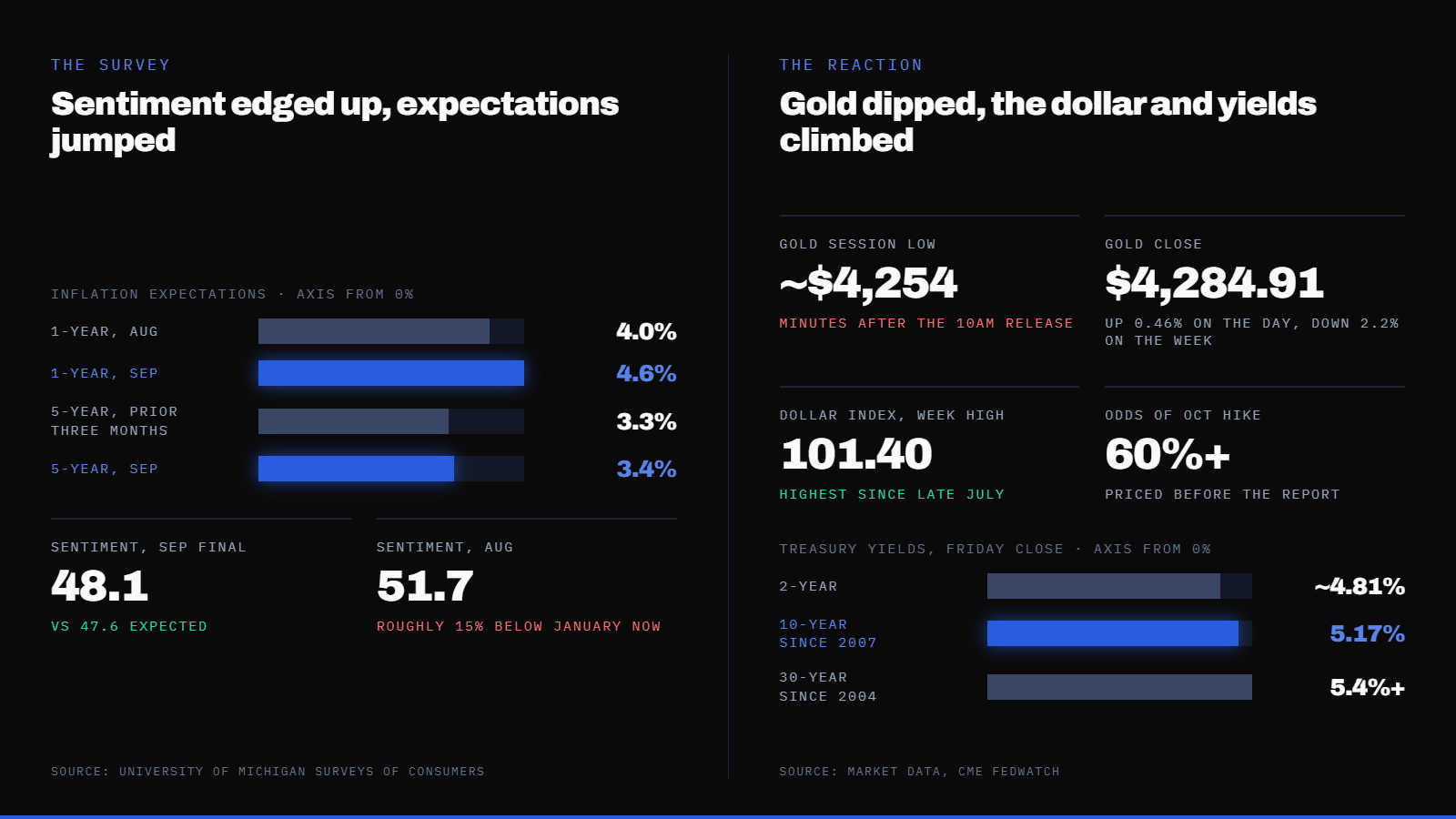
The number that actually moved gold, the dollar and Treasury futures was inflation expectations, not the sentiment headline. One-year inflation expectations jumped to 4.6% from 4.0% in August, the largest single-month increase the survey has recorded since June. Five-year expectations, which the Fed watches more closely because they reflect longer-run credibility rather than a reaction to this week's gas prices, rose to 3.4%, breaking a three-month streak at 3.3%. Surveys of Consumers director Joanne Hsu described the underlying picture as more strained than the headline suggested: "Views of current and year-ahead expected personal finances both weakened about 10% this month, with concerns over high prices continuing to climb."
Gold sold off within minutes of the 10am release, dropping to a session low near $4,254 an ounce, before clawing back through the rest of the day to close at $4,284.91, up 0.46% on the session even as it finished the week down 2.2%. The dollar did more of the damage than the inflation data alone would explain. The dollar index climbed as high as 101.40 during the week, its highest level since late July, before easing back slightly in Friday's trading. Gold's year-over-year gain has already shrunk from more than 95% in January to a little over 13%, and a stronger dollar paired with higher nominal yields is exactly the combination that keeps squeezing it.
Treasury yields extended a move that has been building for weeks. The 10-year closed Friday at 5.17%, a level last touched in 2007, and the 30-year has pushed above 5.4%, its highest since 2004. Even the 2-year yield, more sensitive to near-term Fed expectations than the long end, closed near 4.81%, extending its own climb toward the 5% mark. That mirrors the broader repricing already underway this week, as the 10-year hit a 2007 high while the yen kept testing 160 and stocks barely reacted.
Why It Matters
Gold's reaction looks backwards at first glance. Rising inflation expectations are usually treated as bullish for an asset marketed as an inflation hedge. But gold pays no yield. What determines its appeal is the real yield, the return investors get on Treasuries after subtracting expected inflation, more than the inflation number by itself. When nominal yields are already climbing as fast as inflation expectations, or faster, real yields stay high or even rise, and that becomes a headwind for gold no matter what the inflation reading itself says. Real yields climbed to 2.68% earlier this month and gold hit a new high anyway, which shows the relationship isn't mechanical. This week, the combination of a stronger dollar and yields grinding toward multi-decade highs outweighed whatever support rising inflation expectations might have offered.
The Fed angle matters just as much. Sixteen of eighteen Fed officials have already signaled support for another rate hike this year, and a consumer survey showing inflation expectations breaking higher gives that camp more ammunition heading into the October 27-28 meeting. Futures markets had already pushed the odds of an October hike above 60%, up from closer to even odds earlier in September, and a fresh inflation-expectations spike makes it harder for the doves on the committee to argue for patience. A Fed that hikes into rising inflation expectations, rather than pausing to see if they fade, is a Fed telling markets it's more worried about losing credibility on prices than about slowing growth.
What to Watch Next
The next major test comes at the October 27-28 FOMC meeting, where the question isn't only whether the Fed hikes again but how it talks about inflation expectations specifically. A quarter-point move that comes with dovish language about expectations reverting would land very differently than one paired with warnings that price pressures are becoming entrenched. Between now and then, keep an eye on whether the gap between headline sentiment and inflation expectations keeps widening. Consumers reporting steady-to-improving sentiment while expecting faster inflation is an unusual combination, and if it persists into October's preliminary reading, it becomes harder for the Fed to dismiss as noise.
The Pulse24 Take
The lesson from Friday's report is that the subcomponents often carry more information than the headline number does. Consumer sentiment improving by 0.3 points was never going to move gold or the dollar on its own. Inflation expectations jumping six-tenths of a point, arriving the same morning the Fed is weighing its next move, mattered more.
None of this locks in an October hike. Fed officials have surprised markets before, and a single survey reading rarely settles policy on its own. But between the inflation expectations spike, yields near multi-decade highs, and a dollar that keeps grinding higher, the market's working assumption going into the next meeting has shifted further toward tightening, not away from it. Gold's session-low reaction is a reasonable proxy for how that assumption is being priced across other markets too.
How we read the data
Curious how we get from raw data to a take like this? Our Trader's Toolkit walks through the tools we lean on.
Explore the Toolkit