Pulse24 Original
Central Banks Just Had Their Strongest Second Quarter of Gold Buying on Record, 289 Tonnes. The First Half of 2026 Was Still Their Weakest Since 2022.
August 14, 2026
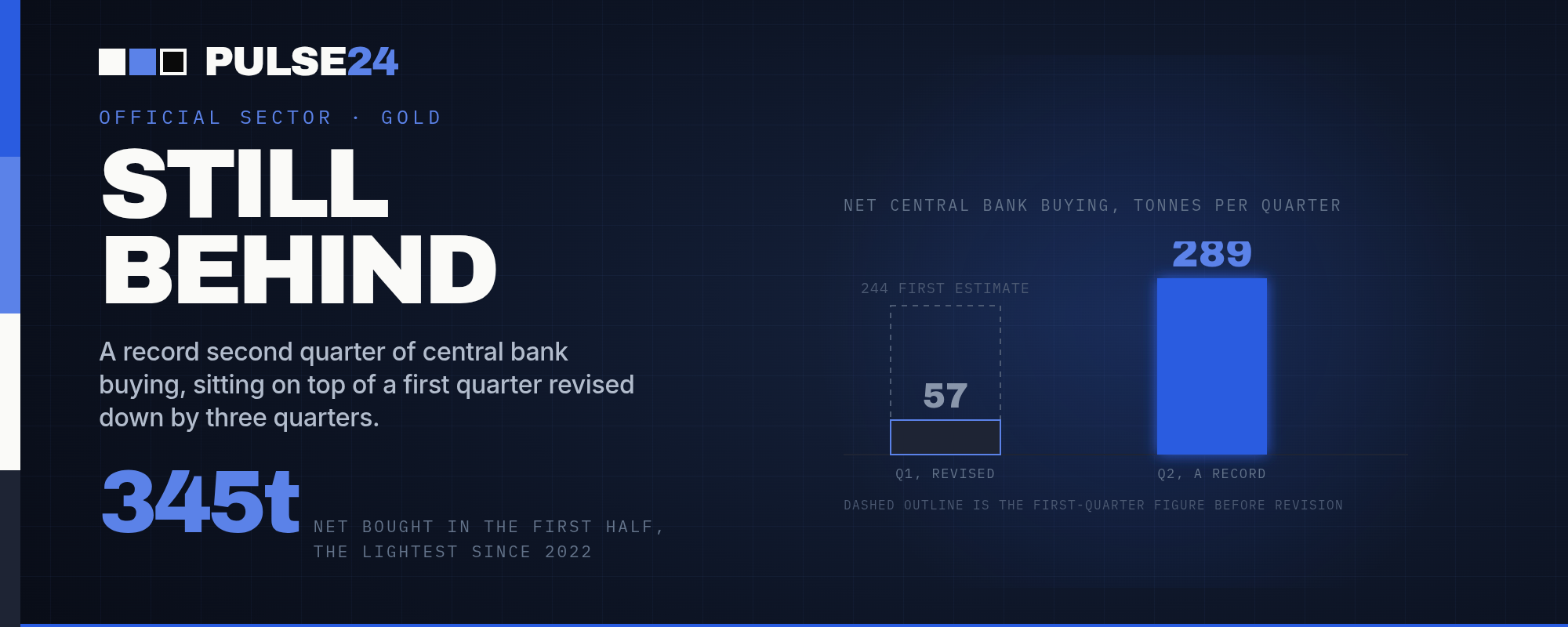
Central banks bought 289 tonnes of gold last quarter, the strongest second quarter for official buying on record. A revised-down first quarter still left the first half of 2026 as their weakest for gold buying since 2022.
Gold touched a two-month high this week, trading within sight of $4,400 an ounce and sitting roughly a third above where it was a year ago. It would be easy to read that as a momentum trade riding this summer's bets on a Federal Reserve rate hold. A World Gold Council report released in late July points to a different kind of buyer behind a good part of the move, one that was adding to its gold holdings months before this week's price action and did so while prices were falling, not rising.
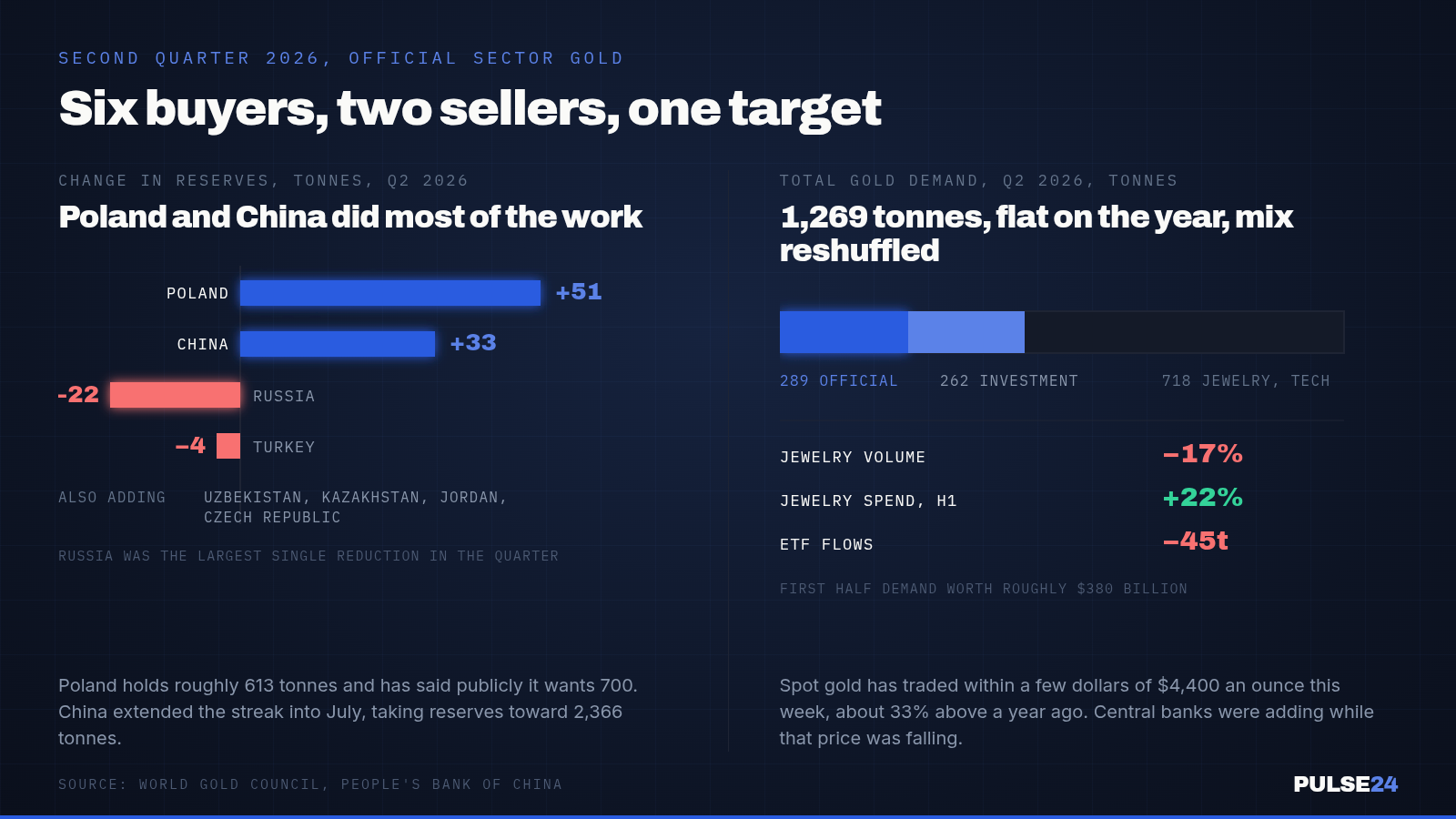
Central banks added a net 289 tonnes to their gold reserves in the second quarter. This was the strongest second quarter for official-sector buying the Council has on record, and a 62% increase from the 177.9 tonnes central banks bought in the same quarter last year. Poland led all buyers with 51 tonnes. China added 33 tonnes, its largest quarterly increase since late 2023, pushing the People's Bank of China's reserves to roughly 2,346 tonnes by the end of June.
What Changed
The quarterly headline hides a messier picture underneath it. Poland, China, Uzbekistan, Kazakhstan, Jordan and the Czech Republic all added to reserves in the second quarter. Russia sold 22 tonnes, the largest reduction by any central bank in the period. Turkey sold a further 4 tonnes and pared back its gold swap positions, a far smaller retreat than the heavy sales it made in the first quarter.
The first quarter turned out to be weaker than first reported. An initial estimate had central banks buying 244 tonnes in the first three months of the year, but the World Gold Council's second-quarter report revised that down to just 57 tonnes once more complete data came in. Add the two quarters together and the first half of 2026 produced only 345 tonnes of net central bank buying, the lightest first half since 2022, when central banks bought 241 tonnes over the same six months.
Why It Matters
None of the second-quarter buying happened while gold was cheap relative to where it started the year, but it also wasn't chasing new highs. The World Gold Council's own description of the quarter was that the early-year rally reversed, with prices correcting from the records set earlier in 2026 before consolidating. Central banks kept buying through that stretch. Gold remained, in the Council's words, "well supported" even as price momentum cooled.
That is a different kind of buyer than the one behind gold's jump on soft labor-market data earlier in the summer. A reserve manager in Warsaw or Beijing is not rebalancing a portfolio because a single payrolls report missed forecasts. Poland's central bank has said publicly it wants to lift reserves to 700 tonnes, and its holdings already sit near 613 tonnes after 82 tonnes of purchases so far this year. China extended its buying streak into July as well, adding roughly 20 more tonnes and pushing reserves toward 2,366 tonnes, according to figures the People's Bank of China reported in early August. Both countries are working toward numbers they have already stated in public, which behaves differently in a portfolio than a position built on this week's Fed odds.
Central banks were not the only source of demand in the quarter. Total gold demand across every category, jewelry, investment, technology and official reserves, reached 1,269 tonnes, flat from a year earlier, and the first half combined was worth roughly $380 billion. Jewelry volumes fell 17% year over year as high prices priced out casual buyers, even though jewelry spending in dollar terms rose 22% for the half. Investment demand, which covers gold ETFs, bars and coins, added 262 tonnes in the quarter, though ETFs alone saw net outflows of 45 tonnes as some short-term holders took profits into the price correction.
What to Watch Next
The Fed's September meeting is the next scheduled catalyst for gold's dollar price. Futures markets assigned roughly a 63% probability to the Fed holding rates steady in September after Thursday's flat producer-price report, a shift that would normally cap gold's upside by keeping the opportunity cost of holding a non-yielding asset elevated. Central bank buying runs on a slower clock than a rate-odds calendar. If Poland and China keep buying toward the targets they have already announced regardless of what the Fed does next month, that is a source of demand that does not reprice every time a jobs number or inflation print moves futures markets.
The World Gold Council's third-quarter report, expected in late October or early November, will show whether the second quarter's rebound was a brief reaction to cheaper prices or the start of a sustained recovery from the weakest first half since 2022.
The Pulse24 Take
Two things can be true about gold at the same time. The rate-odds trade that has dominated headlines all summer is real, and it explains a good share of the day-to-day price action, including this week's push toward a two-month high. It does not explain why Poland kept buying gold it has already said publicly it wants more of, or why China extended a multi-year accumulation streak through a quarter when prices were falling. Official-sector demand moves on a slower, stickier timeline than a Treasury-yield chart suggests, and anyone tracking gold purely through the Fed calendar is missing the buyer that kept showing up even when the price wasn't moving in its favor.
The bigger question for this rally isn't the next CPI print. It's whether Poland, China and the smaller buyers in this report have room left to run toward the targets they've already set for themselves, and whether that demand holds up if gold's price keeps climbing away from the levels where they were buying in the second quarter.
How we read the data
Curious how we get from raw data to a take like this? Our Trader's Toolkit walks through the tools we lean on.
Explore the Toolkit