Pulse24 Original
$7 Trillion in Treasury Bills Need Buyers. The Stablecoin Market Stalled at $300 Billion Instead.
September 26, 2026
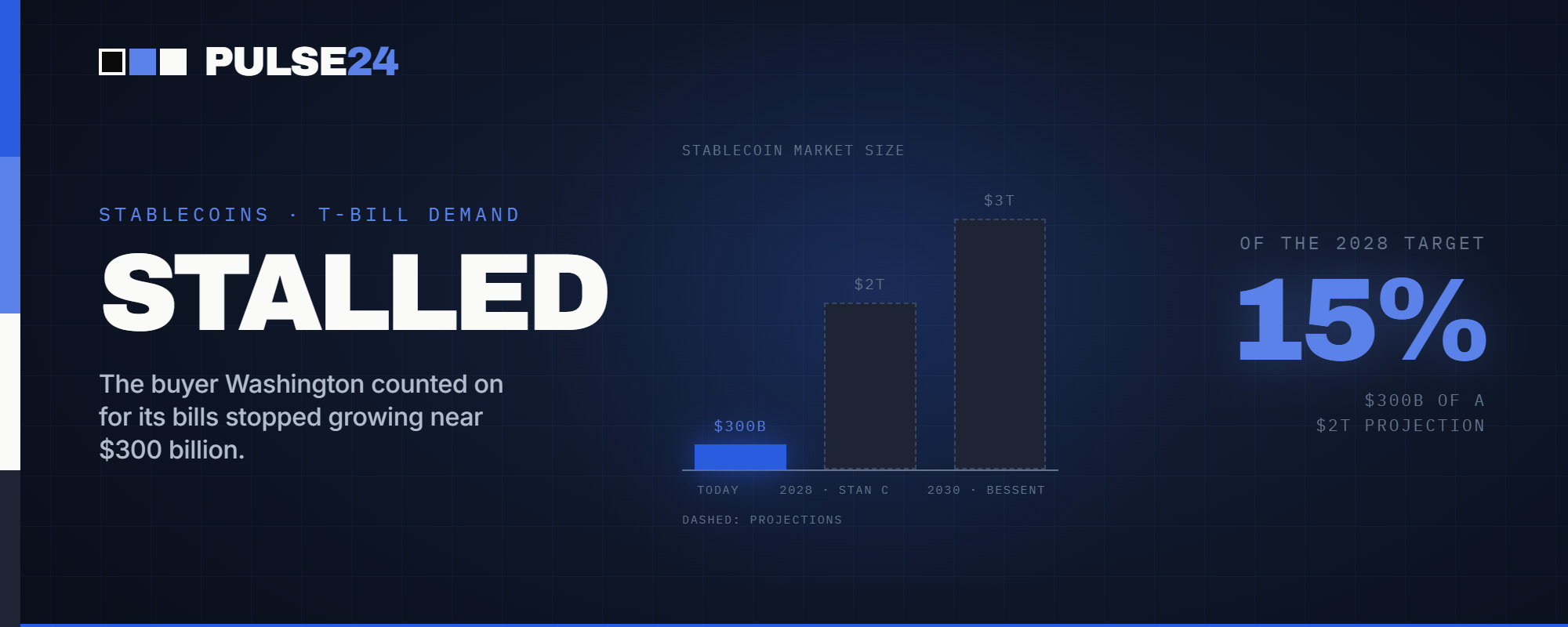
Treasury Secretary Scott Bessent bet stablecoins would become a major buyer of the government's debt as bond yields sit at levels last seen in 2007. Two years in, the market has stalled near $300 billion, a fraction of what that plan needs.
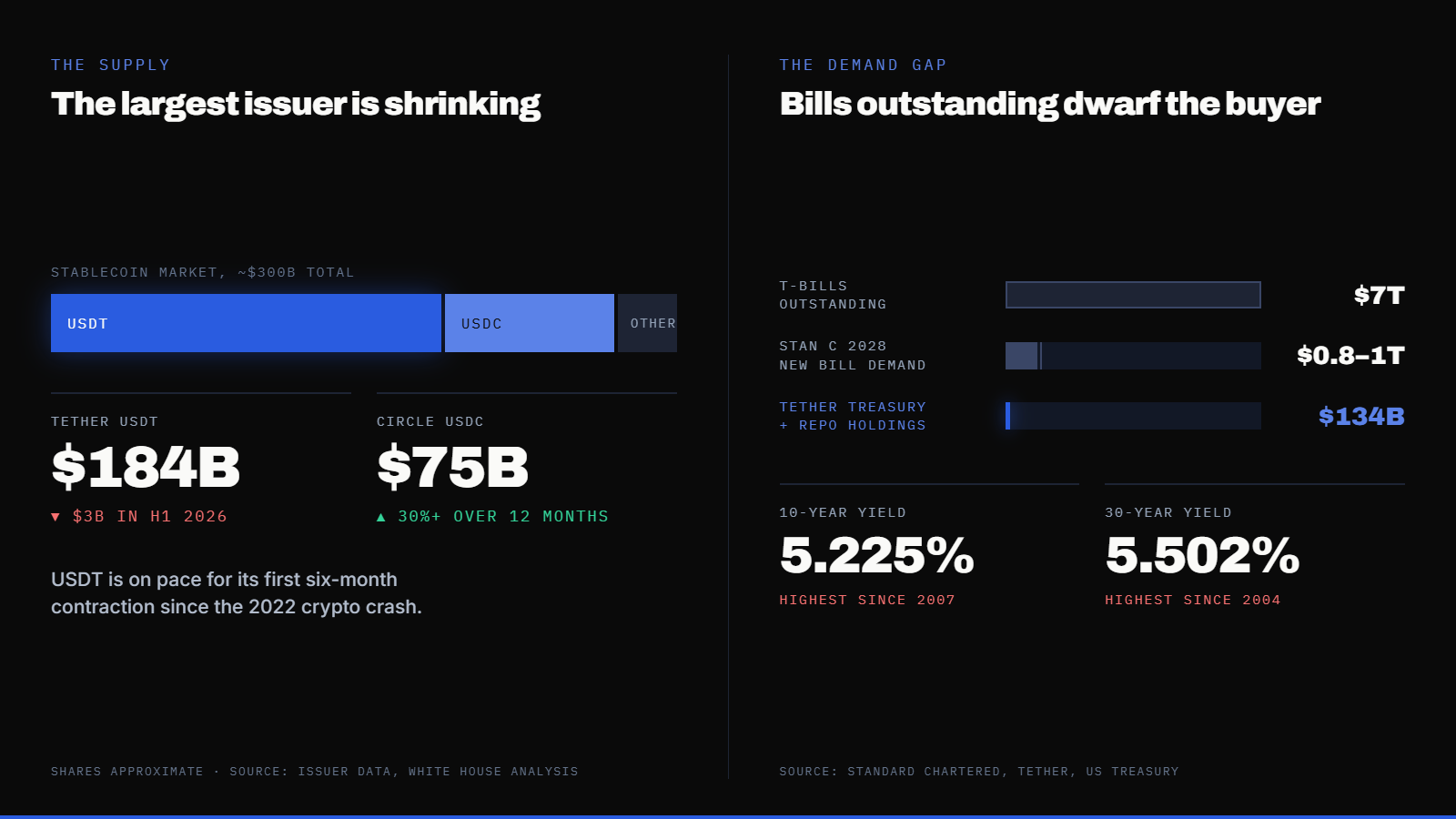
Tether holds more US Treasuries than most national governments do. That single company's reserve portfolio has become one of the more interesting pressure points in a bond market that's already stretched thin: the 10-year Treasury yield touched 5.225% this week, a level unseen since 2007, and the 30-year climbed to 5.502%, its highest since 2004. Washington is issuing debt faster than the traditional buyer base can comfortably absorb, and two years ago, stablecoins looked like a genuine new source of demand for that debt. That story has stalled, right as the government needs it most.
What Changed
The math seemed clean enough when it was first pitched. Every dollar of stablecoin issued has to sit behind reserves, and under the GENIUS Act, signed into law in July 2025, those reserves have to be highly liquid, mostly Treasury bills maturing in 93 days or less. More stablecoins in circulation means more automatic demand for short-term government debt, no persuasion required. For a while, the growth cooperated: the market climbed for two straight years before flattening out in 2026.
It hasn't just flattened. By some measures it's gone slightly backward. Tether's USDT, still more than half the entire stablecoin market, fell by roughly $3 billion in the first six months of 2026 to about $184 billion, putting it on pace for its first six-month contraction since the 2022 crypto crash. Circle's USDC, the second-largest issuer, has actually kept growing, reaching roughly $75 billion and up more than 30% over the past year, evidence that the slowdown isn't uniform across every issuer. Add up every dollar-pegged token in circulation and the total sits a bit north of $300 billion, according to a White House analysis cited this week. Bessent has floated a stablecoin market reaching $3 trillion by the end of the decade. Standard Chartered's own model is more conservative and still enormous by comparison: $2 trillion by 2028, which its analysts calculate could generate $800 billion to $1 trillion in fresh Treasury bill demand. Measured against either number, $300 billion is closer to a rounding error than a down payment.
That gap is what pushed the Trump administration to consider a new lever this week. Treasury, the State Department, and the US International Development Finance Corporation are reportedly weighing government-backed joint ventures with private companies to expand dollar stablecoin adoption abroad, essentially exporting the reserve-demand mechanism to markets where it hasn't taken hold yet. Nothing is finalized. No partner countries, no specific companies, and no funding figures have been disclosed, and the proposal is still preliminary enough that it could easily change shape before it becomes policy. Separately, a group of 21 banks is reportedly working toward a joint dollar-backed stablecoin of their own, targeted for launch in the first half of 2027, which would arrive just as the GENIUS Act's core provisions take effect on January 18 of that year.
Why It Matters
The 20-year Treasury auction earlier this year already raised uncomfortable questions about who's willing to show up at these yields, even as the 10-year and 30-year sales went smoothly. A stalled stablecoin market doesn't cause that kind of auction weakness by itself, but it removes one candidate that policymakers were counting on to help fill the gap. Real yields have already climbed to multi-year highs even as gold keeps setting new records, a sign that the market is demanding more compensation across the board, not just from foreign central banks or bond funds.
Tether's own numbers show why the company matters more than its size might suggest. An estimated $134 billion in Treasuries and repo agreements is a bigger Treasury position than all but a handful of sovereign wealth funds and central banks hold. When a buyer of that size stops growing, or starts shrinking, the marginal effect on demand is not trivial, even if it's not going to move the 10-year by itself. The Fed's own overnight reverse repo facility has already drained from $2.5 trillion in 2022 to a few hundred million dollars today, which was the last big cushion of idle cash sitting on the sidelines. With that gone and stablecoin growth stalled, there are fewer easy places left for the marginal Treasury bill to find a home.
What to Watch Next
The clearest near-term signal is whether Tether's contraction stabilizes and whether Circle's continued growth is enough by itself to keep the combined total moving higher. A rebound at Tether specifically would ease the pressure on Bessent's Treasury-demand thesis considerably. Beyond that, watch how concrete the overseas stablecoin push gets. A preliminary idea floated to reporters is very different from an actual joint venture with a named country and a funding commitment, and the distance between those two things will say a lot about how seriously Washington is willing to lean into this strategy.
The 21-bank joint stablecoin, if it stays on schedule for a first-half-2027 launch, is worth tracking too, since a bank-backed entrant could bring in corporate treasury demand that consumer-facing issuers like Tether and Circle have struggled to attract. Only about 13% of middle-market companies currently use stablecoins for anything, which leaves a lot of room to grow if that changes. And with the GENIUS Act's reserve rules taking full effect on January 18, 2027, issuers have a hard deadline to make sure their Treasury holdings actually qualify, which could either tighten demand further or force some smaller players out of the market entirely.
The Pulse24 Take
The stablecoin-as-Treasury-buyer thesis was never really about crypto speculation. It was a bet that a fast-growing, low-friction wrapper around the dollar would quietly become one more source of demand for government debt at a moment when Washington badly needs more of it. That bet still might pay off eventually, but "eventually" is doing a lot of work when the 10-year is already sitting at levels last seen in 2007. A market stuck at $300 billion isn't proof the idea failed. Two years of uninterrupted growth followed by a pause is a normal enough pattern for a still-young asset class, and the GENIUS Act's compliance deadline hasn't even arrived yet. What it does mean is that one of the more optimistic pieces of the government's own financing math is currently on hold, at the exact moment yields are testing multi-decade highs for other reasons entirely. Whether Washington's overseas push, the bank consortium, or simple time gets that growth restarted is the question worth watching into 2027, more than any single auction or headline between now and then.
How we read the data
Curious how we get from raw data to a take like this? Our Trader's Toolkit walks through the tools we lean on.
Explore the Toolkit