Pulse24 Original
The Fed's Reverse Repo Facility Held $2.5 Trillion in 2022. This Week It Held $276 Million.
September 18, 2026
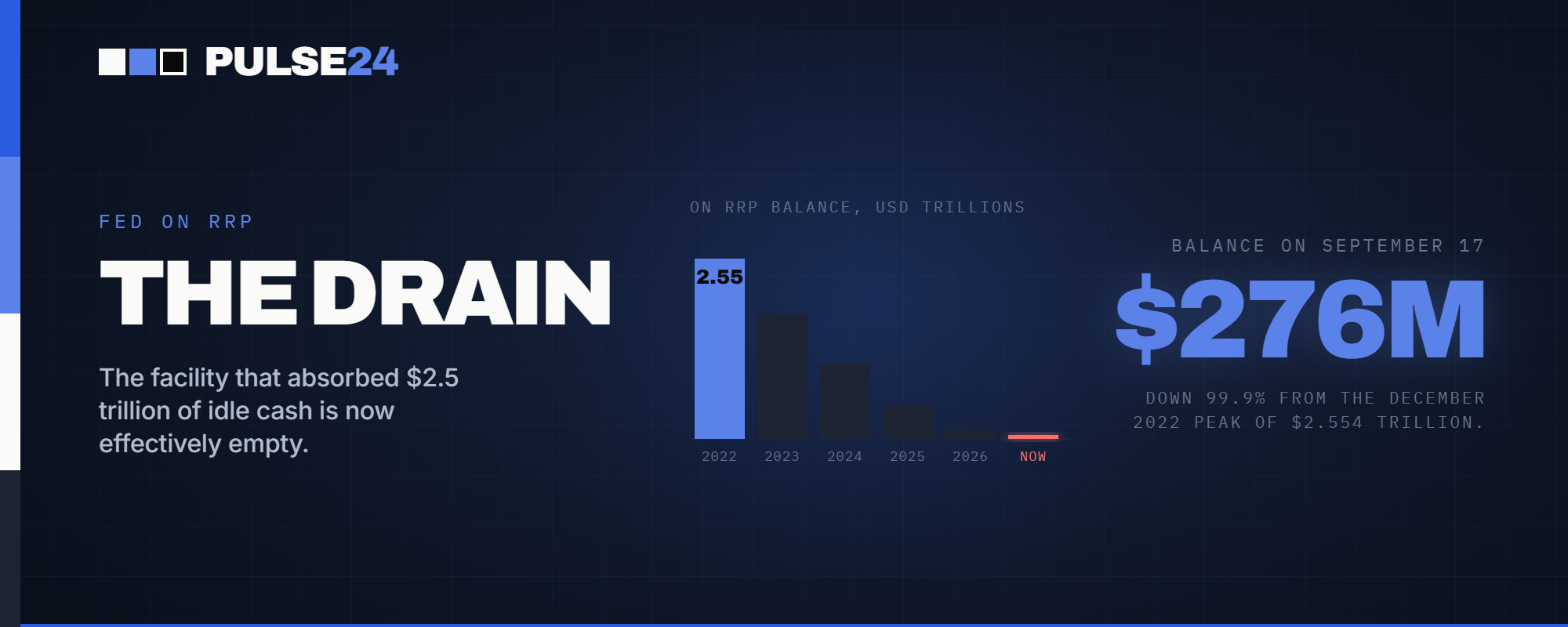
A facility that once absorbed $2.5 trillion in idle cash from money market funds is now almost empty, and the timing puts fresh pressure on the Fed's promise that bank reserves remain ample. The next real test comes at quarter-end, less than two weeks away.
Two hundred seventy-six million dollars. That's the balance the Federal Reserve's overnight reverse repo facility carried on September 17, according to the New York Fed's own daily data. Back on December 30, 2022, the same facility held $2.554 trillion. Almost all of that cash has left the building.
The reverse repo facility, known on trading desks as the ON RRP, worked like an overflow drain for the financial system. Money market funds and other approved counterparties parked excess cash there overnight in exchange for Treasury collateral and a guaranteed rate, whenever they couldn't find a better home for it. During the flood of pandemic-era stimulus, when funds were sitting on more cash than the market could absorb, that drain filled to the brim. Three years of quantitative tightening and a steady rise in Treasury bill supply have since pulled nearly every dollar back out.
What Changed
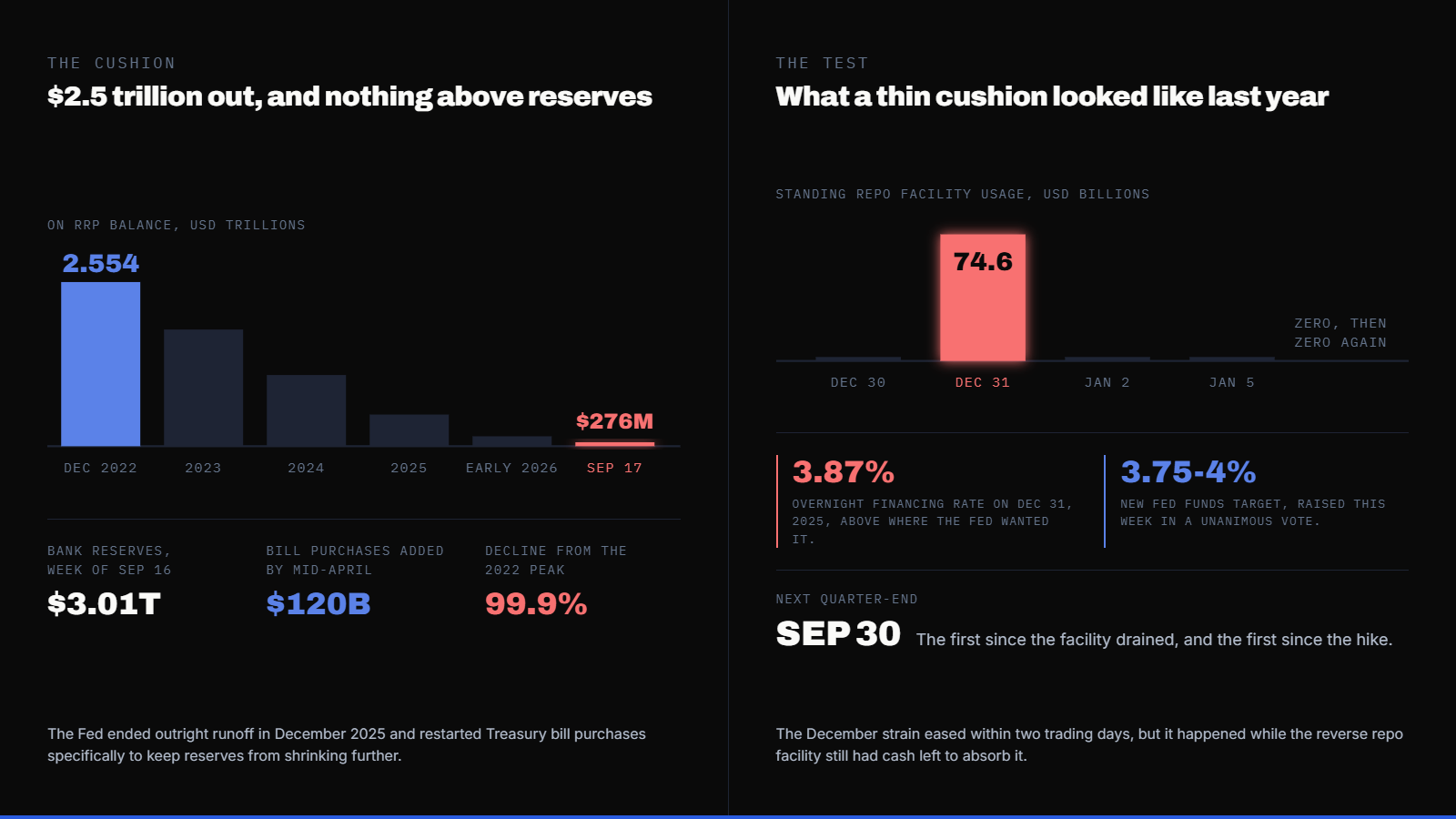
Reserve balances held by banks at the Fed stood at roughly $3.01 trillion in the latest weekly report, still comfortably inside the range Fed officials describe as ample. What's different is the cushion that used to sit on top of that number. For most of 2022 through 2024, the RRP acted as a shock absorber: if reserves got tight anywhere in the banking system, cash could flow out of the RRP to fill the gap without anyone needing to sell a bond or scramble for an overnight loan. With the facility down to $276 million, that shock absorber is gone.
The Fed has been aware of this for a while, and it has already changed course once. In December 2025, the Federal Open Market Committee ended outright balance sheet runoff and began reserve management purchases, buying short-dated Treasury bills to keep the supply of reserves from shrinking further. By mid-April, according to the Fed's own research staff, those purchases had already added roughly $120 billion to its holdings. That's an unusual admission for an institution that spent three years insisting reserves were still ample: the purchases only make sense if officials were worried the cushion wouldn't last on its own.
Why It Matters
History gives a preview of what a thin cushion looks like in practice. On December 31, 2025, year-end pressure on bank balance sheets sent the overnight financing rate to 3.87%, above where the Fed wanted it to sit, and pushed usage of the Standing Repo Facility, the backstop lending tool banks can tap at a fixed rate, to $74.6 billion from zero. Within two trading days the strain eased and the balance fell back to zero. It was a one-day event rather than a crisis, but it happened while the RRP still had some cash left in it to absorb the shock. That cash is no longer there.
Wednesday's rate decision adds a second variable to the same plumbing problem. The Fed raised its federal funds target to 3.75%-4.00% this week, its first increase in more than three years, in a unanimous vote. A higher policy rate doesn't by itself drain reserves, but it raises the cost of coming up short overnight, precisely the situation an empty RRP makes more likely if funding markets wobble again.
What to Watch Next
September 30 is the next quarter-end, the point in the calendar when repo markets have historically shown the most strain as banks temporarily pull back from lending to trim their balance sheets for regulatory reporting. It will be the first quarter-end since the RRP fully drained and the first since this week's rate hike. Traders will be watching two numbers in particular: whether the overnight financing rate pushes toward or above the top of the new 3.75%-4.00% range, and whether the Standing Repo Facility sees meaningful usage the way it did on December 31. Either signal would tell the Fed that reserves have moved from ample to merely adequate, and that its bill-buying program needs to run faster.
None of this points to a repeat of September 2019, when a similar reserve squeeze sent overnight rates as high as 10% and forced the Fed into emergency repo operations for months. Reserves today are far larger in absolute terms, and the Fed's own purchase program is already running specifically to prevent that outcome. But the margin for error has narrowed in a way it hadn't since the current tightening cycle began, and quarter-end will be the first real test of how much margin is actually left.
The Pulse24 Take
Rate decisions get the headlines because they're announced on a schedule, with a press conference and a dot plot attached. Plumbing problems don't announce themselves. They show up as a strange print in an obscure overnight rate, or a footnote in a Fed research note, until suddenly they're the whole story, the way they were for about a week in September 2019. The reverse repo facility's slide from $2.5 trillion to effectively zero belongs in the second category: it's been visible in the data for months, but it hasn't required a headline because nothing has broken yet.
A break isn't guaranteed at month end. What today's numbers confirm is that the buffer which made the last three years of tightening relatively uneventful is no longer there, and the Fed already knows it well enough to have restarted bill purchases. Whether that response proves sufficient is worth more attention right now than the next scheduled rate decision, which isn't due until October 27-28.
How we read the data
Curious how we get from raw data to a take like this? Our Trader's Toolkit walks through the tools we lean on.
Explore the Toolkit