Pulse24 Original
High-Yield Spreads Widened to 294 Basis Points Last Week. September Was the Busiest Month for Junk Bond Sales All Year.
September 30, 2026
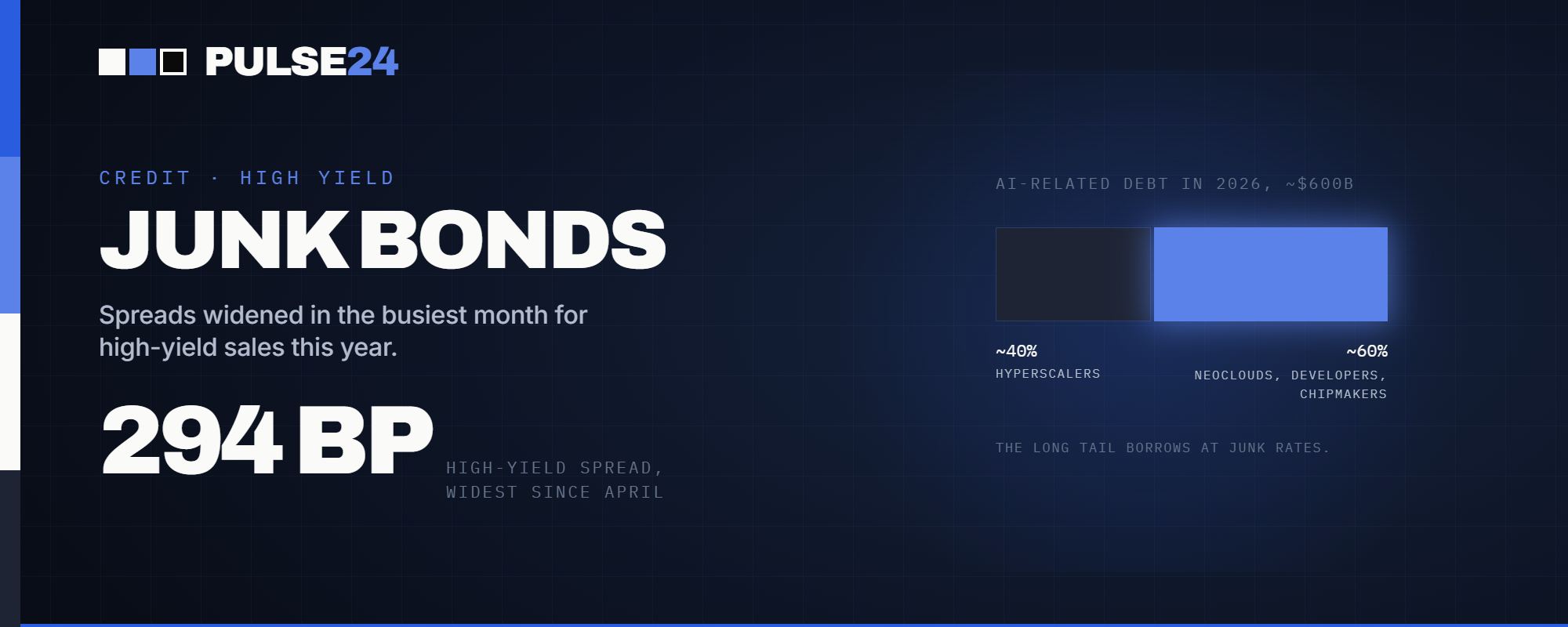
Junk bond spreads widened to their highest level since April, even though Wall Street sold more high-yield debt in September than in any other month this year. The credit market is starting to feel the weight of financing the AI buildout.
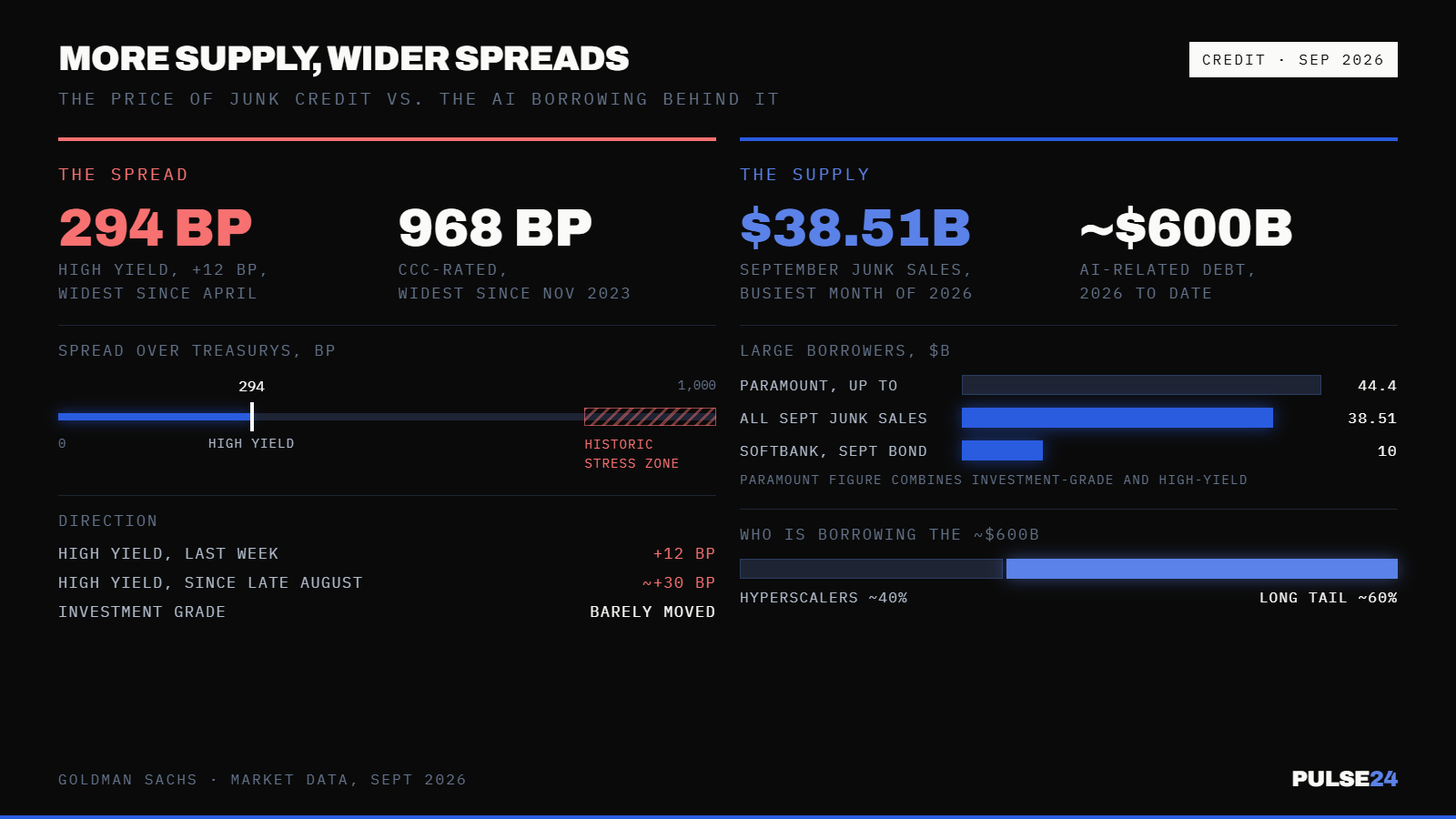
High-yield bond spreads widened 12 basis points to 294 basis points last Friday, the widest gap over Treasurys since April. Goldman Sachs credit strategist Amanda Lynam described it as the market bracing for what she called "the same sort of episodic indigestion that we've seen in the investment grade market earlier in the summer." Not a crisis, in other words. Just indigestion, and the meal causing it is AI debt.
The riskiest slice of that market moved even further. CCC-rated bonds, the bottom rung of speculative-grade credit, closed at 968 basis points over Treasurys, a level not seen since November 2023. Investment-grade spreads barely budged by comparison, staying far tighter than either junk tier. The stress is concentrated exactly where you'd expect it: among the weakest borrowers taking on the most debt to chase the AI buildout.
What Changed
September became the busiest month of 2026 for junk bond sales, with $38.51 billion in new high-yield debt pricing in a single month. SoftBank Group priced $10 billion of it alone, money it's funneling into its OpenAI ambitions. Paramount Skydance is lining up as much as $44.4 billion in combined investment-grade and high-yield borrowing of its own. Add it up across every sector touching AI infrastructure, and roughly $600 billion in AI-related debt has hit the market so far this year.
Only about 40% of that $600 billion came from hyperscale cloud providers, the companies building the biggest data centers with the strongest balance sheets. The rest came from a longer tail: neoclouds, data center developers, and chipmakers without Microsoft's or Google's credit rating, borrowing at junk rates to keep pace with a buildout that hasn't slowed all year.
Why It Matters
Spreads are the market's way of pricing risk before anyone has to say the word out loud. When they widen, investors are demanding more compensation to hold the debt, which raises the cost of the next dollar borrowed. A well-capitalized hyperscaler barely notices an extra basis point or two; a neocloud or data center developer already running thin margins might find it's the difference between a project that pencils out and one that doesn't.
This is also a preview of a familiar pattern. Credit markets tend to notice trouble before equity markets do, because bondholders get paid back before shareholders and price risk accordingly. A widening spread doesn't mean AI spending is about to collapse. It means the market is starting to ask harder questions about which borrowers in this buildout can actually service what they're taking on, and lower-rated issuers are the ones getting asked first.
What to Watch Next
Both spread readings remain well below the roughly 800 to 1,000 basis point range that has historically coincided with recession-level stress, so this isn't a five-alarm signal yet. But the direction matters more than the level right now: the spread has climbed roughly 30 basis points since late August. Micron reports fiscal fourth-quarter earnings after Wednesday's close, and as one of the more debt-reliant names tied to AI memory demand, its guidance will say something about whether lenders' caution is catching up with reality or running ahead of it. The Fed's December meeting is another checkpoint: further rate cuts would lower the cost of the next AI bond sale, while a pause would tighten the squeeze on the borrowers already paying up the most.
The Pulse24 Take
The AI trade isn't cracking; the bill for financing it is simply shifting from the income statement to the bond market, where it's harder to hide. Equity investors have spent two years rewarding anyone with exposure to AI infrastructure. Credit investors are now doing the opposite, charging more for it, especially from borrowers without a balance sheet anywhere near a hyperscaler's. Watch the spread, not just the stock price. It tends to move first.
How we read the data
Curious how we get from raw data to a take like this? Our Trader's Toolkit walks through the tools we lean on.
Explore the Toolkit