Pulse24 Original
World Labs Was Worth $1 Billion in 2024. AMD Paid $8.2 Billion for It Monday.
September 29, 2026
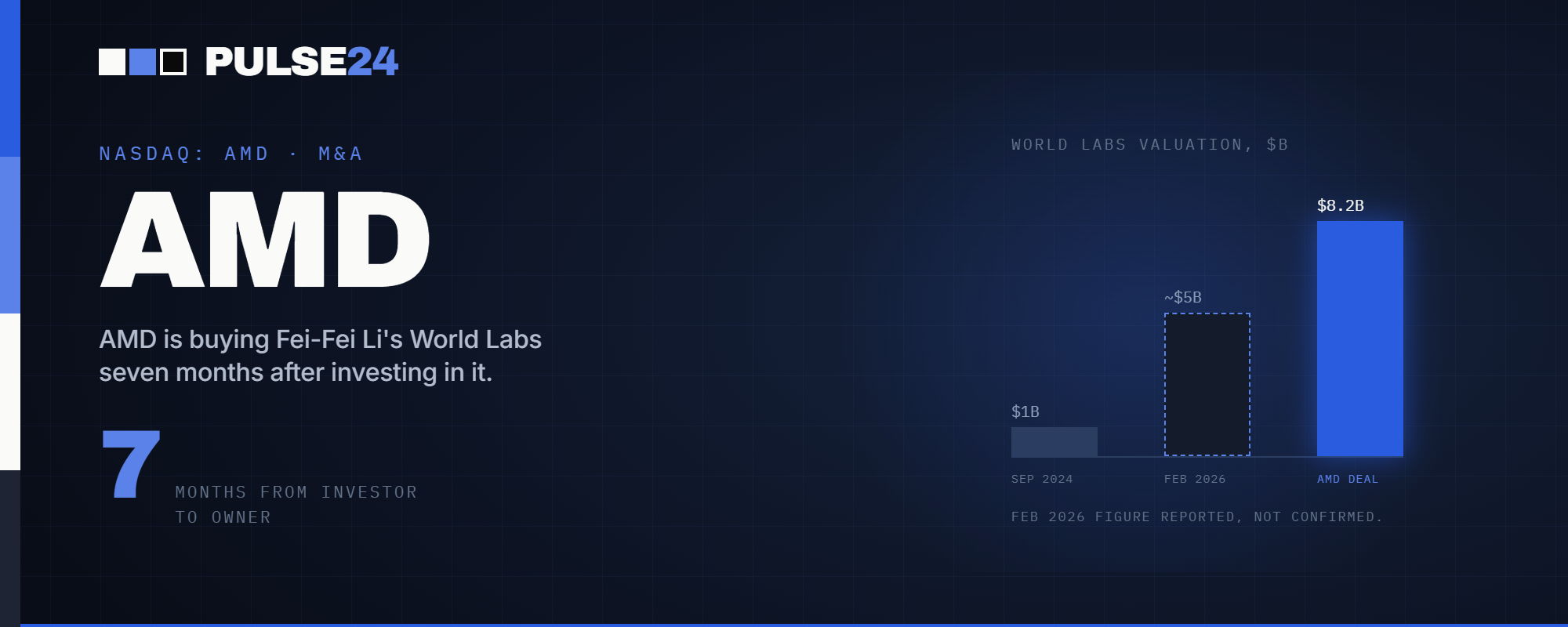
AMD is paying $8.2 billion in stock for Fei-Fei Li's World Labs, a startup AMD itself had invested in just seven months earlier. The deal pulls the ImageNet creator into AMD's C-suite as it races Nvidia into AI world models, robotics, and physical-world simulation.
Seven months is roughly how long AMD waited between investing in World Labs and agreeing to buy the whole company. AMD announced Monday that it will acquire the spatial-intelligence startup founded by Fei-Fei Li in an all-stock transaction, pulling one of AI's most closely watched research labs into a chipmaker that spent much of the past decade playing catch-up to Nvidia.
What Changed
World Labs builds what the industry calls world models: systems trained to generate, reconstruct, and simulate three-dimensional environments rather than just process text or images. Li founded the company in 2024 after more than a decade at Stanford, where she built ImageNet, the labeled-image dataset widely credited with kickstarting the deep learning boom in computer vision. Her pitch for World Labs was that AI needs genuine spatial understanding, not just pattern matching on flat data, to eventually operate in the physical world through robots, simulated training environments, and generated 3D content. The company's first product, Marble, targets entertainment studios and robotics teams that need synthetic environments to train models without the cost of collecting real-world data.
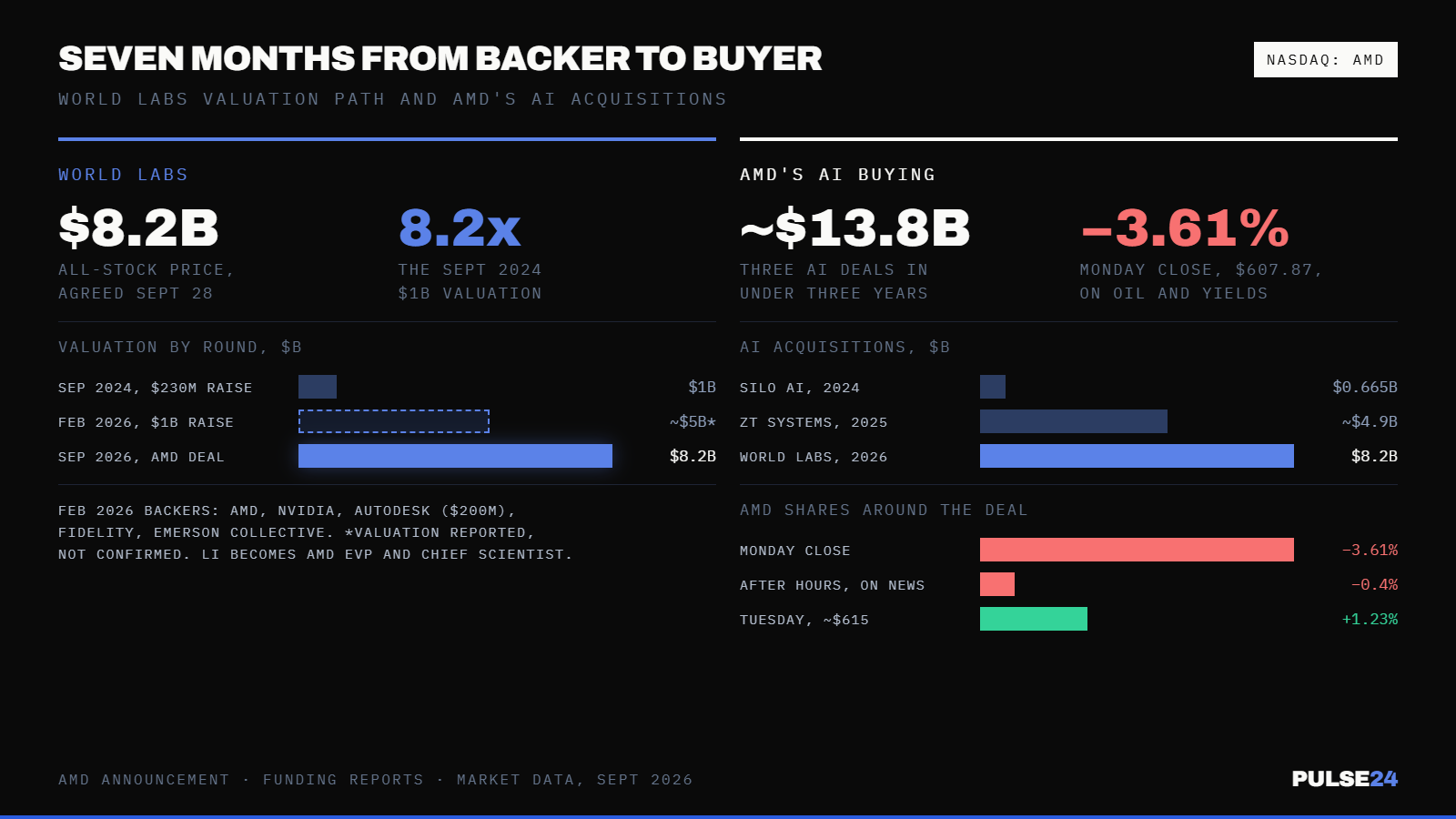
The funding trail explains why AMD's price tag looks aggressive. World Labs raised $230 million in a September 2024 round that valued it at $1 billion, backed by Andreessen Horowitz, NEA, and Radical Ventures, plus corporate money from AMD Ventures, Nvidia's NVentures, Adobe Ventures, and Databricks Ventures. In January 2026, Bloomberg reported the company was in talks to raise up to $500 million more at a $5 billion valuation. The round that actually closed in February 2026 came in twice as large, a full $1 billion, with Autodesk contributing $200 million and AMD and Nvidia both returning as backers alongside Fidelity and Emerson Collective. World Labs never confirmed whether that round priced at the reported $5 billion figure. Either way, AMD's $8.2 billion all-stock offer, agreed roughly seven months after that funding closed, values the company well above where its own venture arm had just bought in.
Monday's announcement landed on a rough day for AMD stock, though not because of the deal itself. Brent crude climbed above $107 a barrel and Treasury yields pushed toward multi-year highs that session, part of a broader market selloff tied to renewed uncertainty over Middle East oil supply. AMD shares closed down 3.61% at $607.87, and the stock slipped another 0.4% in after-hours trading once the World Labs news broke, a decline easy to miss against the day's larger macro swings. By Tuesday, as oil and yields eased back, AMD recovered alongside the broader market and traded roughly 1.23% higher than Monday's close, near $615.
Why It Matters
This is AMD's third notable AI-focused acquisition in roughly two years, and the pattern says as much as any single deal does. AMD bought Finnish AI shop Silo AI for $665 million in 2024, then paid close to $4.9 billion for server maker ZT Systems in a deal that closed in early 2025, and now World Labs for $8.2 billion. Add those three together and AMD has spent roughly $13.8 billion buying its way into AI software, systems integration, and now foundation models in under three years, on top of the chip business it built organically and the $49 billion Xilinx acquisition that closed back in 2022. The company is no longer just trying to sell GPUs and CPUs that compete with Nvidia's; it is trying to build the same kind of full-stack ecosystem, spanning hardware, software, and now research talent, that has made Nvidia so difficult to displace.
World Labs specifically targets a niche Nvidia has already staked out with its own Cosmos platform, a suite of world foundation models aimed at robotics, autonomous systems, and other physical AI applications. AMD had a front-row seat to World Labs' progress well before Monday. It invested in the company's February funding round, giving it direct visibility into the technology and the team, and converted that stake into full ownership within seven months. That is a fast timeline for a strategic investor to go from minority backer to outright buyer, and it suggests AMD saw enough in that window to decide partial exposure was not enough. This comes at a moment when AMD's server CPU share has been climbing amid Intel's supply constraints, part of a broader run that helped push AMD's market capitalization above $1 trillion earlier this year. A company with that kind of currency in its own stock can afford to pay up for research talent in an all-stock deal without touching its cash balance.
Nvidia's position here is the more interesting wrinkle. Nvidia's venture arm backed World Labs in both the 2024 seed round and the February 2026 round, doubling down on the spatial-intelligence thesis each time. Seven months after that second check, the company it funded joined the leadership ranks of its biggest rival instead. Strategic venture investing in AI has increasingly worked this way: chipmakers and cloud providers spread bets across a wide field of startups to keep a window into where research is heading, without any guarantee that a portfolio company will not eventually end up strengthening a competitor.
The muted stock reaction is its own lesson. An $8.2 billion acquisition and the addition of a globally recognized AI researcher to the C-suite would typically be the biggest story of the day for AMD. Instead it barely registered against a session where oil and bond yields moved the entire market. Company-specific news, even genuinely significant news, competes with macro forces for a stock's attention on any given day, and macro usually wins the short-term battle.
What to Watch Next
The deal still needs regulatory clearance before closing, expected by the end of 2026. At $8.2 billion the transaction is unlikely to draw the kind of extended antitrust scrutiny that has slowed larger AI infrastructure deals, but given how closely regulators have been watching consolidation across the AI supply chain, any review timeline is worth tracking.
Watch how AMD integrates World Labs' research roadmap with its existing GPU and software plans, and whether Marble or a successor product ships features aimed squarely at matching Nvidia's Cosmos platform. Li's title, Chief Scientist, suggests she will have influence over AMD's broader AI research direction rather than running World Labs as a walled-off unit, which raises the question of how much independence the original team retains.
Also worth watching is whether other AI labs see similar treatment from their own strategic investors. World Labs' path, from a $1 billion valuation to over $1.2 billion raised in total to an $8.2 billion sale to one of its own backers, could become a template other richly funded, pre-revenue AI startups watch closely, whether or not their businesses are anywhere near as far along commercially.
The Pulse24 Take
Two things are true about this deal at once. World Labs is joining a company with real chips, real customers, and a real balance sheet, which gives its research a commercial home it did not have as an independent startup still working out how spatial-intelligence models turn into revenue. And AMD just paid a price that assumes a lot of that translation happens successfully, for a company whose flagship product has been shipping for less than a year.
None of that makes the deal a mistake. AMD has shown with Xilinx and ZT Systems that it is willing to pay up for capabilities it cannot build fast enough on its own, and both of those bets have arguably paid off in different ways. But World Labs sits earlier in its commercial life than either of those targets did at the time AMD bought them, which means the payoff here depends more on execution over the next several years than on anything closing this deal accomplishes by itself. The seven-month jump from investor to owner also says something about how fast conviction can shift once a strategic buyer gets a close look at the technology. The valuation looks aggressive today. Whether it looks aggressive in three years depends entirely on whether physical AI and world models turn into the kind of enterprise demand that GPUs already have.
How we read the data
Curious how we get from raw data to a take like this? Our Trader's Toolkit walks through the tools we lean on.
Explore the Toolkit