Pulse24 Original
Intel Can Meet Only Half Its CPU Orders. AMD's Server Market Share Jumped From 27% to 34% in a Year.
September 28, 2026
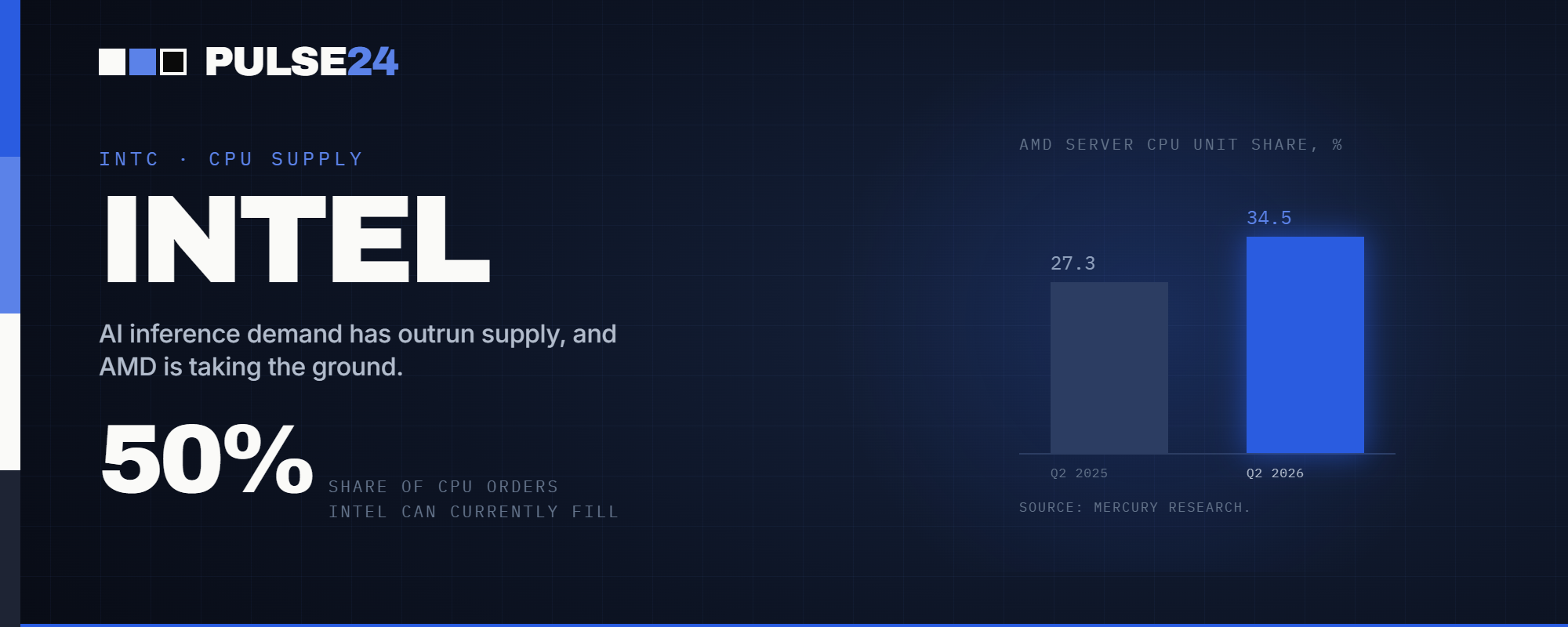
Intel says it can fill only half its CPU orders as AI inference demand outruns supply, and the stock jumped 10% on the news. AMD's server market share has already climbed from 27% to over 34% in the past year, and Intel is reportedly planning another CPU price increase for 2027.
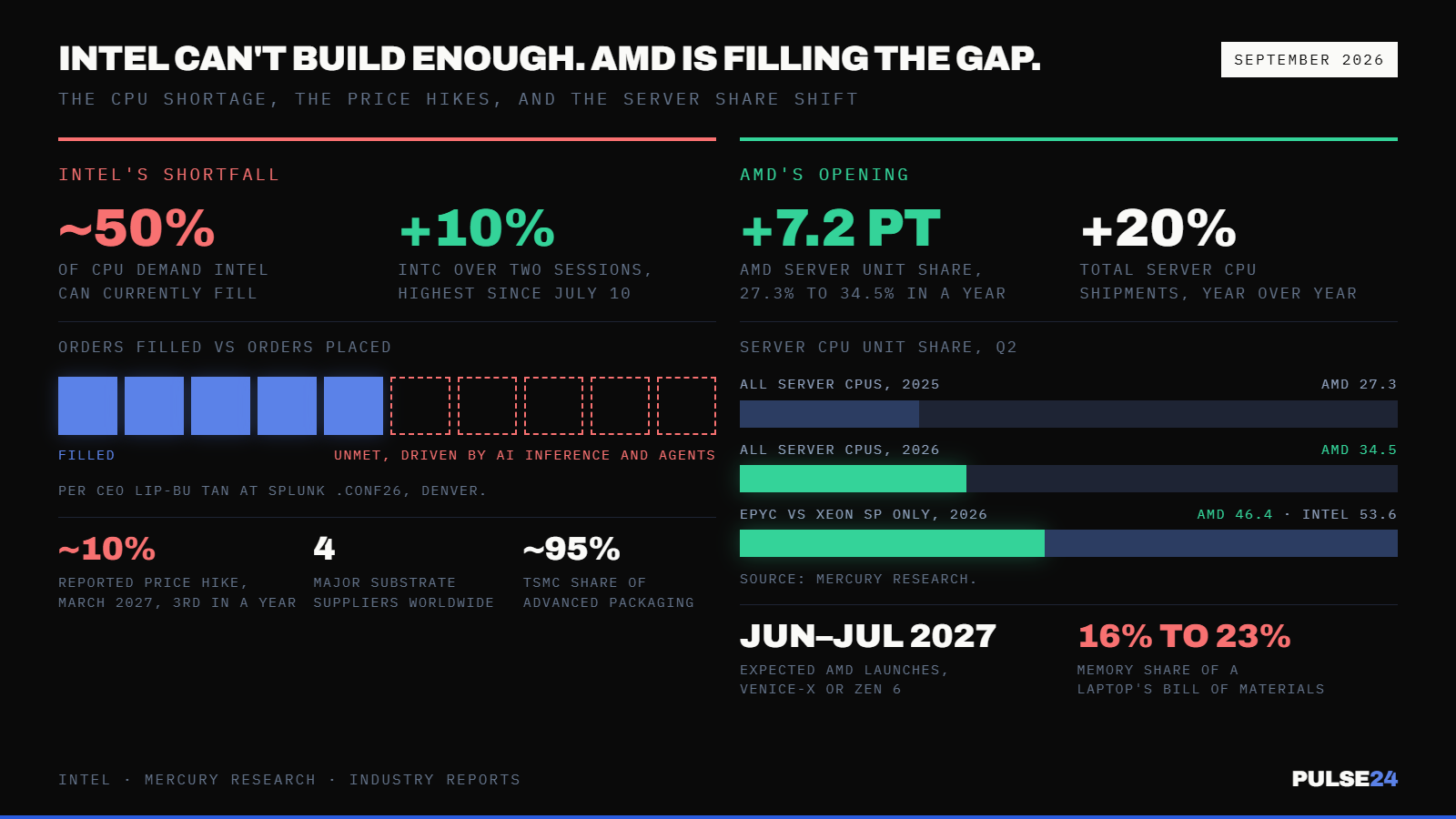
Fifty percent. That's the share of CPU orders Intel says it can currently fill, according to CEO Lip-Bu Tan, who told a room in Denver earlier this month that some of his largest customers are calling to apologize for not being able to order more. For a company that spent much of the past three years explaining chronic underutilization at its fabs, a shortage this severe amounts to a whiplash-inducing reversal.
What Changed
Tan's remarks came at Splunk's .conf26 conference in mid-September, where he tied the shortfall to a shift in what AI workloads actually require. The first wave of AI spending went almost entirely toward GPUs for training large models. This second wave, built around inference and autonomous software agents that plan, reason, and hand off tasks to each other, leans more heavily on the kind of general-purpose orchestration a CPU handles well. "When orchestration, control flow, and complex single-threaded or multi-threaded scheduling are needed, the CPU is the best choice," Tan said, adding that future systems will need to support not thousands but potentially millions of these software agents running at once.
Markets reacted immediately. Intel shares rose about 10% over two sessions after the comments circulated, touching their highest level since July 10. That's a striking move for a stock that has spent most of the past two years trading on turnaround hopes rather than demand data. TSMC's own capacity crunch pushed it into a second straight year of wafer price increases, and Intel's shortage suggests the squeeze has now spread from advanced foundry nodes to finished CPUs sitting several steps further down the chain.
Why It Matters
AMD is the most immediate beneficiary of Intel's supply gap, and the numbers already show it. Mercury Research put AMD's overall server CPU unit share at 34.5% in the second quarter of 2026, up from 27.3% a year earlier, with total server processor shipments up 20% year over year as demand across the industry outpaces supply. Narrow the comparison to the datacenter chips that compete head to head, Intel's Xeon SP against AMD's EPYC line, and AMD's adjusted share reaches 46.4% versus Intel's 53.6%. A company that spent a decade fighting for single-digit server share is now closing in on parity with the incumbent, and it's happening at a moment when Intel is telling the market it simply can't produce enough to defend the ground it has left.
There's a pricing angle too. Reports this month point to Intel planning roughly a 10% CPU price increase timed around a major product launch in March 2027, what would be its third such increase in about a year. AMD isn't confirmed to be raising prices in response, but it's reportedly planning new product launches of its own, potentially Venice-X server chips or Zen 6 desktop parts, around June or July 2027. Rising component costs have already pushed memory chips to 23% of a typical laptop's bill of materials, up from 16% a year ago, and a CPU increase on top of that would add another line item to a hardware cost stack that keeps climbing across categories, not just AI infrastructure. When the chips inside ordinary laptops and the CPUs inside AI-heavy servers are facing price pressure from the same underlying capacity shortage, it's a signal the constraint runs wider than any single product category.
Tan flagged a longer-term worry as well. He said only four major suppliers make the substrates used in advanced chip packaging, the process that binds multiple silicon dies into a single finished chip, two based in Japan and two in Taiwan, and that Intel has had to prepay simply to secure a place in line. That scarcity sits on top of an already concentrated market: separate industry reporting has put TSMC's own share of the world's advanced packaging capacity at roughly 95%. A handful of suppliers clustered in two countries means any disruption, a natural disaster, a labor shortage, or a facility running flat out, could ripple through Intel's, AMD's, and Nvidia's supply chains at once. Building meaningful alternative capacity elsewhere takes years, not quarters.
What to Watch Next
Intel's next earnings call will be the real test of whether the 50% demand-fulfillment figure holds up to specifics, including which product lines are most constrained and how much of the shortfall is a temporary bottleneck versus a structural ceiling on fab output. AMD's own quarterly report will show whether its server share gains are converting into the revenue growth investors are pricing in, and whether the company can add capacity fast enough to keep taking share while Intel is constrained rather than simply matching demand it can't fully serve either.
Also worth tracking is how the reported price increases actually land. Server buyers, mostly hyperscalers already spending tens of billions on AI infrastructure, have shown limited price sensitivity so far. PC makers serving budget-conscious consumers have far less room to pass costs through, which means a CPU price hike could squeeze notebook margins well before it dents a hyperscaler's capital budget.
The Pulse24 Take
It's easy to read a stock jumping 10% on a CEO's comments and assume the story is about Intel's turnaround. The more interesting story is what the shortage reveals about where AI spending is actually heading. GPUs got the headlines during the training era because a handful of companies bought nearly all of them. A shortage spreading to CPUs, the least glamorous, most commoditized chip in the stack, says the demand driving this cycle has broadened well past a few hyperscalers stockpiling accelerators.
None of this guarantees Intel's fortunes have permanently turned, and a supply shortage flattering a stock price is a different thing than a company solving the manufacturing problems that created the shortage in the first place. But a market that can't get enough CPUs, GPUs, or advanced packaging all at once is telling a fairly consistent story about how much physical capacity this AI buildout still needs, regardless of which company ends up selling the parts.
How we read the data
Curious how we get from raw data to a take like this? Our Trader's Toolkit walks through the tools we lean on.
Explore the Toolkit