Pulse24 Original
TSMC Is Raising Wafer Prices for a Second Year in a Row. Samsung Already Went as High as 15%.
September 26, 2026
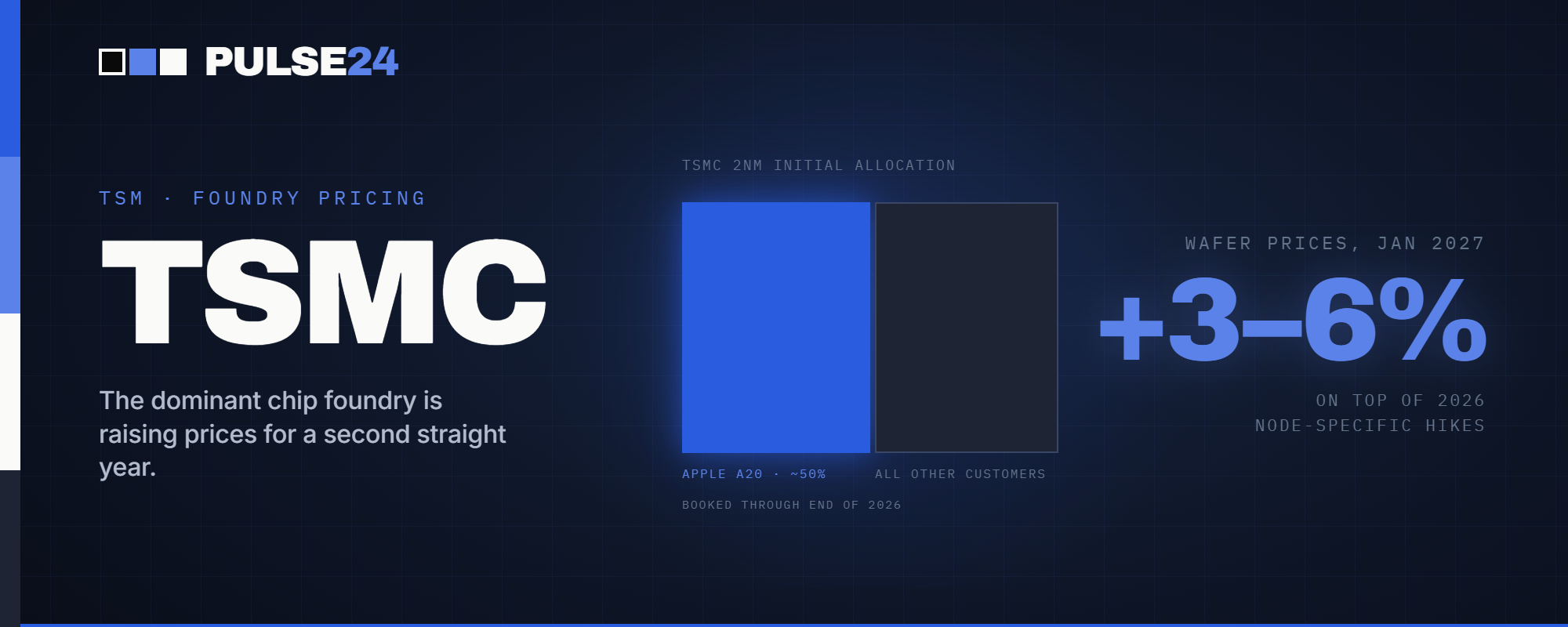
TSMC is preparing another wafer price increase for January 2027, on top of hikes it already pushed through this year. Samsung's advanced foundry prices already jumped as much as 15%, and the AI-driven shortage behind both shows no sign of easing before 2027.
Taiwan Semiconductor Manufacturing Company is telling customers to brace for higher prices again. Multiple reports this week point to wafer price increases of 3% to 6% starting in January 2027, landing on top of smaller node-specific hikes the foundry already pushed through earlier in 2026. For a company that built its dominance partly on pricing discipline, two consecutive years of increases marks a real shift in posture.
What Changed
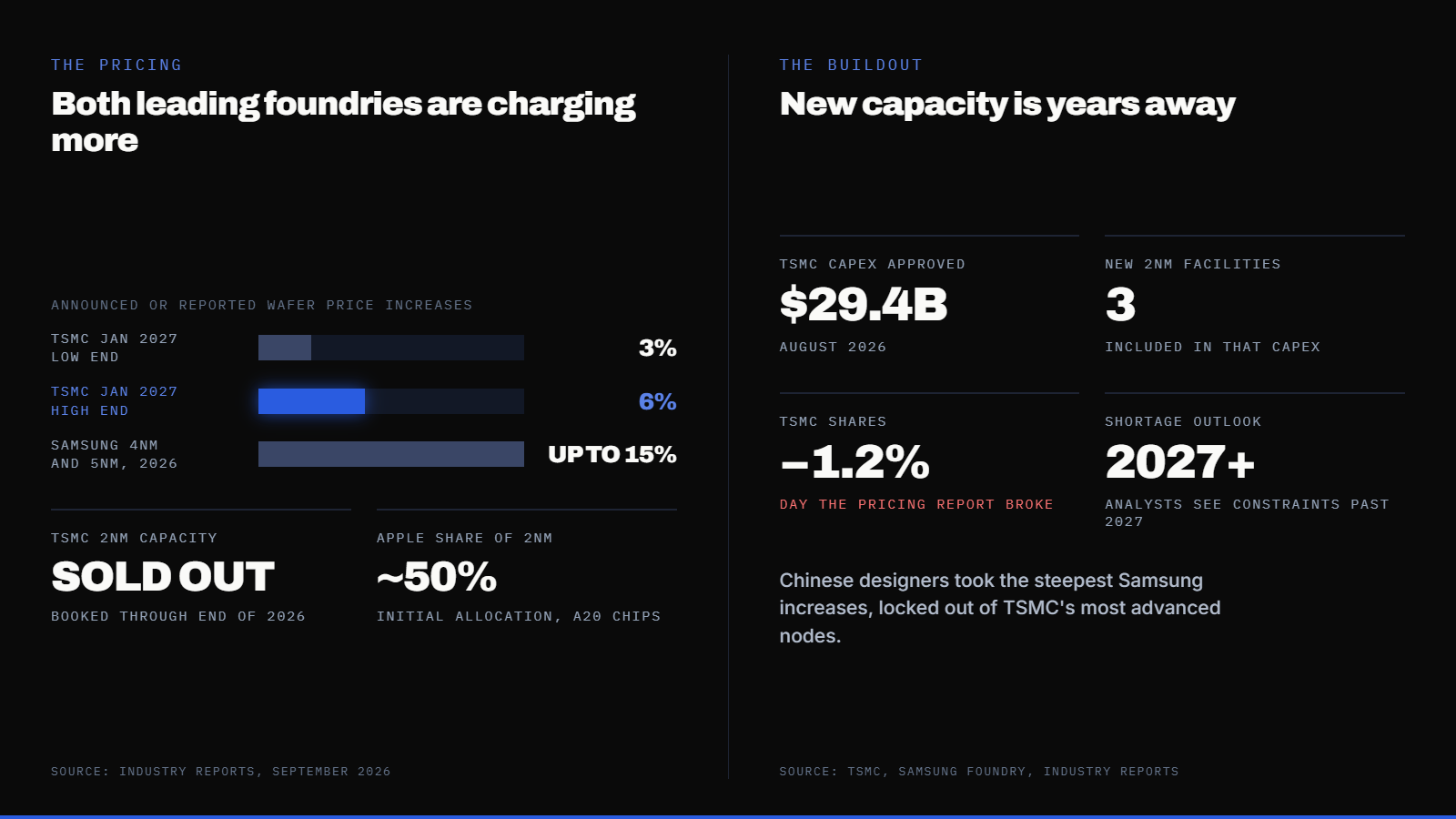
The increases concentrate on TSMC's most advanced nodes, the 2nm and 3nm processes that power the newest AI accelerators and flagship phone chips. Both are effectively sold out. TSMC's 2nm line is booked through the end of 2026, and Apple alone has reportedly locked up roughly half of the initial allocation for its A20 and A20 Pro chips, with some reports putting the figure just above 50% and others just below. When a supplier's most valuable product line has a waiting list instead of a sales pitch, raising the price stops being a strategic choice and starts looking like an acknowledgment of where demand already sits.
Samsung is watching the identical dynamic play out one rung down the ladder. Its foundry division raised prices on 4nm and 5nm orders by as much as 15% this year, and the hikes weren't spread evenly. Chinese chip designers, cut off from TSMC's most advanced tools by U.S. export controls, took the steepest increases as they compete for whatever mature-node capacity Samsung has left. Memory chip suppliers ran a similar playbook this year, pushing prices high enough to noticeably reshape the cost of an ordinary laptop. Foundry pricing is following the same script, just several rungs higher up the value chain, on parts that go into far more expensive machines.
Why It Matters
Wafer costs sit near the bottom of a long chain that ends with whoever buys a finished chip. Nvidia, AMD, Apple, and Qualcomm all pay TSMC first, then decide how much of that cost to absorb and how much to pass along. Margins at the top of the AI stack have generally been wide enough that a mid-single-digit wafer increase won't move headline gross margins much on its own. Stack four consecutive years of the same story on top of each other, which is what current reporting suggests is coming, and the arithmetic starts to matter more. Data center operators already face all-in build costs that can run $38 billion to $60 billion per gigawatt depending on what gets counted, and rising silicon costs are one more input nudging that range toward its higher end rather than its lower one.
There's a market-structure wrinkle here too. TSMC's own capital spending, $29.4 billion approved in August alone for three new facilities dedicated to 2nm production, shows a company investing aggressively to meet demand rather than simply squeezing a captive customer base. Management's own guidance flags near-term margin dilution from that ramp-up, which suggests the price increases are partly funding the buildout rather than pure pricing power extracted from scarcity. Earlier this month, TSMC and Samsung jointly moved to fix a photomask bottleneck slowing down ASML's most expensive lithography machines, another sign that supply constraints, not a deliberate squeeze, are the real driver. How durable these higher prices prove to be once that new capacity actually comes online in 2027 and 2028 is a separate question from why they exist today.
What to Watch Next
Nvidia, AMD, and Apple all report earnings before TSMC's new prices take effect in January, and each will face questions about whether it plans to hold the line on its own margins or pass the increase through to customers. Apple has historically absorbed component cost increases rather than raising iPhone prices outright, while Nvidia's data center customers have so far shown limited price sensitivity. Worth watching too is whether Intel, the one large foundry with spare advanced capacity, uses this moment to undercut TSMC and Samsung on price to win business it hasn't been able to attract on technical merit alone.
The bigger question is how long the shortage enabling these increases actually lasts. Industry analysts have projected AI-driven capacity constraints running past 2027, since new fabs take years to reach full output regardless of how much capital gets committed today. If that timeline holds, this week's pricing report probably won't be the last one of its kind.
The Pulse24 Take
Price increases from the world's dominant chip foundry rarely make for dramatic headlines. Nothing crashed on the news, and no analyst framed it as a record being broken. What happened instead is quieter and, in some ways, more informative than a stock swing would be: the supplier sitting underneath practically every major AI chip in production told the market, in the plainest way a business can, that scarcity is real and durable enough to raise prices in back-to-back years.
Whether that scarcity turns into higher costs for a data center buildout, a smartphone upgrade, or a GPU order depends on how much pricing power each buyer has of its own. Nvidia and Apple likely have room to absorb a few points of margin pressure without investors noticing much. Smaller AI chip designers with thinner margins and less negotiating leverage may not have that luxury, and they're worth watching if this pricing cycle keeps running through 2027 the way current bookings suggest it will.
How we read the data
Curious how we get from raw data to a take like this? Our Trader's Toolkit walks through the tools we lean on.
Explore the Toolkit