Pulse24 Original
$54.23 Billion in Record Micron Revenue Couldn't Lift Korea's Chip Stocks Thursday
October 1, 2026
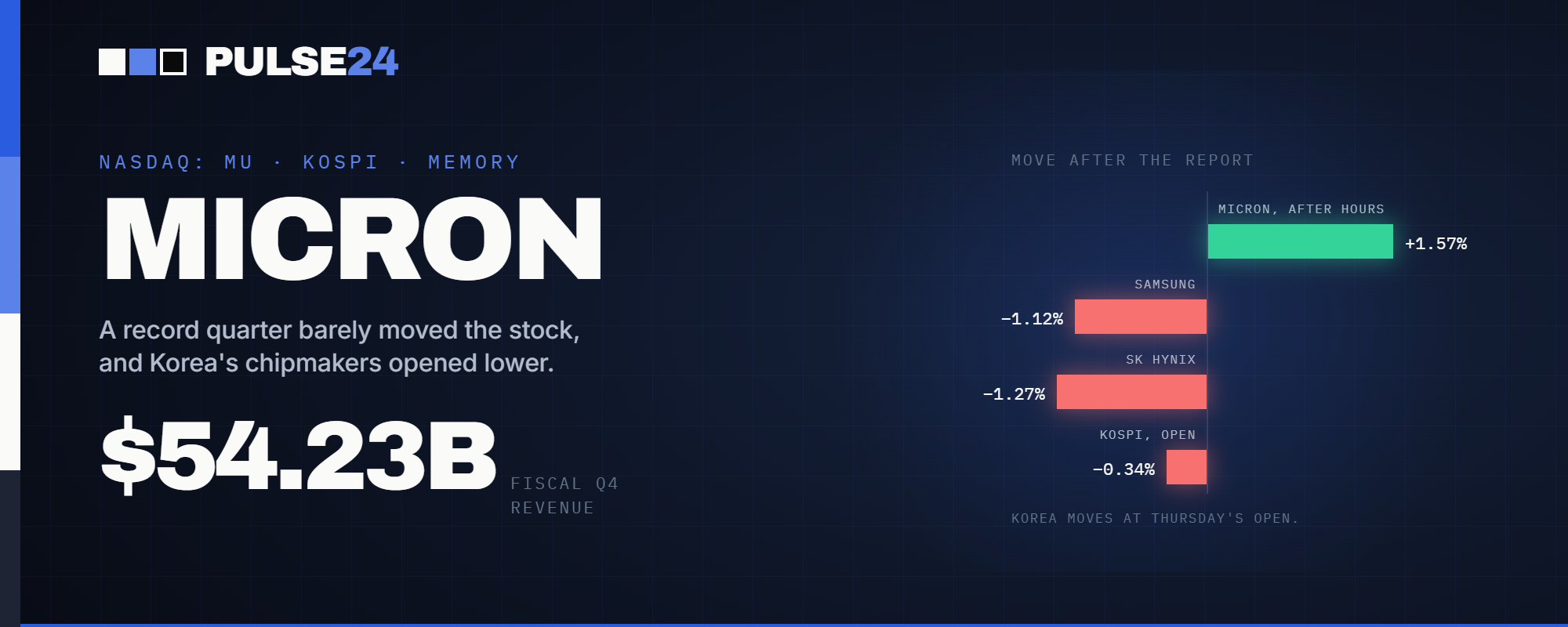
Micron beat Wall Street's revenue estimate by $3.48 billion and guided even higher for the quarter ahead, yet Samsung and SK Hynix both opened lower Thursday. Treasury yields near two-decade highs are doing more to move chip stocks right now than earnings are.
Micron Technology reported fiscal fourth-quarter revenue of $54.23 billion on Wednesday, nearly five times what it made in the same quarter a year ago and $3.48 billion above what Wall Street had modeled. By the time Korean markets opened Thursday morning, Samsung Electronics and SK Hynix, the two companies most exposed to the same memory boom, were both trading lower.
Adjusted earnings per share landed at $33.42, also clear of the $31.45 analysts expected. Micron's two data center segments, a cloud memory unit and a core data center unit, generated a combined $34.3 billion for the quarter, and revenue from data center SSDs alone grew more than tenfold year over year. Micron said there is "no clear line of sight for when supply and demand will return to balance," calling DRAM the industry's principal constraint. CEO Sanjay Mehrotra called it a record year and said he expects "an even stronger fiscal 2027." Guidance for the quarter now underway came in at $60 billion to $63 billion in revenue, again above what the Street had penciled in.
None of that produced much of a stock reaction. Micron shares rose a modest 1.57% in after-hours trading to $1,082, a small move given the scale of the beat. Wall Street has been debating Micron's valuation for weeks, with price targets spread over more than a thousand dollars, and Wednesday's results didn't settle that argument in either direction.
What Changed
The muted reaction carried into Thursday's session in Seoul, where the Kospi opened down 0.34% at 6,814.49, extending a decline that had already reached a third straight losing session the day before. Samsung slipped 1.12% to 265,500 won and SK Hynix fell 1.27% to 1,753,500 won, both moving lower within hours of Micron's numbers crossing the wire. South Korea's chip exports jumped 259% earlier this year on the same AI memory demand, and both companies have ridden that wave for most of 2026. Thursday's open suggests something else is now setting the tone.
Why It Matters
Treasury yields are doing more to move these stocks right now than earnings reports are. The 10-year yield reached its highest level in nearly two decades this week, and the 30-year pushed past 5.6%, matching the highest level it has reached since 2002. That happened even after Wednesday's inflation report, which showed the Fed's preferred gauge rising 3.4% year over year in August, below the 3.7% economists had expected. Yields dipped briefly on the news, then traders looked past it toward Friday's jobs report, and the climb resumed.
Foreign investors sold a net 1.45 trillion won of Korean shares on Wednesday, and institutions sold another 1.18 trillion won, even as individual investors bought. Rising long-term yields raise the discount rate investors apply to future profits, and memory stocks carry a lot of their expected value years out, tied to AI data center buildouts that are supposed to keep running through 2030. A higher discount rate shrinks the present value of that future revenue more than it shrinks the value of a company whose earnings mostly arrive within the next year. Micron's quarter was about as strong as a quarter gets. The yield move still outweighed it.
What to Watch Next
Watch whether Seoul's selling extends into a fourth straight session once Thursday's final numbers are in, and whether Samsung's own earnings report in the coming weeks draws a similarly muted response regardless of what it shows. The Fed's next move matters more than any single earnings print right now. October hike odds had already slipped below 50% before this week's data, and a further pullback in those odds could finally give long-term yields room to fall. Until then, blowout quarters may keep landing with a thud across the memory and AI infrastructure trade, not because the demand story is cracking, but because the price of money has become the bigger variable this quarter.
The Pulse24 Take
Micron turned in one of the strongest quarters any chipmaker has ever reported, and the stock barely moved. The demand picture the company described, a DRAM market with no clear path back to balance, hasn't changed. What has changed is the cost of owning that demand. When the 10-year yield sits near a two-decade high, investors discount every future dollar of AI-driven memory revenue more harshly than they did a year ago, and that recalculation is playing out in Seoul and New York at the same time. Earnings season will keep testing this pattern in the weeks ahead. For now, the yield curve is setting the price, and the chipmakers are along for the ride.
How we read the data
Curious how we get from raw data to a take like this? Our Trader's Toolkit walks through the tools we lean on.
Explore the Toolkit