Pulse24 Original
October Fed Hike Odds Dropped From 70% to 51% Tuesday. The 30-Year Treasury Yield Hit a 2002 High Anyway.
September 30, 2026
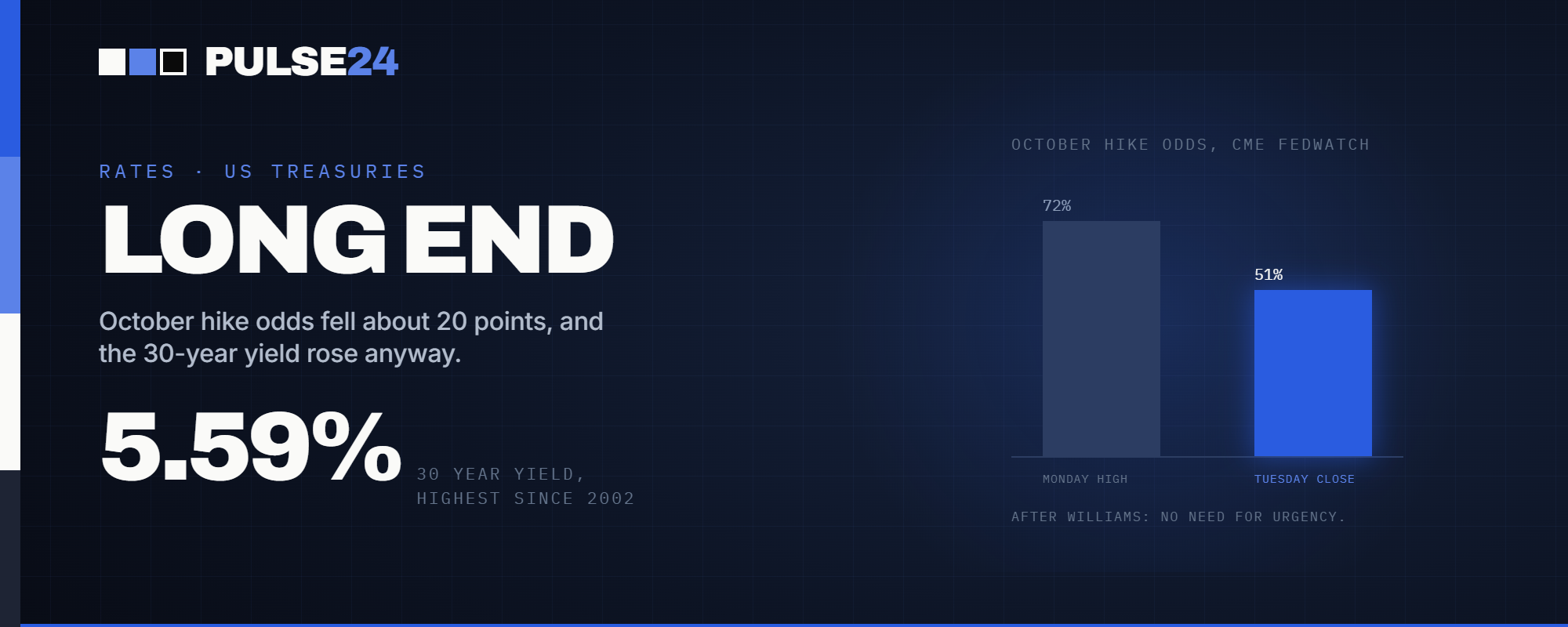
October rate-hike odds fell twenty points in a single session after the New York Fed's John Williams said there's no rush to move again. The 30-year Treasury yield didn't get the memo, climbing to its highest level since 2002 anyway.
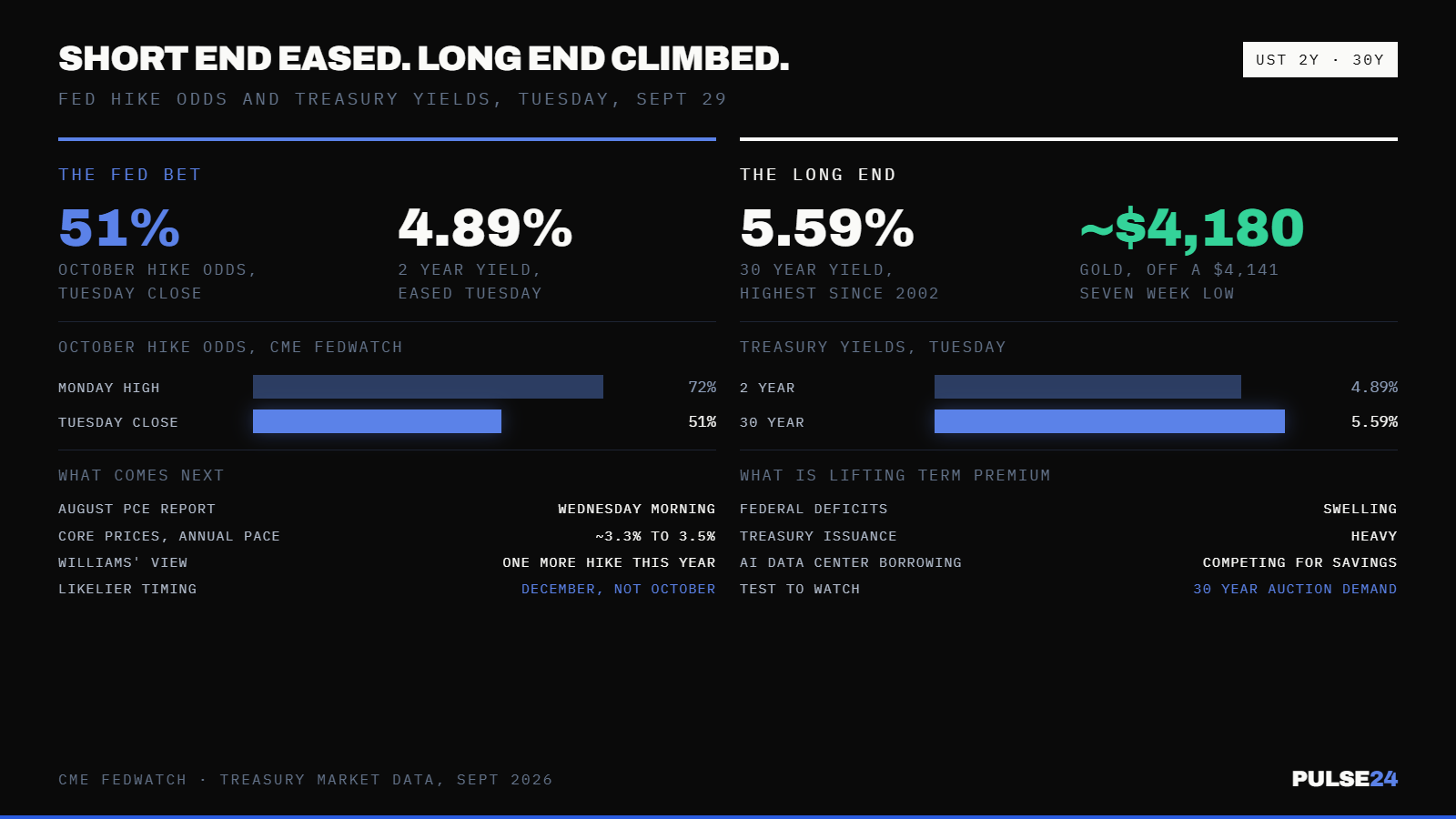
Fifty-one percent. That's where CME FedWatch had the odds of an October Federal Reserve rate hike by Tuesday's close, down from as high as 72% a day earlier. New York Fed President John Williams did the damage himself, telling an audience Tuesday there's no need for urgency on another increase and that policymakers have time to gather more information before moving again.
The reversal came fast. Monday, oil-driven inflation fears had pushed hike odds to a multi-week high and dragged gold to its worst day in weeks. By Tuesday afternoon, one Fed official had talked the market back down by roughly twenty percentage points. Williams wasn't ruling out another hike entirely. He still expects one more move before the year is out, just not as soon as futures markets had started pricing in.
What Changed
Short-term and long-term yields told two different stories Tuesday, and the gap between them is the real story here. The 2-year Treasury yield, the maturity most sensitive to what the Fed does in the next few months, eased to about 4.89%, a small but clear sign that traders believe Williams. The 30-year yield did the opposite. It climbed to roughly 5.59%, a level the bond hasn't touched since 2002, extending a climb that had already pushed it to a multi-decade high earlier this month.
That split matters because it separates two questions the bond market is answering independently. The 2-year yield mostly reflects where the Fed funds rate will sit over the next couple of years, and on that question, Williams just gave a clear, dovish answer. The 30-year yield reflects something else: how much extra compensation investors demand for locking up money for three decades, known as term premium. That number has little to do with next month's FOMC meeting and everything to do with how much debt the Treasury needs to sell, how sustainable the federal deficit looks, and how much of the country's capital gets absorbed by other borrowers competing for the same pool of savings.
Right now, one of the biggest new competitors for that capital is the AI buildout. SoftBank is already paying its highest-ever bond yields to help fund OpenAI's infrastructure needs, and CoreWeave's own interest bill is approaching its operating income. Multiply that kind of borrowing across every hyperscaler racing to build data centers, and it's not hard to see why investors are demanding more yield to hold 30-year paper, regardless of what the Fed does with short-term rates next month.
Why It Matters
Gold's move fits the same logic. The metal bottomed near $4,141 an ounce Tuesday morning, its lowest level in seven weeks, before climbing back to around $4,180 by Wednesday's Asian session as the dovish Williams comments took hold. Gold pays no yield, so it tends to benefit when the market pulls back expectations for a near-term hike. But the metal's bounce has been more muted than the swing in Fed odds would suggest, and the 30-year yield's climb is likely why: as long as long-term borrowing costs keep rising, the opportunity cost of holding gold doesn't fall nearly as much as a simple read of Fed odds would imply.
There's a policy dimension here too. A hike this year was never fully settled among Fed officials, and the committee's own dot plot pointed to a fight over timing rather than direction. Williams effectively took October off the table and nudged the debate toward December, which lines up with the growing sense on the FOMC that the case for one more hike this year is intact, just not urgent. For a Fed that raised rates in September for the first time since 2023, that's a meaningful softening in tone, even if the destination hasn't changed.
What to Watch Next
Wednesday's PCE report is the next test. It's the Fed's preferred inflation gauge, and a hot reading on core prices, which have been running near 3.3% to 3.5% annually, could undo some of what Williams accomplished Tuesday by reviving hike bets for October rather than December. Beyond that, watch Treasury auction results over the next few weeks. If demand for 30-year paper comes in weak, that's the clearest sign yet that term premium, not Fed policy, is now the dominant force in the long end of the curve, and that's a very different problem for markets than a Fed that's simply hiking too much.
The Pulse24 Take
The easiest headline here is that the Fed just turned dovish. That's not quite right. One official said he doesn't feel rushed, and futures markets, which had gotten ahead of themselves Monday on an oil scare, corrected accordingly. What actually changed is smaller and arguably more important: the market re-learned that Fed odds and long-term borrowing costs aren't the same trade anymore.
For most of the past two decades, the 30-year yield mostly took its cues from the Fed. Now it's taking cues from the deficit, from Treasury issuance calendars, and from how much of the country's savings the AI buildout needs to borrow. A Fed that talks dovish can still coexist with a bond market that keeps making long-term borrowing more expensive, and that combination, cheaper near-term money and pricier long-term money, is exactly the kind of curve investors haven't had to navigate in a generation.
How we read the data
Curious how we get from raw data to a take like this? Our Trader's Toolkit walks through the tools we lean on.
Explore the Toolkit