Pulse24 Original
Japan's 10-Year Bond Yield Hasn't Been This High Since 1996. The 30-Year US Treasury Hit a 2004 High in the Same Week.
September 25, 2026
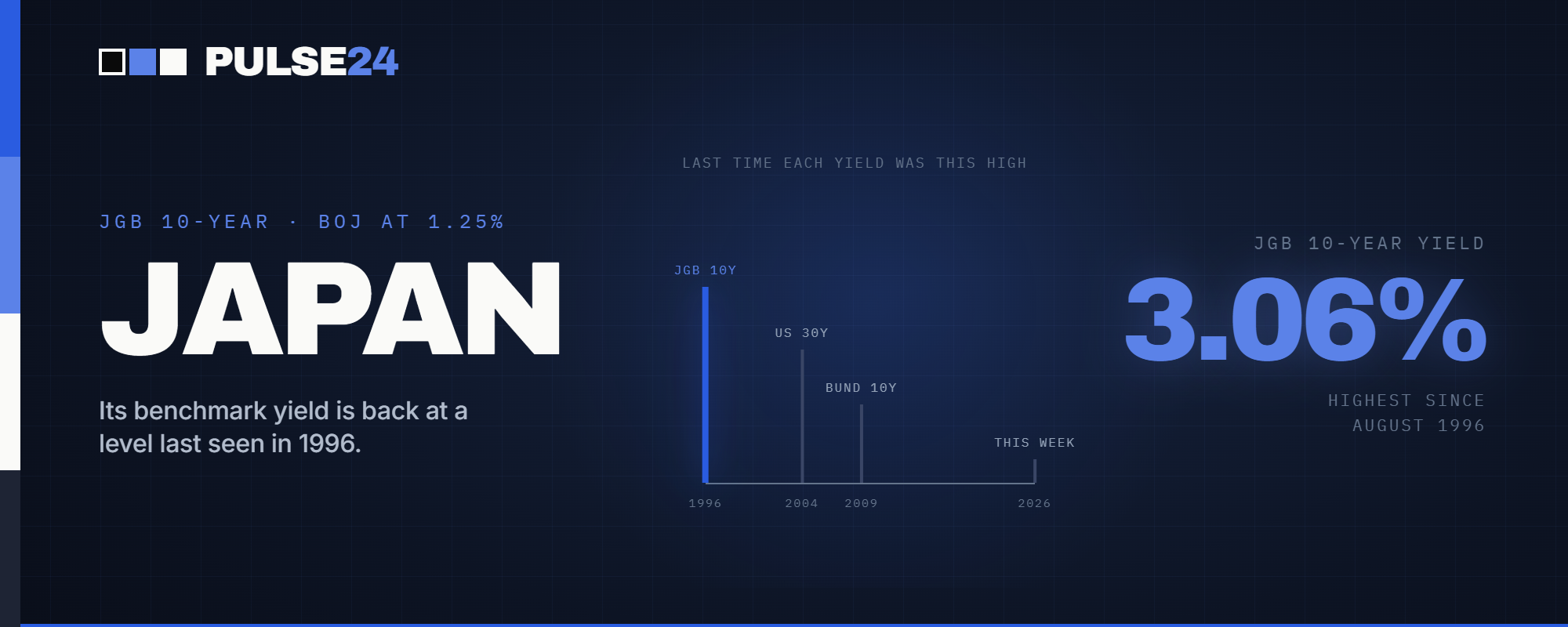
Japan's 10-year bond yield broke above 3% this week, a level unseen since 1996, and the tremors are reaching Washington too. The 30-year Treasury's climb to its highest since 2004 traces back to a Japanese repatriation trade that keeps getting delayed instead of arriving.
Japan's 10-year government bond yield touched 3.06% this week. The last time it traded that high, the Dow Jones Industrial Average hadn't cracked 6,000 yet and Google didn't exist. Now it's back, and the tremors are showing up in the US Treasury market too.
What Changed
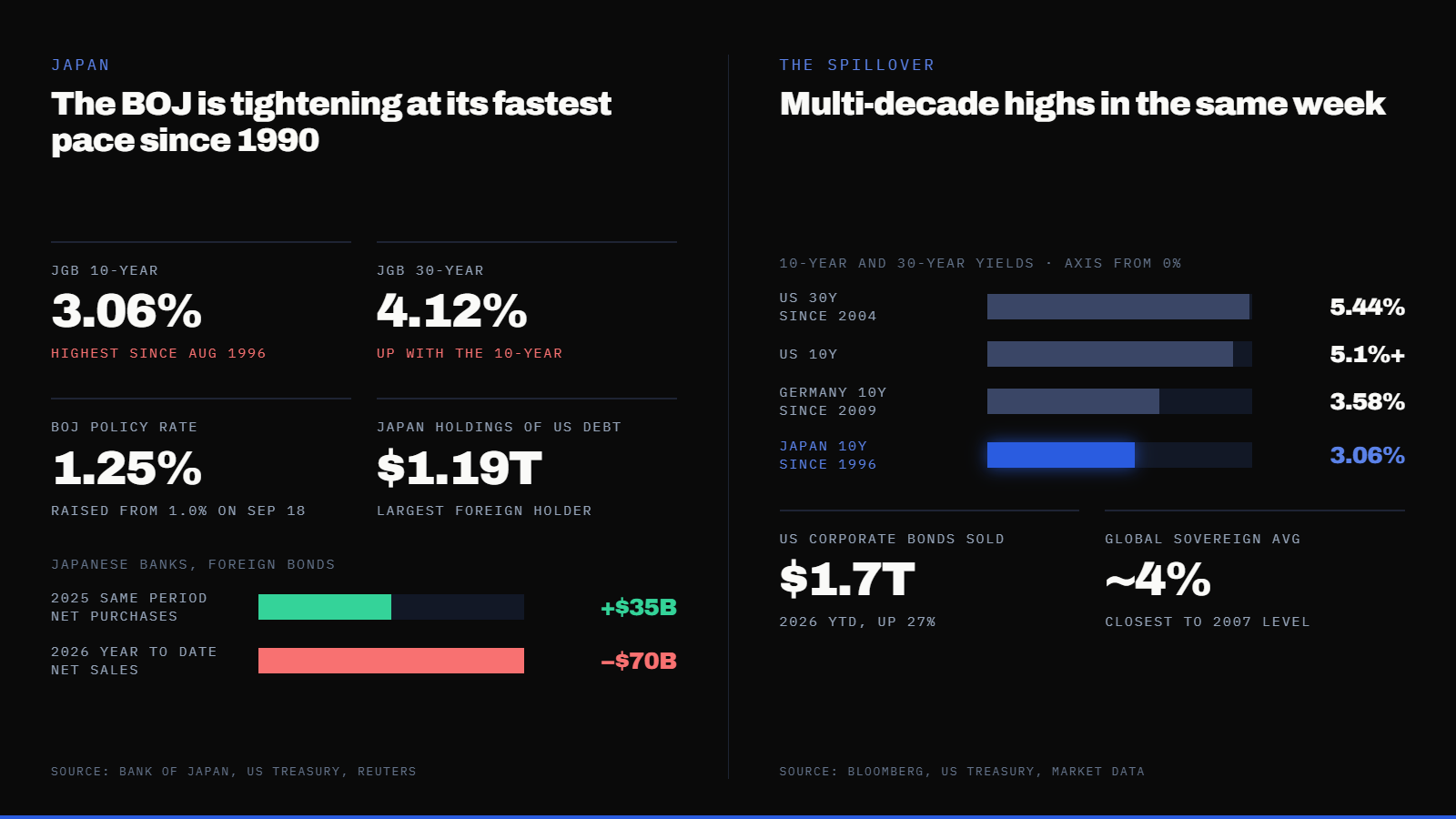
The move didn't happen in isolation. Two days after the Federal Reserve's own hike, the Bank of Japan followed with an increase to a 31-year high, lifting its policy rate to 1.25% from 1.0%, the fastest pace of tightening the central bank has delivered since 1990. Governor Kazuo Ueda framed it as a shift in phase rather than a one-off adjustment, saying underlying inflation is finally approaching the BOJ's 2% target after decades of falling short.
Since then, JGB yields have kept grinding higher. The 10-year gained another 8 basis points this week alone, and the 30-year JGB yield rose to 4.12%. That's pulled other government bond markets along with it. Germany's 10-year bund reached 3.58%, the highest since mid-2009, and the worldwide average yield on government debt is closing in on 4%, a level last seen in 2007, according to Bloomberg's Global Aggregate Treasuries index.
In the US, the 30-year Treasury yield hit 5.44% this week, the highest since 2004, and the 10-year climbed above 5.1%. The 5-year Treasury crossed 5% for the first time since 2007 just last week, and the 10-year had already moved past that mark by then too. This week's move added another leg onto that climb.
Why It Matters
For months, the working assumption on Wall Street was straightforward. Once Japanese government bond yields rose high enough, Japan's enormous pool of overseas capital, an estimated 438.6 trillion yen (about $2.78 trillion) that Reuters reports is held by life insurers alone, would start coming home. Higher yields in Tokyo would make it less attractive to hold hedged Treasury exposure abroad, and that repatriation would help settle global bond markets. Japan currently holds roughly $1.19 trillion in US Treasuries, more than any other country, according to Treasury Department data.
That repatriation hasn't shown up yet, and the reason is almost the opposite of what the theory predicted. "The fast-money carry trade has already been unwound; the slow-money one has not started," Deutsche Bank strategist Shoki Omori said this week. Japanese investors are watching JGB yields keep climbing and don't want to buy in before the selling stops. "Nobody wants to catch the falling knife," said Aaron Hurd of State Street Global Advisors. Reuters reported that Japanese banks have sold roughly $70 billion in foreign bonds so far this year, versus about $35 billion in purchases over the same period last year, and some analysts don't expect the repatriation trade to gain real momentum until 2027.
The result is a bond market with fewer natural buyers stepping in on either side of the Pacific, just as issuance keeps climbing. US corporations have sold nearly $1.7 trillion in bonds so far this year, up 27% from last year, with a meaningful share going toward AI data center financing. Those borrowers are now competing directly with the US Treasury for the same pool of investor dollars, pushing up the price everyone has to pay to borrow.
What to Watch Next
The Treasury isn't sitting still, though its main tool predates this week's move. Back in August, it doubled the size of its long-end buyback operations to at least $4 billion per operation, a program running from September 9 through November 4. That support hasn't stopped yields from setting fresh multi-decade highs this week, which says something about how much pressure is still building underneath. Whether it holds from here depends partly on the Fed. Markets are currently pricing roughly a two-thirds probability of another rate hike in October. Sixteen of eighteen Fed officials have already signaled they want one this year, and a fourth developed-market central bank tightening into an already stressed bond market would add one more variable for investors to price.
Japan's own repatriation trade is worth watching too. Reuters reported that speculative positioning has already flipped from a large net short on the yen to a net long of $9.7 billion in the first two weeks of September, which suggests traders are betting the shift is coming even if actual portfolio flows haven't followed yet. If Japanese buyers return to Treasuries in size, some of the pressure could ease. If JGB yields keep climbing first, the standoff could drag on well into next year.
The Pulse24 Take
Global bond markets don't often move in sync like this. When Japan, Germany, and the US are all posting decade-plus yield highs in the same week, it usually points to something structural rather than a single data surprise. Here it looks less like one catalyst and more like two forces colliding: central banks still fighting inflation that hasn't fully cooled, and a Japanese repatriation trade that keeps getting delayed instead of arriving, even while governments and AI-hungry corporations keep issuing record amounts of debt. None of that guarantees yields keep rising from here. The Treasury's buyback expansion already nudged the 30-year down a touch, and cooler inflation data could slow the Fed's pace before October. But the mechanical story matters regardless of where yields go next. The market's biggest natural buyer of government debt is currently sitting on the sidelines, waiting for a bottom that keeps moving further away.
How we read the data
Curious how we get from raw data to a take like this? Our Trader's Toolkit walks through the tools we lean on.
Explore the Toolkit