Pulse24 Original
GDPNow Swung From 4.0% to 6.2% This Quarter. The Fed's December Decision May Hinge on Which Number Was Right.
September 27, 2026
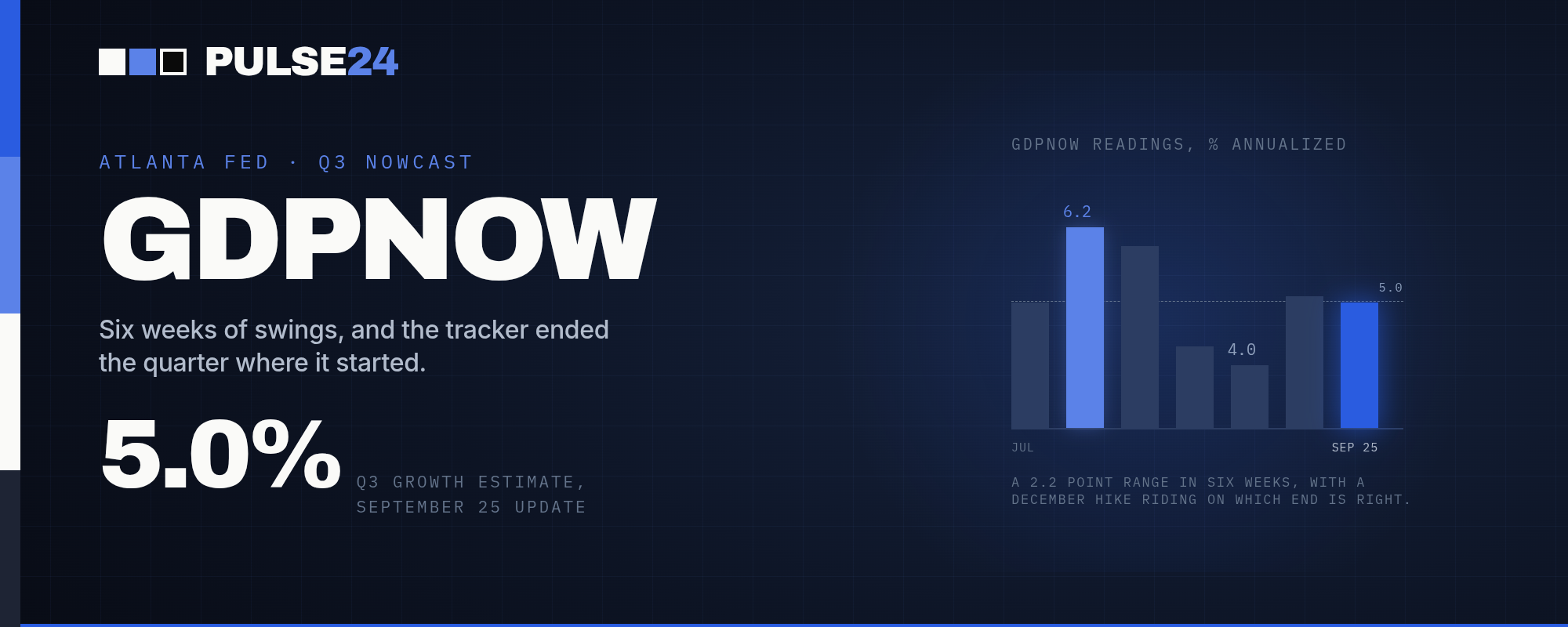
The Atlanta Fed's GDPNow model bounced between 4.0% and 6.2% for third-quarter growth before settling at 5.0% on September 25. That volatility lands right as the Fed weighs a fourth rate hike with inflation still running above target.
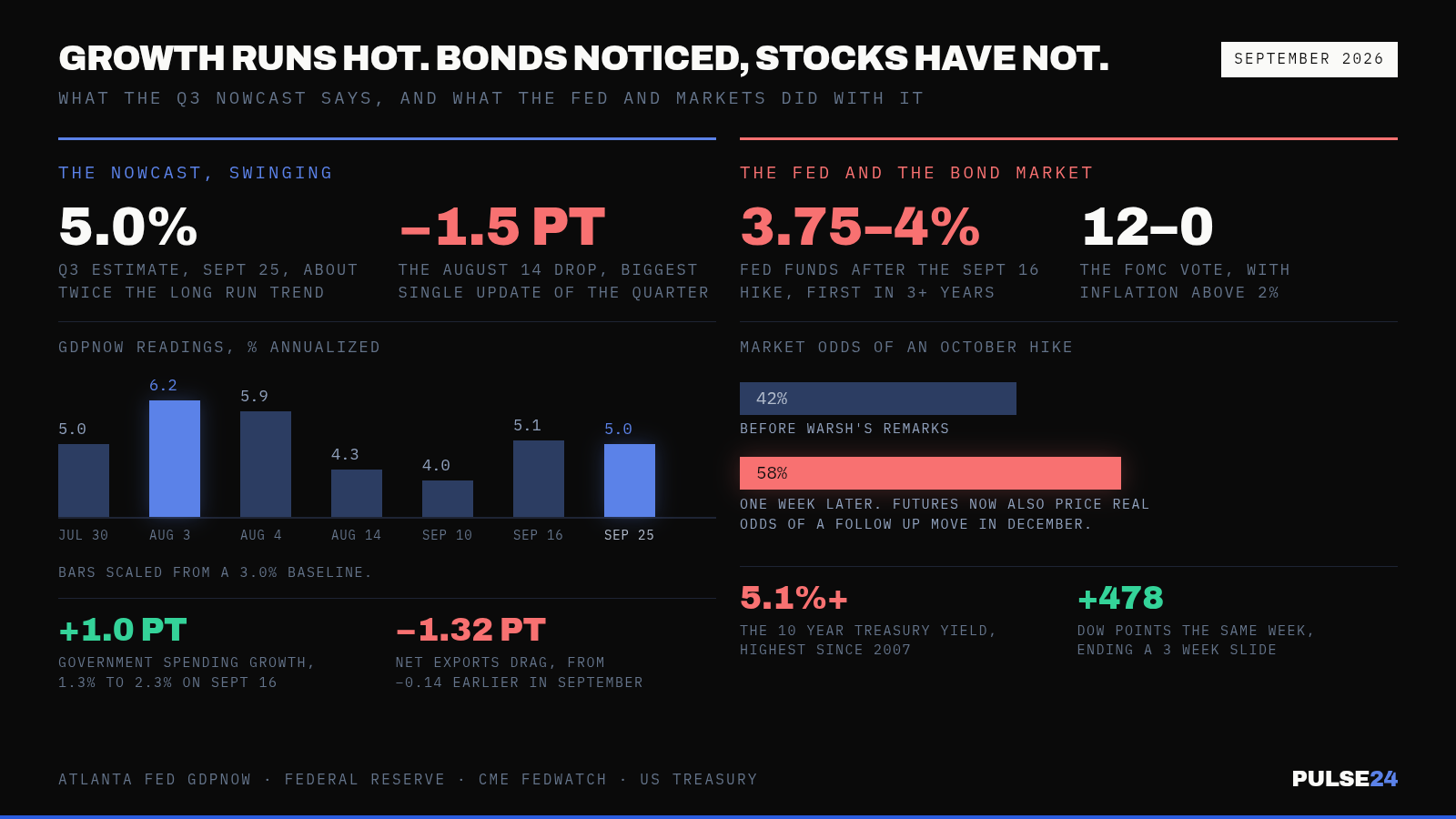
Five percent is where the Atlanta Fed's GDPNow model landed for third-quarter growth on September 25, its last scheduled update before the government's own data replaces the estimate in late October. On its own, that number looks unremarkable, close to where most forecasters expected the quarter to land. What's remarkable is the six weeks it took to get there. GDPNow opened the quarter at 5.0% on July 30, jumped to 6.2% within days, fell by 1.5 percentage points in a single mid-August update to 4.3%, slid further to 4.0% by September 10, then climbed back above 5% and held there through the month's final print.
That volatility matters because the Federal Reserve just raised interest rates for the first time in more than three years, and it's weighing whether to do it again. On September 16, the FOMC voted 12-0 to lift the federal funds rate to a range of 3.75% to 4.00%, citing an economy expanding at a solid pace alongside inflation that remains elevated. Growth running near 5% supports the case for another hike in December. Growth stuck near 4%, which is where the model sat for most of August and early September, would have made that case a lot harder to win internally.
What Changed
The swings trace back to a model that recalculates its estimate every time new data arrives, sometimes several times in a week. In early August, stronger Census Bureau and ISM readings pushed the tracked contribution from consumption and investment higher, taking the estimate from 5.0% to 6.2% in just three trading days. A day later, the nowcast for third-quarter consumption growth eased from 4.6% to 4.2%, pulling the estimate back to 5.9%. The bigger move came on August 14, when weaker consumption and investment data knocked 1.5 percentage points off the estimate in a single update, the largest single-day swing of the quarter. Investment growth got marked down again on August 18, from 15.2% to 13.7%, dragging the model to 4.0% by September 10, its low point for the quarter.
The reversal since then has been just as sharp. A September 16 update built on fresh Census, Bureau of Labor Statistics, and Treasury fiscal data pushed consumption growth from 3.6% to 4.1% and government spending growth from 1.3% to 2.3%, lifting the estimate seven-tenths of a point to 5.1% in a single day. It held there through September 17 before easing slightly to 5.0% on September 25, the last full reading ahead of the Bureau of Economic Analysis's official first estimate for the quarter. A drag from net exports, whose contribution swung from negative 0.14 percentage points to negative 1.32 percentage points earlier in September, has been the main offset keeping the headline number from running even hotter.
Why It Matters
A growth estimate this strong lands at an awkward moment for the Fed. Inflation is still running above the central bank's 2% target, which is part of why officials raised rates on September 16 despite an economy that, by GDPNow's count, is growing at roughly twice its long-run trend pace. Kevin Warsh's recent comments already pushed October rate-hike odds from 42% to 58% in a single week, and a growth reading in the 5% range gives officials who favor another hike a fresh data point to cite. The 10-year Treasury yield's climb to its highest level since 2007 reflects some of that same logic: bond investors are pricing in both stronger growth and a Fed that stays restrictive for longer, and lately both forces have pulled in the same direction.
Stocks have mostly shrugged off the move so far. The Dow, S&P 500, and Nasdaq all closed higher for the week ending September 25, with the Dow's 478-point gain snapping a three-week losing streak even as the 10-year yield pushed above 5.1%. BlackRock's Rick Rieder described the bond market's reaction as "not a crisis but an eye-opener," language that captures the market's current mood: uneasy about where yields are headed, but not yet convinced that growth this strong is a problem rather than a reason for optimism. Growth and inflation rising together is precisely the combination that makes a soft landing harder to engineer, since raising rates enough to cool inflation risks doing the same to the growth investors are currently cheering.
Not every part of the economy is running that hot. Housing inventory topped 1.6 million listings for the first time since 2019 even as home sales fell for a third straight month, a reminder that GDPNow's headline number is an average across sectors moving in very different directions, and that the strength showing up in consumption and government spending isn't showing up everywhere.
What to Watch Next
The Bureau of Economic Analysis releases its official first estimate for third-quarter GDP in late October, the number GDPNow has spent the whole quarter trying to predict. The model's final pre-release readings tend to land within a percentage point of that first government print more often than not, which would put actual third-quarter growth somewhere in the 4% to 6% range if this quarter behaves like most others. The next GDPNow update arrives September 30, folding in whatever data lands in the final days of the quarter. Beyond that, the December FOMC meeting is the number that matters most: a growth reading anywhere near 5% makes it harder for officials skeptical of another hike to make their case, while a downside surprise in the government's own count would cut the other way.
The Pulse24 Take
A model that swings by two full percentage points several times in six weeks isn't one to treat as gospel, and GDPNow has a track record of overshooting early in a quarter before enough data arrives to correct it. Five percent is a reasonable midpoint, not a certainty. Still, the direction matters more than the exact decimal. This tracker spent the quarter oscillating between numbers that all describe an economy growing faster than the Fed would probably prefer while inflation sits above target, and that combination is a harder problem to solve than either piece alone.
The bond market has already started pricing that tension in. Stocks, for the most part, have not. Something in that gap usually gives: either growth cools on its own before the Fed has to force the issue, inflation comes down without a December hike, or one of those two markets ends up repricing hard once the actual GDP number replaces the guesswork in late October.
How we read the data
Curious how we get from raw data to a take like this? Our Trader's Toolkit walks through the tools we lean on.
Explore the Toolkit