Pulse24 Original
The ECB Hiked Rates to 2.50% This Month. The Euro Fell to Its Weakest Level Since July Anyway.
September 23, 2026
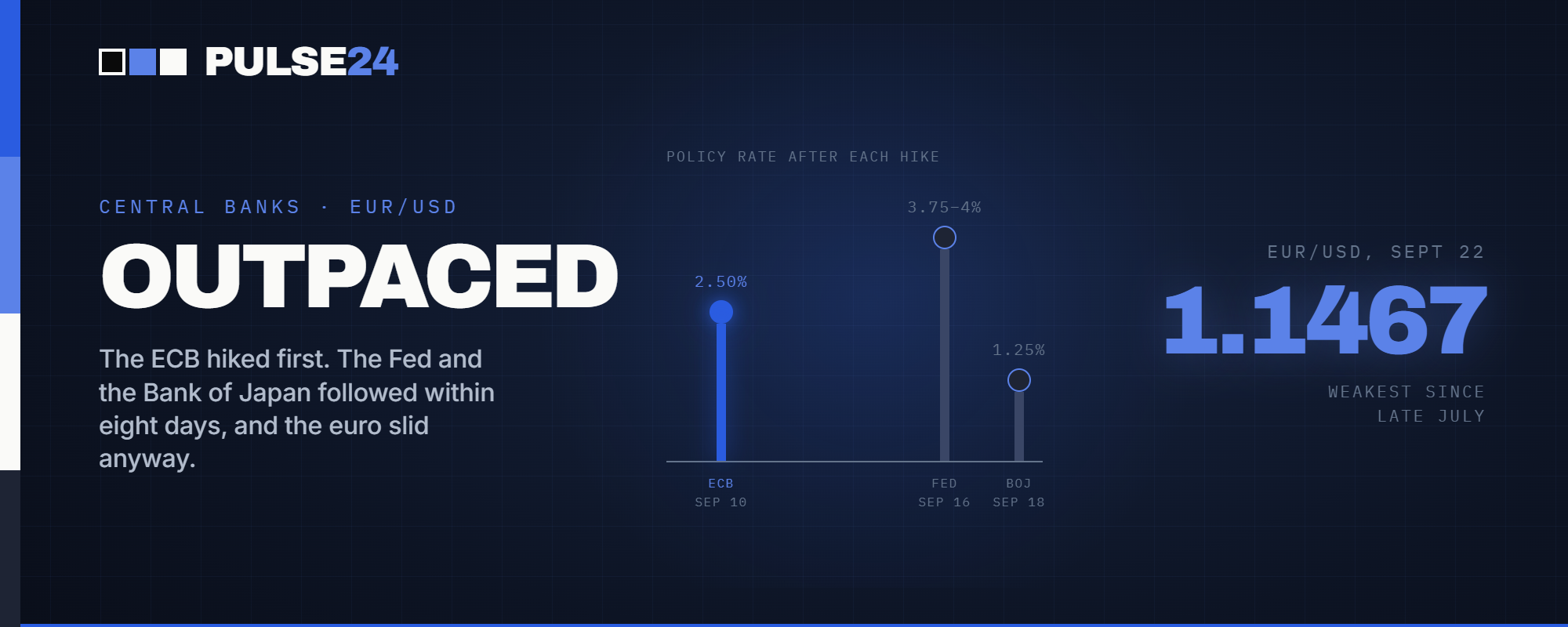
The European Central Bank raised rates for the second time this year, yet the euro slid to its weakest level since July against the dollar. The reason has less to do with direction than with speed, and it says something about how the Fed's own hike this month reset the pecking order among the world's major currencies.
Three of the world's four largest central banks raised interest rates inside an eight-day span this month. The Federal Reserve, the European Central Bank, and the Bank of Japan haven't tightened policy in the same stretch of days in years, and outside commentators are already calling it a synchronized global rate-hike cycle.
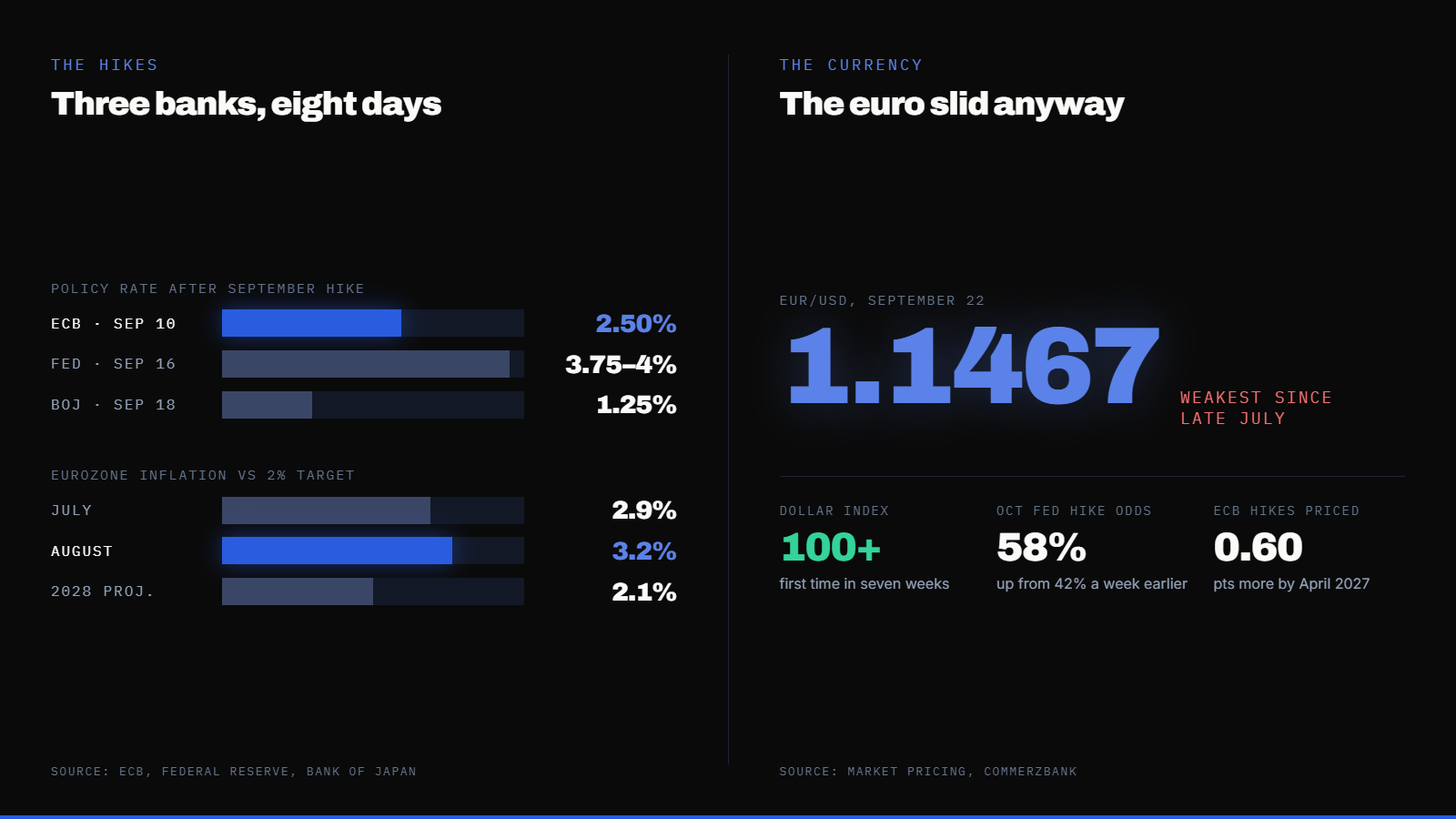
The strange part is what happened to the currency of the bank that moved first. The ECB raised its deposit rate a quarter point to 2.50% on September 10, its second hike of 2026. Inflation had just been confirmed at 3.2% for August, up from 2.9% in July and more than a full point above the ECB's target. A central bank tightening into inflation that hot would normally be expected to support its currency. Instead, the euro slid to roughly 1.1467 against the dollar by September 22, its weakest level since late July.
What Changed
Timing explains part of it. Six days after the ECB's move, the Federal Reserve raised its own target range to 3.75%-4% on September 16, its first hike in more than three years. Two days after that, the Bank of Japan lifted its policy rate to 1.25%, a 31-year high. All three moves trace back to the same underlying problem: inflation that has refused to cool, made worse in Europe by energy prices that have stayed elevated amid ongoing supply disruptions overseas.
The ECB's own projections, released alongside the decision, put eurozone inflation averaging 3.0% for all of 2026, 2.5% in 2027 (revised up from an earlier 2.3% estimate), and 2.1% in 2028, still above target three years out. President Christine Lagarde called the hike a "no brainer" but stopped short of promising more, saying the bank has not committed to a predetermined rate path. Money markets weren't as cautious: futures pricing implies roughly 0.60 percentage points of additional ECB hikes by April 2027, with traders divided on whether the next move lands in October or December.
Why It Matters
Currency markets judged the Fed's move as the more credible one, even though the ECB acted first and Japan hiked to a three-decade high. Commerzbank analysts summed it up simply: the Fed has regained credibility after years of being seen as reactive, and the dollar index climbed above 100 for the first time in seven weeks on the strength of that view. A quarter-point move from the ECB couldn't compete with that narrative, even with eurozone inflation running hotter than inflation in the US.
That's worth sitting with. A rate hike doesn't automatically strengthen a currency. What actually moves exchange rates is the gap between what a hike signals about a central bank's resolve and what markets had already priced in. Lagarde's refusal to commit to further tightening read, in this context, as caution rather than conviction. The Fed, by contrast, came across as the central bank still willing to keep going.
The bigger implication sits in credit markets. Years of unusually cheap financing helped fund everything from European corporate expansion to data centers built on newly issued high-yield debt. Borrowing costs rising at the same time across the dollar, the euro, and the yen removes a tailwind that companies on three continents had grown used to counting on. European issuers refinancing debt this quarter now face a materially higher cost of capital than they did over the summer, before the ECB, the Fed, and the Bank of Japan all moved within the same three weeks.
What to Watch Next
Odds of another US hike in October were last pegged near 58%, up sharply from 42% a week earlier. If the Fed moves again before the ECB does, the dollar's advantage over the euro could widen further regardless of what the next round of eurozone inflation data shows. Watch the ECB's next policy meeting for any shift in Lagarde's language away from strict data dependency, and watch whether Japanese officials signal discomfort with a yen that's had to absorb hikes from two much larger economies within the same month.
The Pulse24 Take
Investors spent years treating the major central banks as a single bloc, moving through the same cutting cycle more or less together. That bloc just split into three institutions hiking at different speeds for overlapping but distinct reasons, and the market's verdict on which hike mattered most had little to do with which bank acted first or which economy looked weaker on paper. It came down to credibility, and for now the Fed is winning that argument by default.
How we read the data
Curious how we get from raw data to a take like this? Our Trader's Toolkit walks through the tools we lean on.
Explore the Toolkit