Pulse24 Original
Washington and Beijing Extended Their Trade Truce to January 10. Rare Earth Stocks Fell on the News.
September 24, 2026
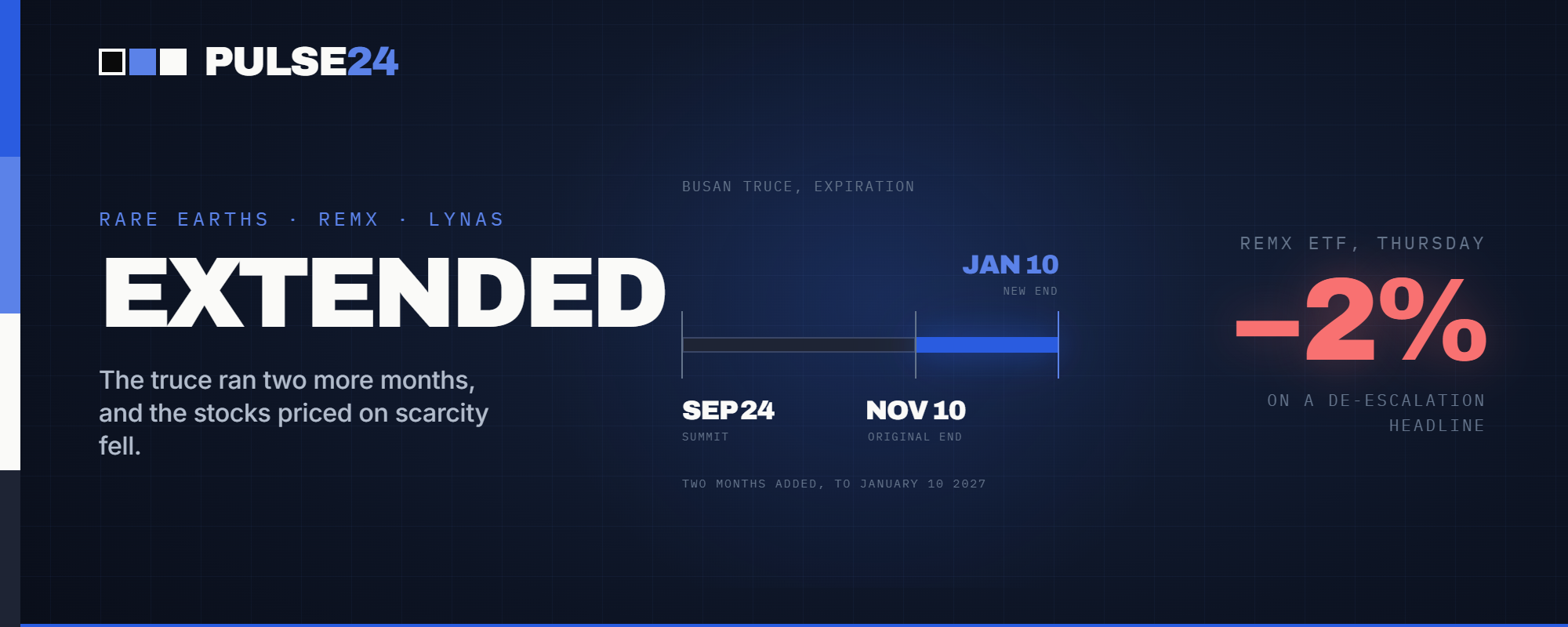
Washington and Beijing extended their trade truce to January 10, but rare earth stocks fell on the news instead of rising. The reaction shows how much of the sector's rally was built on scarcity fears rather than fundamentals.
Scott Bessent stood near Xi Jinping's motorcade Thursday and announced something markets had been treating as a coin flip: two more months. The Treasury Secretary confirmed the US and China extended their trade truce, known as the Busan Agreement, from its original November 10 expiration to January 10, 2027. Rare earth mining stocks, which had rallied for months on the threat of renewed Chinese export curbs, sold off within hours.
What Changed
The extension keeps in place the tariff reductions both sides agreed to earlier this year, cutting rates that had briefly touched triple digits during the height of the trade war. It also pauses Beijing's restrictions on rare earth and critical mineral exports, the leverage China has used most effectively since April 2025. China separately committed to purchasing 25 million tons of US soybeans, though Bessent noted the country is behind on a companion $17 billion pledge for other agricultural products. Two days earlier, China's trade surplus for August came in at $119 billion, a number that gave both sides leverage heading into Thursday's meeting.
A separate policy sits in the background as a reminder of how this administration uses tariffs: duties of 10% to 12.5% on goods from the top 60 US trading partners over unresolved forced-labor concerns, imposed back in July and unrelated to the China truce, remain in force. A $14 billion Taiwan arms package also remains on hold, one of several items both sides left for the next round.
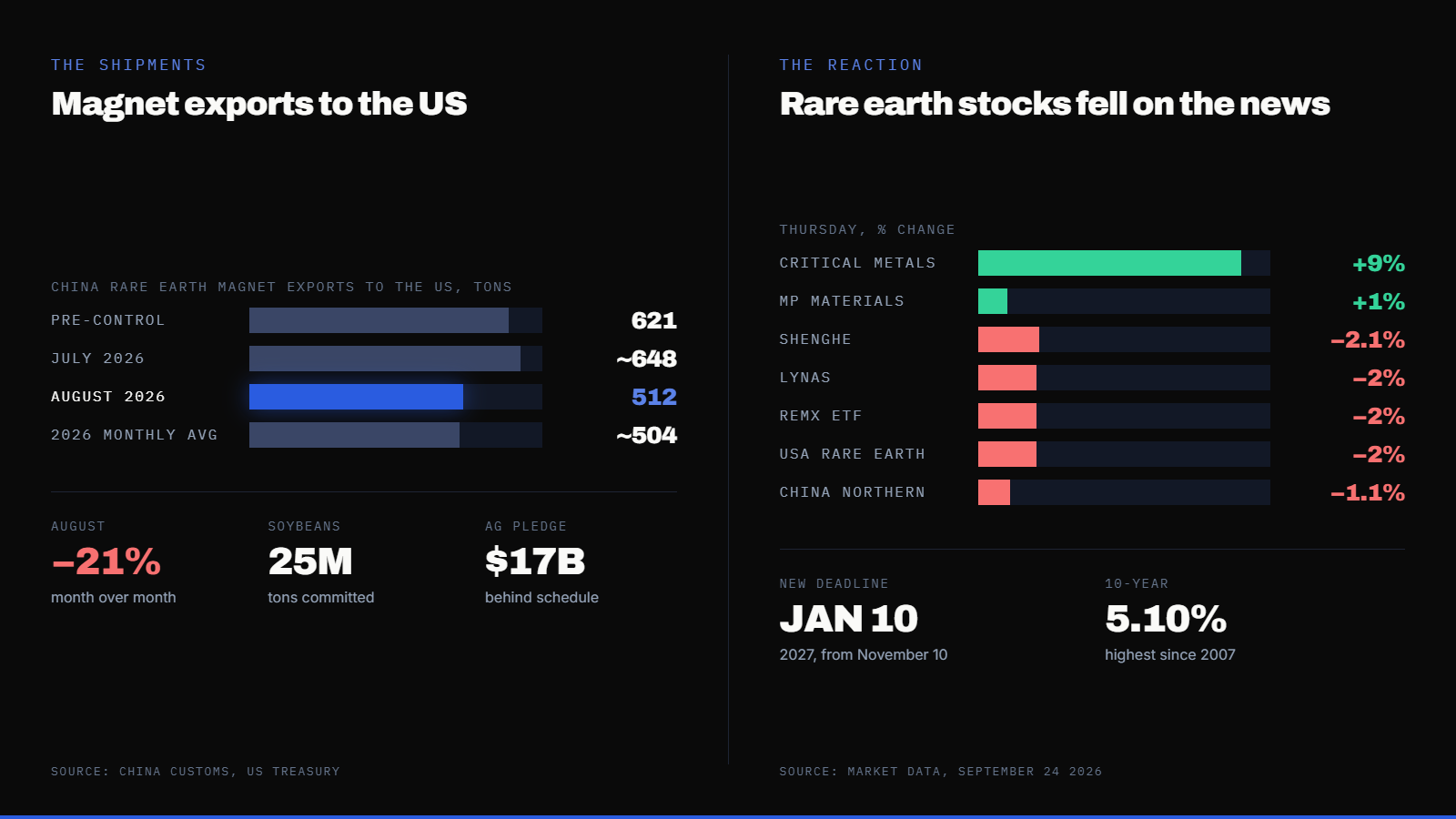
The timing lines up with data that had already hinted at where this was headed. China's rare earth magnet shipments to the US fell 21% month over month in August, to 512 tons from roughly 648 tons in July, according to customs data Beijing released four days before the summit. Full-year 2026 shipments have averaged around 504 tons a month, still well below the 621 tons China was sending before it tightened export controls in April 2025.
Why It Matters
A de-escalation should, in theory, be good news for rare earth demand. It was bad news for rare earth stocks. Shenghe Resources fell 2.1%, China Rare Earth Nonferrous Metals dropped 1.1%, and Australia's Lynas Rare Earths lost 2%. Investors had bid up rare earth miners for months on the assumption that Chinese export restrictions would tighten, not loosen, and that scarcity would keep prices elevated. A truce, even a short one, chips away at that scarcity premium.
US-listed names told a messier story. MP Materials rose 1% to $49.37 while USA Rare Earth slipped 2% to $15.47, and the sector-wide REMX ETF fell 2%. Critical Metals bucked the trend entirely, jumping 9% on what traders described as leftover momentum from a Greenland security agreement earlier in the week rather than anything tied to Thursday's news. That divergence matters: when a sector's biggest single-day mover has nothing to do with the sector's biggest headline, it's usually a sign the trade has gotten crowded and reactive rather than fundamentals-driven.
The bond market gave the clearer signal. Ten-year Treasury yields climbed to roughly 5.10%, their highest since 2007, extending a move Pulse24 flagged earlier this week when the 5-year first crossed 5%. Thirty-year yields hit 5.43%, a level last seen in 2004. None of that move is really about China. It's about a Fed that markets increasingly expect to hike again this year, and a trade truce doesn't change that calculus at all.
What to Watch Next
January 10 is now the date that matters. A short extension buys both sides time without forcing a permanent deal, and China's own stock market fell Thursday partly because investors had hoped for something longer. Watch whether Beijing's rare earth export data for September, due out in mid-October, shows shipments recovering toward that 621-ton pre-control baseline or staying suppressed. A sustained recovery would support the market's current read that this is genuine de-escalation, while a repeat of August's 21% drop would suggest the truce is more fragile than Thursday's photos suggest.
Also worth tracking: whether Trump's new 12.5% forced-labor tariff on those 60 other trading partners draws retaliation, and whether China closes the gap on that $17 billion agricultural pledge before January. Neither is a US-China flashpoint on its own, but both are the kind of detail that decides whether this truce becomes a template or just a pause.
The Pulse24 Take
The headline event Thursday was a handshake and a two-month extension. What actually moved markets was the reaction underneath it: rare earth stocks falling on good news, Treasury yields climbing on a story that has nothing to do with China, and one US rare earth stock ripping higher for reasons unrelated to any of it. That divergence says something. This market has stopped treating trade headlines as the only thing that matters this week; rates are doing more of the work now than tariffs are. China's rare earth leverage is real, and Beijing's August export data proves it still has teeth. But investors who spent the year pricing rare earth miners as a geopolitical hedge got a reminder Thursday that a truce, even a partial one, can unwind that trade fast. The 21% drop in magnet shipments won't reverse overnight, and neither will the market's tendency to overreact to summit headlines in both directions.
How we read the data
Curious how we get from raw data to a take like this? Our Trader's Toolkit walks through the tools we lean on.
Explore the Toolkit