Pulse24 Original
China's Trade Surplus Hit $119 Billion in August. Trump and Xi Meet Thursday to Decide What Happens to It.
September 23, 2026
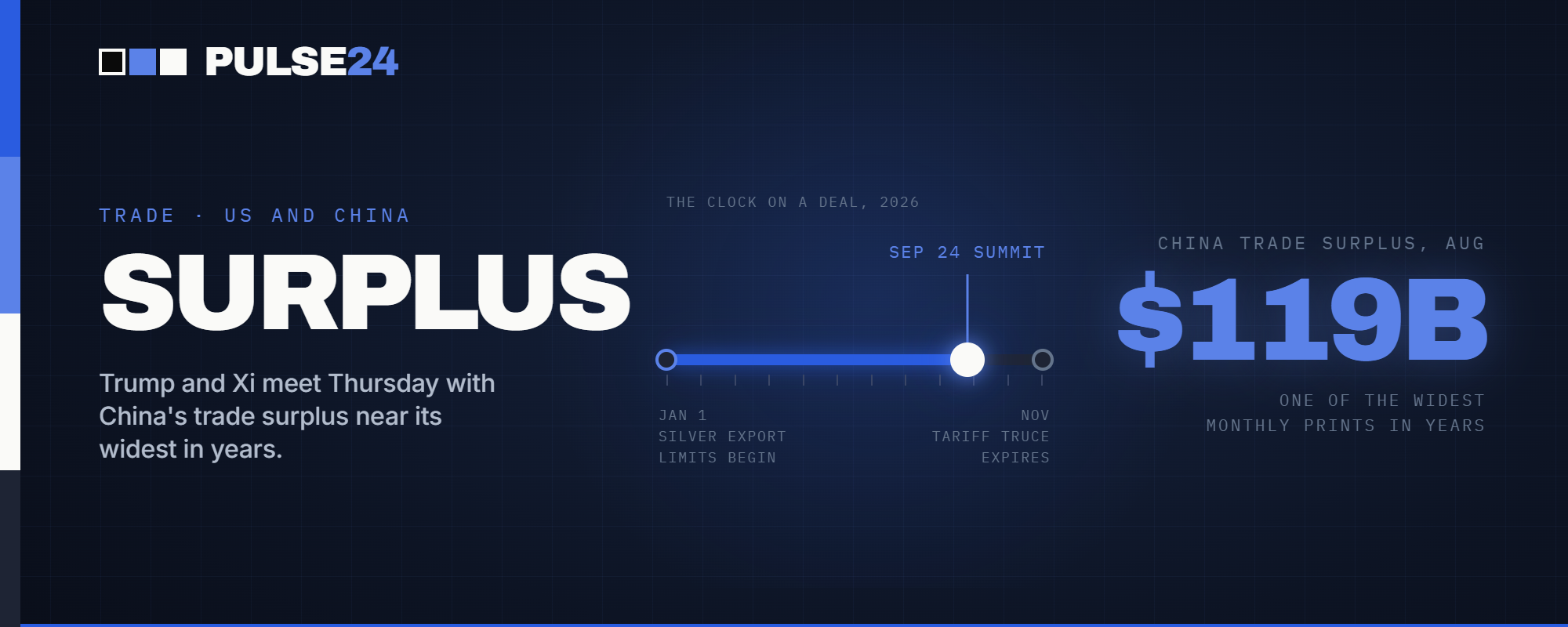
China's exports jumped 25% in August and its trade surplus hit $119 billion, one of the widest in years. Thursday's summit between Trump and Xi could reshape the rules on everything from rare earths to the silver inside an AI server.
China's factories shipped 25% more goods abroad in August than a year earlier, and the country's trade surplus swelled to $119 billion. Two days from now, that number becomes a bargaining chip. Trump and Xi sit down in Washington on Thursday for a summit built almost entirely around the terms of that trade, and the list of goods on the table runs from soybeans to the rare earths inside a wind turbine to the silver soldered onto a chip.
That last item is doing more work than its price tag suggests. Silver has spent 2026 living a double life: a monetary metal that investors buy alongside gold, and an industrial input that solar panel makers and chipmakers cannot build around. Both identities are getting tested at once this week, by a Federal Reserve turning more hawkish and by a trade summit that could tighten or loosen the flow of the metal itself.
What Changed
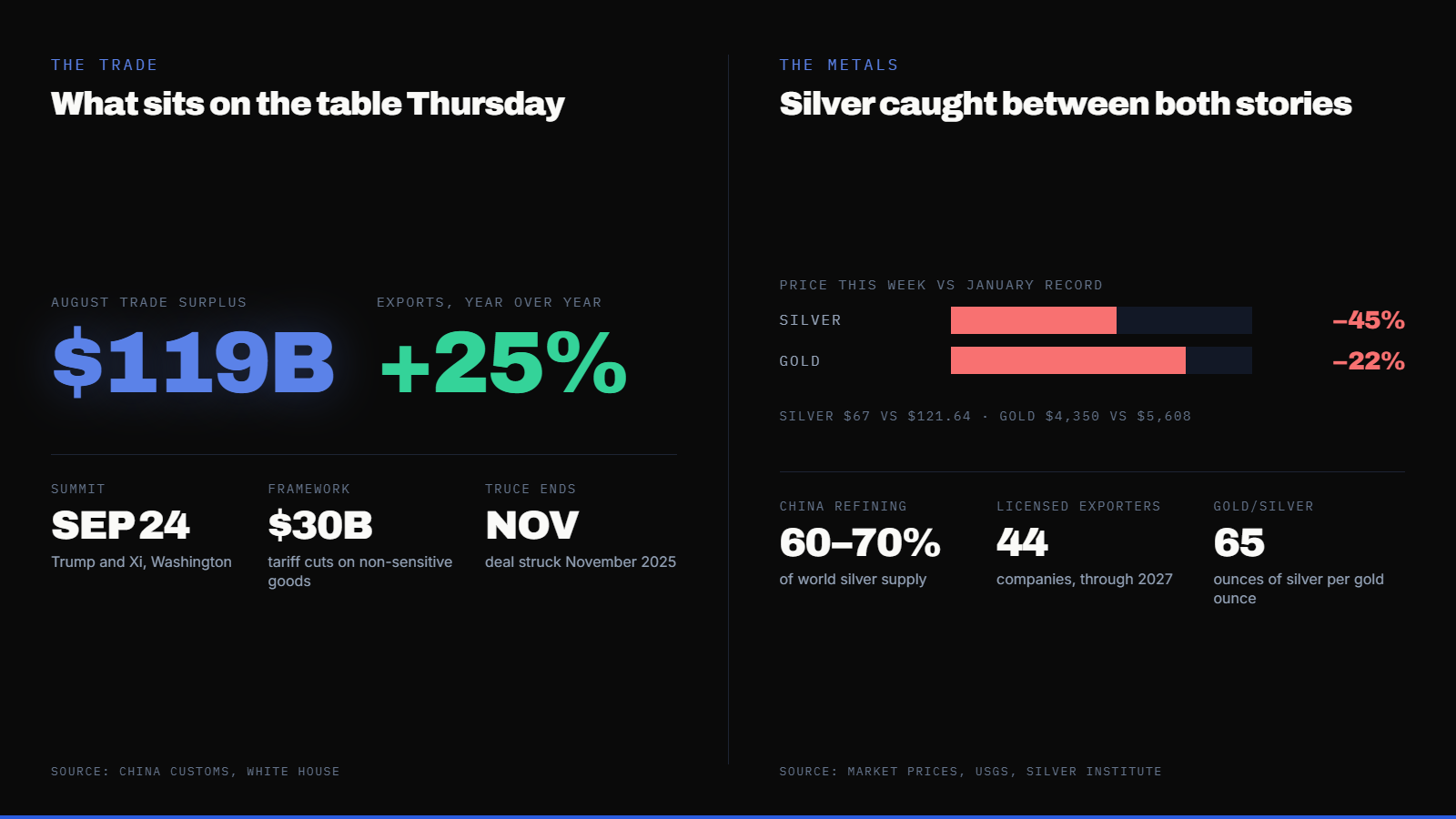
Thursday's meeting is not expected to produce a grand bargain. Negotiators have instead been working toward something narrower: a framework, known as the Board of Trade, that would cut tariffs on roughly $30 billion of goods each side designates as non-sensitive, alongside a newly agreed US-China dialogue on AI safety. Which products actually qualify as non-sensitive is still being negotiated, and that ambiguity is a big part of why the framework slipped past an earlier summit without being finalized. Washington wants a notification system for AI security risks and continued authority to restrict advanced chip exports. Beijing wants guardrails on how far those restrictions can extend, plus clearer, longer-term access to the rare earth and critical mineral licenses American manufacturers now depend on. The truce both sides struck in November 2025 to keep tariffs from escalating further expires this November, which is part of why the clock matters this week and not next month.
While that plays out in Washington, the domestic story has been running in the opposite direction. The Fed raised its benchmark rate to 3.75%-4% on September 16, and instead of pausing to assess the move, two regional presidents spent this week making the case for more. Musalem called the current rate "on the accommodative side" and said he would rather raise in smaller, gradual steps now than delay and be forced into a bigger move later. Goolsbee was blunter about the tradeoff, arguing that "the only way to bring inflation down is to raise rates and narrow the gap between supply and demand," and that doing so would be "necessarily painful." He left open whether one more hike would suffice or several are needed, depending on whether elevated oil prices and tariffs, rather than plain demand, are driving the persistence. Odds of an October increase had already jumped from 42% to 58% in a single week before these comments landed.
Gold and silver felt it. Both metals set fresh highs earlier this month before pulling back, and this week's hawkish tone added another reason for holders of a non-yielding asset to think twice. Real yields near 2.68% already made that math tougher before Musalem and Goolsbee spoke.
Why It Matters
Silver's critical minerals designation is barely a year old. The US Geological Survey added it to the official list in November 2025, citing a run of consecutive years, six by some counts and seven by others, in which mine production has fallen short of demand. Solar panel manufacturing alone accounted for 29% of silver's industrial demand in 2024, up from just 11% a decade earlier, and AI data centers have added a newer source of demand on top of that, since silver conducts electricity better than any other element and shows up throughout the servers and cooling systems those facilities run. China controls most of the refining capacity that turns mined ore into that usable metal, an estimated 60% to 70% of the global total, and it began restricting exports on January 1, licensing only 44 companies to ship the metal out through 2027, two more than the 2025 quota. Beijing has described the move as protecting supplies for its own industries, the same language it has used for its longer-running rare earth controls.
That is the backdrop Thursday's summit sits on top of. Any movement on rare earth licenses or export guardrails would not stay contained to those minerals. It would ripple into silver, into the solar and semiconductor supply chains that depend on it, and into the calculus every AI infrastructure buildout has to make about where its inputs come from. Meanwhile, the Fed's path shapes a separate but related calculus: how much it costs, in foregone yield, to hold a metal that pays no interest while short-term rates climb. Silver and gold are being pulled by both forces simultaneously this week, which helps explain why prices have chopped sideways rather than continued their earlier run toward new records.
What to Watch Next
Watch for whether Thursday's summit produces actual text on the $30 billion trade framework and the disputed categories, or just a joint statement short on specifics. A concrete agreement on rare earth or critical mineral licensing would be the more market-moving outcome for silver specifically. The November truce deadline is the next hard date after that.
On the Fed side, the next policy meeting lands October 27-28. Whether Musalem and Goolsbee's tone this week reflects a growing consensus or two vocal outliers should become clearer well before then, through further Fed speeches and the inflation data due in early October. Watch the gold-silver ratio too. A move back toward 60 would suggest silver clawing back ground on gold; a push toward 70 would suggest the opposite.
The Pulse24 Take
It's tempting to treat this week's metals pullback as a simple rate story, and the Fed commentary from Musalem and Goolsbee genuinely matters. But silver's price this year has never moved on monetary policy alone. It is being priced as a safe haven one week and an industrial commodity with a genuine supply problem the next, and sometimes both readings show up in the same session. That is unusual for a metal that spent most of the last decade trading as gold's quieter, more volatile cousin. Thursday's summit will not resolve any of that on its own, and readers should be skeptical of any headline claiming it did. What it can do is shift, at the margin, how much of that industrial squeeze eases or tightens. The Fed shapes the safe haven trade. Washington and Beijing, this week, are shaping the other one.
How we read the data
Curious how we get from raw data to a take like this? Our Trader's Toolkit walks through the tools we lean on.
Explore the Toolkit