Pulse24 Original
Arm Dropped 9% Monday and Jumped 5% Tuesday. A $25 Billion SoftBank Loan Explains the Whiplash.
September 29, 2026
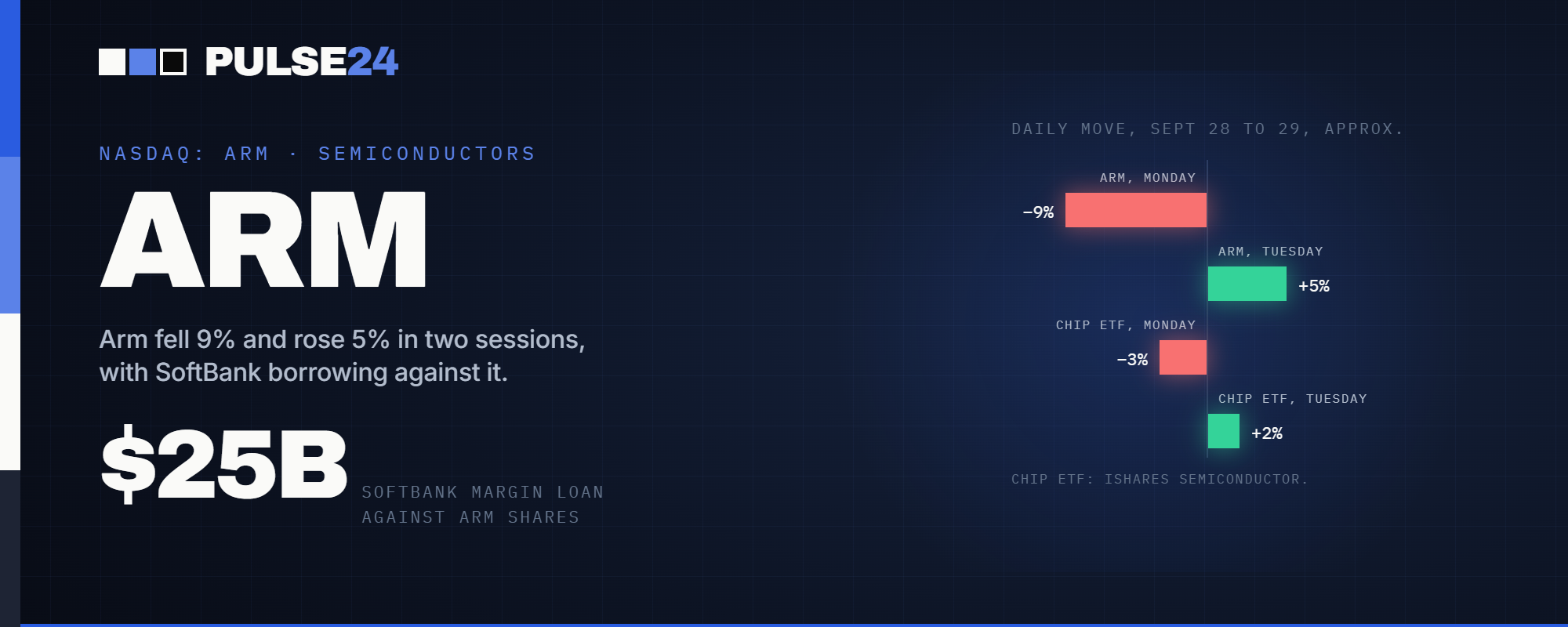
Arm sank 9% Monday and rallied 5% Tuesday, a round trip that says as much about SoftBank's $25 billion margin loan against its own shares as it does about bond yields. The stock trades at one of the market's richest multiples, which means small shifts in rate expectations move it far more than its business actually changes.
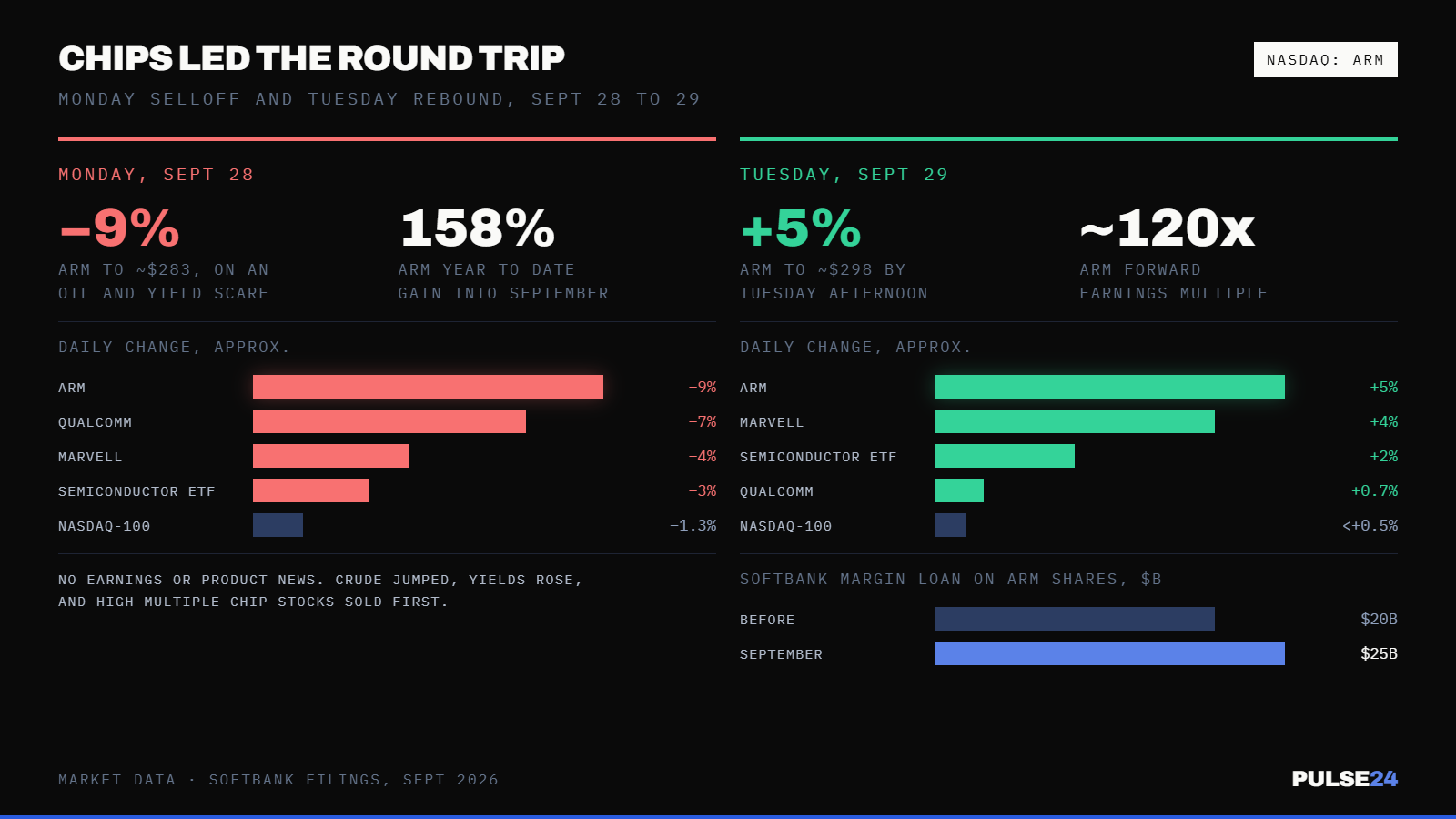
Arm Holdings fell 9% on Monday, closing at about $283. Qualcomm dropped 7% to about $187. Marvell Technology slid 4% to about $254. By Tuesday afternoon, all three had rebounded: Arm was back up roughly 5% near $298, Marvell climbed 4%, and Qualcomm added a smaller 0.7% gain.
The moves weren't tied to any single earnings report or product news. Sector-wide, the iShares Semiconductor ETF fell 3% Monday and rose 2% Tuesday. By contrast, the Nasdaq-100 dropped 1.3% Monday and gained less than half a percent Tuesday. Chips led the market down, then led it back up, on both sides of the round trip.
What Changed
Monday's selloff traces back to oil. A jump in crude prices revived inflation worries, pushing bond yields higher across the curve. Rate-sensitive growth stocks tend to get hit hardest when yields climb like that, and few sectors carry higher valuation multiples right now than AI-linked semiconductors. Investors who had ridden Arm's 158% year-to-date gain into September took the opportunity to lock in profits.
The 10-year Treasury yield has also been grinding toward levels not seen since 2007, and that climb alone has rattled plenty of rate-sensitive trades this month. Chipmakers with high multiples and long growth runways are exactly the kind of stock that move gets aimed at first.
Arm had an extra reason to fall harder than its peers. Earlier this month, SoftBank Group increased a margin loan secured by its Arm shares from $20 billion to $25 billion, part of a broader borrowing push tied to its investment in OpenAI. A margin loan backed by stock cuts both ways: when the collateral's value rises, the borrower's capacity expands, and when it falls, that capacity shrinks right along with it. SoftBank's move ties a meaningful slice of its own balance sheet to where Arm trades, giving the market one more reason to sell Arm specifically whenever the broader chip trade turns sour. The company has leaned on debt elsewhere too to fund its AI bets, and the pattern is becoming a theme in how this cycle gets financed.
Why It Matters
None of this means Arm's underlying business changed over 48 hours. Royalty growth from its newer v9 architecture and Neoverse server chips unfolds on a timeline measured in years, not days. What moved was the price investors are willing to pay for that same future earnings, and right now that price is unusually sensitive to small shifts in sentiment. At a forward P/E near 120, Arm is priced as though its growth is close to guaranteed. Any stumble in execution, or any further rise in the cost of capital, leaves that valuation with less room to absorb bad news.
The sharper snapback in Arm than in Qualcomm or Marvell is itself informative: the stock that fell hardest also recovered fastest, which is usually what happens when selling is driven by rate expectations and short-term positioning rather than a change in the underlying story. That's a healthier explanation than the alternative, in which real doubts about AI infrastructure spending resurface. It also means the next rate scare could produce the same round trip, and there's no guarantee the recovery half repeats every time.
What to Watch Next
Two things are worth tracking from here. First, whether the 10-year yield keeps grinding higher or finds a ceiling; semiconductor valuations are now more correlated with rate moves than at almost any point in this AI cycle, so that relationship isn't going away soon. Second, whether SoftBank's leverage against Arm resurfaces the next time the stock drops. A $25 billion loan tied to one company's share price is a lot of exposure concentrated in one place, and if Arm ever sells off for a reason that has nothing to do with rates, that structure could turn an ordinary pullback into something sharper.
The Pulse24 Take
Chip stocks trading like one highly levered basket isn't new this year, but the SoftBank angle adds a wrinkle worth watching. Most of this week's move was ordinary. Yields rose and expensive growth stocks fell; yields paused and those same stocks bounced back. What's less ordinary is that one of Arm's largest shareholders has now borrowed against its own stock twice in a matter of weeks, at a moment when that stock trades at one of the richest multiples in the market. That's a bet that AI infrastructure spending keeps compounding for years. It doesn't have to be wrong to still make Arm's stock swing harder than its fundamentals alone would justify, in both directions.
How we read the data
Curious how we get from raw data to a take like this? Our Trader's Toolkit walks through the tools we lean on.
Explore the Toolkit