Pulse24 Original
Canada Hits Back With $27.6 Billion in Counter-Tariffs Tuesday, Matching Washington Dollar for Dollar. Economists Still Call the Trade War Too Small to Move Inflation.
September 7, 2026
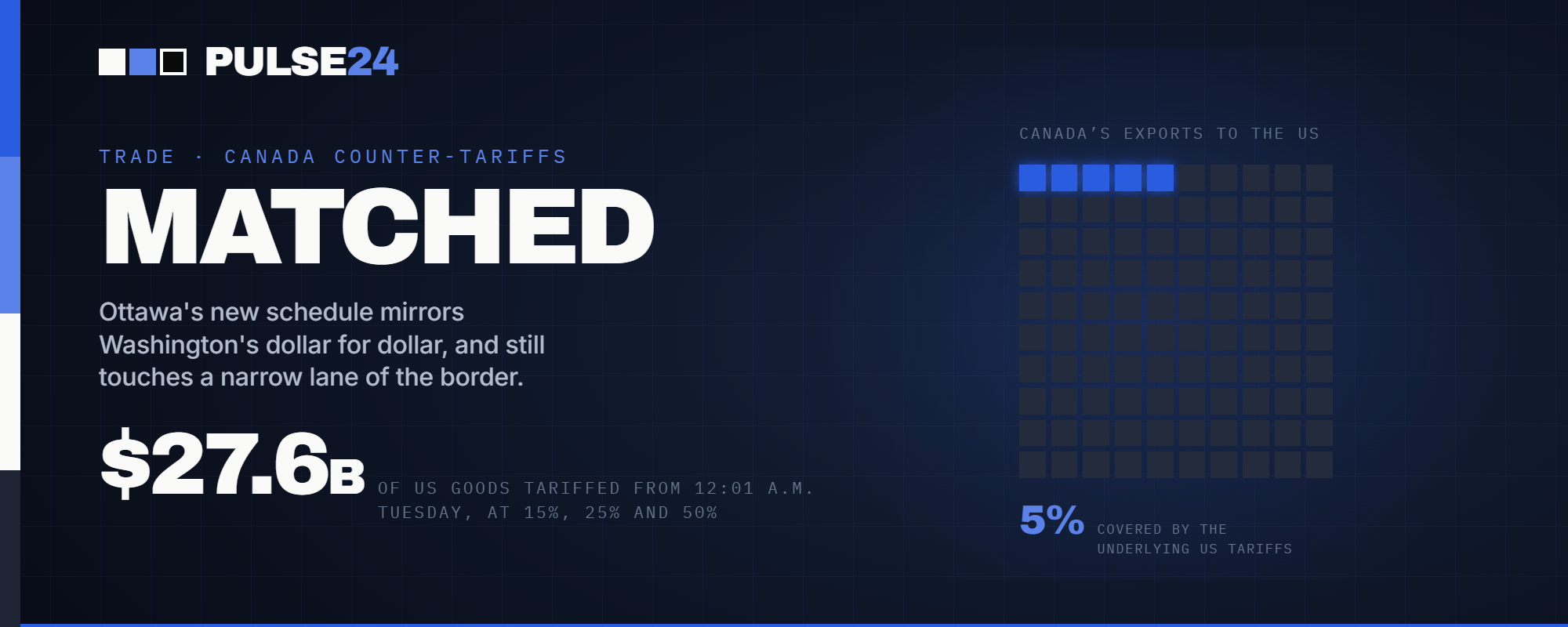
Canada's retaliatory tariffs on $27.6 billion of US goods take effect at 12:01 a.m. Tuesday, mirroring Washington's own tariffs dollar for dollar. Trade lawyers estimate the underlying dispute still touches only about 5% of Canada's exports to the US, even as steel, dairy, and lumber producers brace for the hit.
At 12:01 a.m. Tuesday, Canada starts charging its own tariffs on $27.6 billion of American goods. Milk, cheese, plywood, dishwashers, lawnmowers, and cosmetics all get more expensive to ship north starting this week, and the total lands almost exactly where Washington's tariffs on Canadian goods landed two weeks earlier.
What Changed
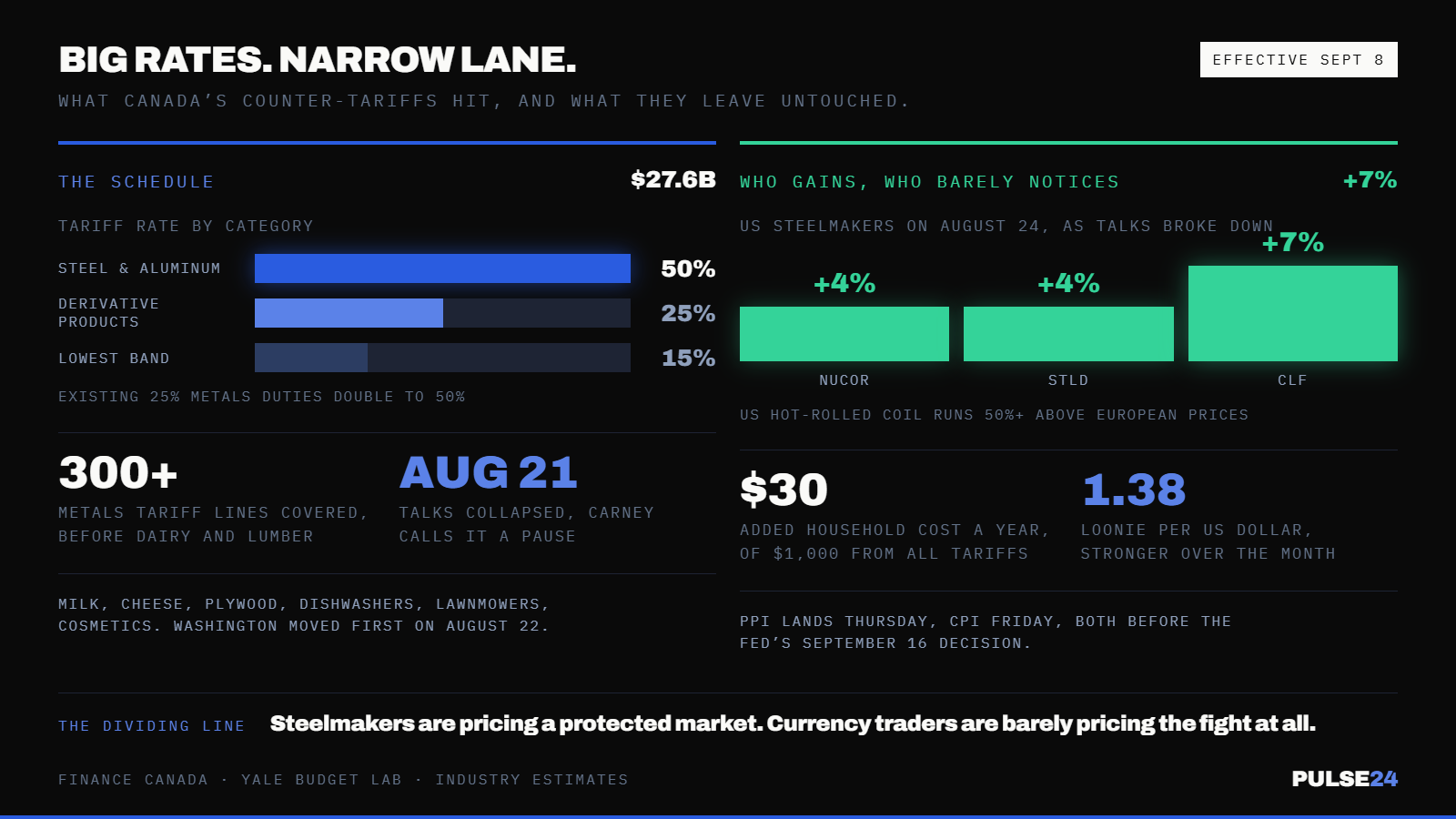
Ottawa's finance ministry didn't hide the logic behind the number. The new schedule matches the US Section 338 tariffs dollar for dollar, hitting steel and aluminum hardest: existing 25% Canadian duties on those metals jump to 50%, while derivative products, stamped auto parts and aluminum siding among them, face 25%. Dairy, lumber, textiles, and small appliances round out a list spanning hundreds of tariff codes.
This is the second punch in a fight that started well before this year. Washington imposed 50% tariffs on roughly $27.6 billion of Canadian goods on August 22, arguing that Canada had unfairly targeted American autos, alcohol, and dairy. Canada's own measures weren't invented for this round either: it has taxed US vehicle imports at 25% since April 2025, and most provinces pulled American liquor from store shelves after an earlier round of US tariffs. Washington's original 50% tariffs already sank the Canadian dollar to a two-month low when they took effect in late August, even as Toronto's stock market gained ground the same day.
Trade talks between the two governments collapsed on August 21. Prime Minister Mark Carney called Washington's terms a miscalculation, saying the US had asked for too much and offered too little in return. By early September, Carney was framing the standoff as a pause rather than a permanent break, telling reporters Canada would return to the table when the Americans were ready. Neither side has signaled urgency to reopen talks before Tuesday's deadline.
Why It Matters
US steel and aluminum producers stand to gain the most in the near term, and their stock prices already reflect it. Nucor rose about 4%, Steel Dynamics rose about 4%, and Cleveland-Cliffs rose about 7% on Monday, August 24, as investors reassessed the implications of the breakdown, because a frozen tariff wall is good news for anyone selling steel domestically. Hot-rolled coil in the US has been trading, by one industry estimate, more than 50% above European prices and well over double the global benchmark, a gap that Canadian competition would normally help close.
The harder question is what this does to prices outside the steel aisle. Trade attorney Patrick Childress has pointed out that the underlying US tariffs cover only about 5% of Canada's total exports to America, a narrow enough slice that most economists aren't forecasting a broad inflation shock from this dispute alone. Ernst & Young's Blake Harden has made a similar point about the corporate response: many companies are absorbing tariff costs internally rather than passing them straight to shoppers, at least for now. The Yale Budget Lab estimates tariffs now cost the typical American household more than $1,000 a year in total, with the new Canada-specific measures alone adding only about $30 of that annually, a rounding error next to the headline percentages.
Currency markets have barely reacted either. The Canadian dollar has actually strengthened against its US counterpart over the past month, trading near 1.38 per US dollar as of Monday, even with a trade war technically running on both sides of the border. Headline tariff rates and currency moves don't always point the same direction, especially when a fight stays contained to specific product categories instead of spreading across the full trade relationship.
What to Watch Next
The timing overlaps awkwardly with the Fed's own calendar. Thursday brings the August Producer Price Index, Friday brings August CPI, and both land within days of Canada's countertariffs taking hold, just ahead of the Federal Reserve's September 16 rate decision. Fed Chair Kevin Warsh has already shown how sharply rate expectations can swing on a single inflation surprise this cycle, so any tariff-driven wrinkle in either report will get parsed closely, however small it turns out to be.
Watch for exemption requests before watching for a grand bargain. Industries hit hardest by Canada's new list, dairy processors, lumber buyers, appliance makers, tend to lobby for carve-outs long before either government agrees to reopen full negotiations. A wave of exemption requests in the weeks after Tuesday would be a more realistic early signal that both sides want a way out than a sudden return to the table.
The Pulse24 Take
Trade wars make for dramatic headlines, and tariffs at 50% sound like exactly that. But drama and macroeconomic impact aren't the same thing. This dispute, so far, is playing out in a narrow lane: steel and aluminum first, dairy and lumber second, with both governments largely avoiding the categories that would move a CPI print meaningfully. That distinction matters the next time a tariff headline promises to reshape prices for everyone.
The more useful habit is watching where the money actually moves, not just where the rhetoric points. Steelmakers are pricing in a protected domestic market that isn't going away soon. Currency traders, so far, are barely pricing in the dispute at all. When those two signals stop agreeing with each other, that's the moment this story turns into something bigger than a trade fight between neighbors.
How we read the data
Curious how we get from raw data to a take like this? Our Trader's Toolkit walks through the tools we lean on.
Explore the Toolkit